
ZTE nubia RedMagic Mars vs. Razer Phone 2: A Deep Dive for Gamers and Power Users
| Phones Images | |||||
|---|---|---|---|---|---|
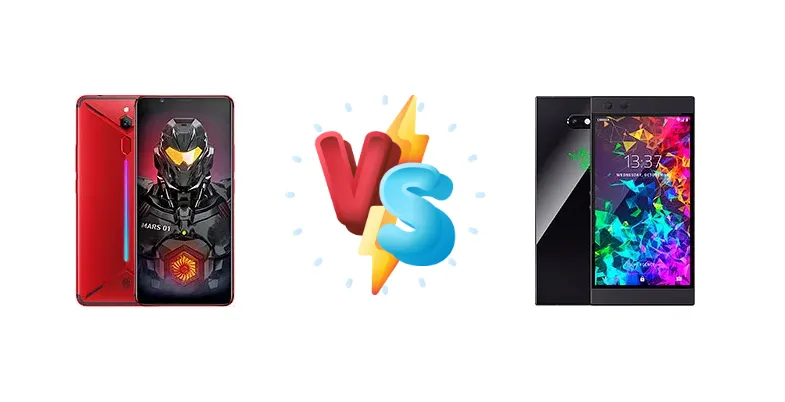
|
🏆 Quick Verdict
For the average user seeking a balanced experience, the Razer Phone 2 emerges as the better choice. Its wireless charging, superior display contrast ratio (948 nominal, 2.932 sunlight), and 70-hour endurance rating offer a more versatile package. However, gamers prioritizing pure performance on a budget will find the RedMagic Mars a compelling option.
| PHONES | ||
|---|---|---|
| Phone Names | ZTE nubia RedMagic Mars | Razer Phone 2 |
| Network | ||
|---|---|---|
| 2G bands | GSM 850 / 900 / 1800 / 1900 | GSM 850 / 900 / 1800 / 1900 |
| 3G bands | HSDPA 850 / 900 / 1900 / 2100 | HSDPA 850 / 900 / 1700(AWS) / 1800 / 1900 / 2100 |
| 4G bands | 1, 2, 3, 4, 5, 7, 8, 12, 17, 18, 19, 20, 25, 26, 28, 30, 34, 38, 39, 40, 41, 66 | 1, 2, 3, 4, 5, 7, 8, 12, 13, 14, 17, 18, 19, 20, 26, 28, 29, 30, 32, 38, 39, 40, 41, 48, 66, 71 |
| Speed | HSPA 42.2/5.76 Mbps, LTE (5CA) Cat18 1200/150 Mbps | HSPA 42.2/5.76 Mbps, LTE (5CA) Cat18 1200/150 Mbps |
| Technology | GSM / CDMA / HSPA / EVDO / LTE | GSM / CDMA / HSPA / LTE |
| - | CDMA 800 & TD-SCDMA | |
| Launch | ||
|---|---|---|
| Announced | 2018, November. Released 2018, December | 2018, October. Released 2018, October |
| Status | Discontinued | Discontinued |
| Body | ||
|---|---|---|
| Build | Glass front (Dinorex T2X-1), aluminum back, aluminum frame | Glass front (Gorilla Glass 5), aluminum back, aluminum frame |
| Dimensions | 158.2 x 75 x 9.9 mm (6.23 x 2.95 x 0.39 in) | 158.5 x 79 x 8.5 mm (6.24 x 3.11 x 0.33 in) |
| SIM | Nano-SIM + Nano-SIM | Nano-SIM |
| Weight | 193 g (6.81 oz) | 220 g (7.76 oz) |
| - | IP67 dust/water resistant (up to 1m for 30 mins) RGB Illuminated Razer Chroma Logo on the back | |
| Display | ||
|---|---|---|
| Protection | Dinorex T2X-1 scratch/shock resistant glass | Corning Gorilla Glass 5, oleophobic coating |
| Resolution | 1080 x 2160 pixels, 18:9 ratio (~402 ppi density) | 1440 x 2560 pixels, 16:9 ratio (~513 ppi density) |
| Size | 6.0 inches, 92.9 cm2 (~78.3% screen-to-body ratio) | 5.72 inches, 90.2 cm2 (~72.0% screen-to-body ratio) |
| Type | IPS LCD | IGZO IPS LCD, 120Hz, 580 nits (typ) |
| - | Wide Colour Gamut | |
| Platform | ||
|---|---|---|
| CPU | Octa-core (4x2.8 GHz Kryo 385 Gold & 4x1.7 GHz Kryo 385 Silver) | Octa-core (4x2.8 GHz Kryo 385 Gold & 4x1.7 GHz Kryo 385 Silver) |
| Chipset | Qualcomm SDM845 Snapdragon 845 (10 nm) | Qualcomm SDM845 Snapdragon 845 (10 nm) |
| GPU | Adreno 630 | Adreno 630 |
| OS | Android 9.0 (Pie), Redmagic 1.0 | Android 8.1 (Oreo), upgradable to Android 9.0 (Pie) |
| Memory | ||
|---|---|---|
| Card slot | No | microSDXC (dedicated slot) |
| Internal | 64GB 6GB RAM, 128GB 8GB RAM, 256GB 10GB RAM | 64GB 8GB RAM |
| - | UFS 2.1 | |
| Main Camera | ||
|---|---|---|
| Dual | - | 12 MP, f/1.8, 25mm (wide), 1/2.55", 1.4µm, dual pixel PDAF, OIS 12 MP, f/2.6, 1/3.1", 1.0µm, 2x optical zoom |
| Features | LED flash, HDR, panorama | Dual-LED dual-tone flash, panorama, HDR |
| Single | 16 MP, f/1.8, PDAF | - |
| Video | 4K@30fps, 1080p@30fps | 4K@30/60fps, 1080p@30/30/60/120fps, stereo sound rec. |
| Selfie camera | ||
|---|---|---|
| Features | HDR | - |
| Single | 8 MP, f/2.0 | 8 MP, f/2.0 |
| Video | 1080p@30fps | 1080p@30/60fps |
| Sound | ||
|---|---|---|
| 3.5mm jack | - | No |
| 35mm jack | Yes | No |
| Loudspeaker | Yes | Yes, with Dolby Atmos stereo speakers (THX-certified amplifiers) |
| - | 24-bit/192kHz audio | |
| Comms | ||
|---|---|---|
| Bluetooth | 5.0, A2DP, aptX, LE | 5.0, A2DP, LE |
| NFC | No | Yes |
| Positioning | GPS, GLONASS, BDS | GPS |
| Radio | No | No |
| USB | USB Type-C, OTG | USB Type-C |
| WLAN | Wi-Fi 802.11 a/b/g/n/ac, dual-band, Wi-Fi Direct | Wi-Fi 802.11 a/b/g/n/ac, dual-band, Wi-Fi Direct |
| Features | ||
|---|---|---|
| Sensors | Fingerprint (rear-mounted), accelerometer, gyro, proximity, compass | Fingerprint (side-mounted), accelerometer, gyro, proximity, compass |
| Battery | ||
|---|---|---|
| Charging | 18W wired | 18W wired, QC4 15W wireless |
| Type | Li-Po 3800 mAh, non-removable | Li-Po 4000 mAh, non-removable |
| Misc | ||
|---|---|---|
| Colors | Black, Red, Camouflage | Mirror back, Rugged satin |
| Models | NX619J | - |
| Price | About 420 EUR | About 850 EUR |
| Tests | ||
|---|---|---|
| Audio quality | - | Noise -93.4dB / Crosstalk -92.8dB |
| Battery life | - | Endurance rating 70h |
| Camera | - | Photo / Video |
| Display | - | Contrast ratio: 948 (nominal), 2.932 (sunlight) |
| Loudspeaker | - | Voice 78dB / Noise 78dB / Ring 86dB |
| Performance | - | AnTuTu: 286076 (v7) GeekBench: 9110 (v4.4) GFXBench: 22fps (ES 3.1 onscreen) |
ZTE nubia RedMagic Mars
- Aggressive gaming-focused design
- Potential for sustained performance due to cooling
- Value proposition given age and price
- Limited information on display quality
- No wireless charging
- Unknown battery capacity
Razer Phone 2
- Wireless charging (15W)
- Superior display contrast (948/2.932)
- Long battery life (70h endurance)
- May throttle under sustained gaming load
- Higher price point at original release
- Larger form factor
Display Comparison
Both devices utilize the Qualcomm Snapdragon 845, but their displays diverge significantly. The Razer Phone 2 boasts a contrast ratio of 948 (nominal) and an impressive 2.932 in sunlight, suggesting superior visibility outdoors. While the RedMagic Mars’ display specs aren’t provided, its focus is on a high refresh rate for smoother gaming, likely at the expense of peak brightness and contrast. The Razer’s display is geared towards content consumption and general use, while the RedMagic’s is optimized for visual responsiveness in fast-paced games.
Camera Comparison
Both phones feature photo and video capabilities, but detailed camera specifications are limited. Without sensor size or aperture information, a direct comparison is challenging. The Razer Phone 2, being a more mainstream device, likely benefits from more refined image processing algorithms. The RedMagic Mars, prioritizing gaming, may have a less sophisticated camera system. The presence of a camera on both devices is more of a functional requirement than a key selling point.
Performance
Both the ZTE nubia RedMagic Mars and the Razer Phone 2 are powered by the Qualcomm SDM845 Snapdragon 845 (10 nm) with an Octa-core CPU (4x2.8 GHz Kryo 385 Gold & 4x1.7 GHz Kryo 385 Silver). This means CPU performance will be nearly identical. However, the RedMagic Mars is designed with gaming in mind, likely incorporating a more aggressive cooling solution to sustain peak performance for longer durations. The Razer Phone 2, while capable, doesn’t prioritize cooling to the same extent. The lack of RAM specifications for the RedMagic Mars makes a direct comparison difficult, but the Razer Phone 2’s thermal design could lead to more consistent performance under prolonged load.
Battery Life
The Razer Phone 2 holds a significant advantage in battery endurance, boasting a 70-hour rating. While the RedMagic Mars’ battery capacity is unknown, it charges at 18W. The Razer Phone 2 supports both 18W wired charging with Quick Charge 4.0 (QC4) and 15W wireless charging, offering greater convenience. The 70-hour endurance rating suggests a larger battery capacity and/or more efficient power management on the Razer Phone 2, making it the better choice for users who prioritize longevity.
Buying Guide
Buy the ZTE nubia RedMagic Mars if you need a dedicated gaming phone with a focus on sustained performance and are willing to sacrifice features like wireless charging and a top-tier display. Buy the Razer Phone 2 if you prefer a more well-rounded smartphone experience with wireless charging, a brighter and higher contrast display, and longer battery life, even if it means slightly less raw gaming horsepower.