
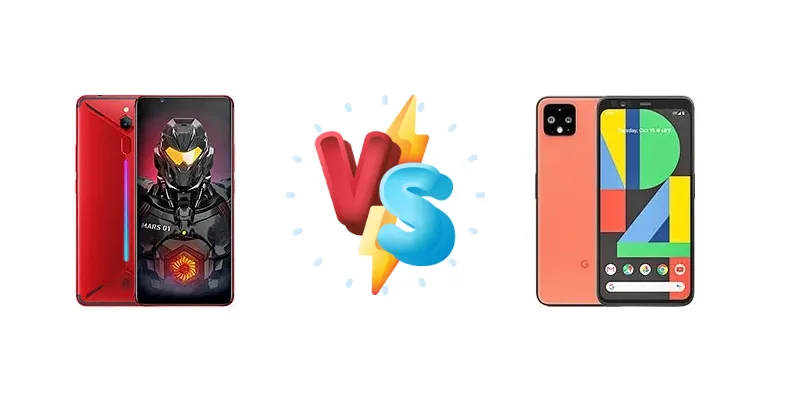
ZTE nubia RedMagic Mars vs. Google Pixel 4 XL: A Deep Dive into Gaming and Photography
| Phones Images | |||||
|---|---|---|---|---|---|
|
🏆 Quick Verdict
For the average user prioritizing camera quality and a seamless software experience, the Google Pixel 4 XL is the better choice. However, gamers on a budget will find the RedMagic Mars offers compelling performance for the price, despite its older chipset and less refined camera system.
| PHONES | ||
|---|---|---|
| Phone Names | ZTE nubia RedMagic Mars | Google Pixel 4 XL |
| Network | ||
|---|---|---|
| 2G bands | GSM 850 / 900 / 1800 / 1900 | GSM 850 / 900 / 1800 / 1900 |
| 3G bands | HSDPA 850 / 900 / 1900 / 2100 | HSDPA 850 / 900 / 1700(AWS) / 1900 / 2100 |
| 4G bands | 1, 2, 3, 4, 5, 7, 8, 12, 17, 18, 19, 20, 25, 26, 28, 30, 34, 38, 39, 40, 41, 66 | 1, 2, 3, 4, 5, 7, 8, 12, 13, 17, 20, 25, 26, 28, 32, 38, 39, 40, 41, 66, 71 - Global |
| Speed | HSPA 42.2/5.76 Mbps, LTE (5CA) Cat18 1200/150 Mbps | HSPA 42.2/5.76 Mbps, LTE (5CA) Cat18 1200/150 Mbps |
| Technology | GSM / CDMA / HSPA / EVDO / LTE | GSM / CDMA / HSPA / EVDO / LTE |
| - | 1, 2, 3, 4, 5, 7, 8, 12, 13, 14, 17, 18, 19, 20, 25, 26, 28, 29, 30, 38, 39, 40, 41, 46, 48, 66, 71 - USA | |
| Launch | ||
|---|---|---|
| Announced | 2018, November. Released 2018, December | 2019, October 15 |
| Status | Discontinued | Available. Released 2019, October 22 |
| Body | ||
|---|---|---|
| Build | Glass front (Dinorex T2X-1), aluminum back, aluminum frame | Glass front (Gorilla Glass 5), glass back (Gorilla Glass 5), aluminum frame |
| Dimensions | 158.2 x 75 x 9.9 mm (6.23 x 2.95 x 0.39 in) | 160.4 x 75.1 x 8.2 mm (6.31 x 2.96 x 0.32 in) |
| SIM | Nano-SIM + Nano-SIM | Nano-SIM + eSIM |
| Weight | 193 g (6.81 oz) | 193 g (6.81 oz) |
| - | IP68 dust/water resistant (up to 1.5m for 30 min) | |
| Display | ||
|---|---|---|
| Protection | Dinorex T2X-1 scratch/shock resistant glass | Corning Gorilla Glass 5 |
| Resolution | 1080 x 2160 pixels, 18:9 ratio (~402 ppi density) | 1440 x 3040 pixels, 19:9 ratio (~537 ppi density) |
| Size | 6.0 inches, 92.9 cm2 (~78.3% screen-to-body ratio) | 6.3 inches, 98.0 cm2 (~81.3% screen-to-body ratio) |
| Type | IPS LCD | P-OLED, 90Hz, HDR |
| - | Always-on display | |
| Platform | ||
|---|---|---|
| CPU | Octa-core (4x2.8 GHz Kryo 385 Gold & 4x1.7 GHz Kryo 385 Silver) | Octa-core (1x2.84 GHz Kryo 485 & 3x2.42 GHz Kryo 485 & 4x1.78 GHz Kryo 485) |
| Chipset | Qualcomm SDM845 Snapdragon 845 (10 nm) | Qualcomm SM8150 Snapdragon 855 (7 nm) |
| GPU | Adreno 630 | Adreno 640 |
| OS | Android 9.0 (Pie), Redmagic 1.0 | Android 10, upgradable to Android 13 |
| Memory | ||
|---|---|---|
| Card slot | No | No |
| Internal | 64GB 6GB RAM, 128GB 8GB RAM, 256GB 10GB RAM | 64GB 6GB RAM, 128GB 6GB RAM |
| - | UFS 2.1 | |
| Main Camera | ||
|---|---|---|
| Dual | - | 12.2 MP, f/1.7, 27mm (wide), 1/2.55", 1.4µm, dual pixel PDAF, OIS 16 MP, f/2.4, 50mm (telephoto), 1/3.6", 1.0µm, PDAF, OIS, 2x optical zoom |
| Features | LED flash, HDR, panorama | Dual-LED flash, Pixel Shift, Auto-HDR, panorama |
| Single | 16 MP, f/1.8, PDAF | - |
| Video | 4K@30fps, 1080p@30fps | 4K@30fps, 1080p@30/60/120fps, 1080p@30fps (gyro-EIS) |
| Selfie camera | ||
|---|---|---|
| Features | HDR | HDR |
| Single | 8 MP, f/2.0 | 8 MP, f/2.0, 22mm (wide), 1.22µm, no AF TOF 3D, (depth/biometrics sensor) |
| Video | 1080p@30fps | 1080p@30fps |
| Sound | ||
|---|---|---|
| 3.5mm jack | - | No |
| 35mm jack | Yes | No |
| Loudspeaker | Yes | Yes, with stereo speakers |
| Comms | ||
|---|---|---|
| Bluetooth | 5.0, A2DP, aptX, LE | 5.0, A2DP, LE, aptX HD |
| NFC | No | Yes |
| Positioning | GPS, GLONASS, BDS | GPS, GLONASS, BDS, GALILEO |
| Radio | No | No |
| USB | USB Type-C, OTG | USB Type-C 3.1 |
| WLAN | Wi-Fi 802.11 a/b/g/n/ac, dual-band, Wi-Fi Direct | Wi-Fi 802.11 a/b/g/n/ac, dual-band, Wi-Fi Direct, DLNA |
| Features | ||
|---|---|---|
| Sensors | Fingerprint (rear-mounted), accelerometer, gyro, proximity, compass | Face ID, accelerometer, gyro, proximity, compass, barometer |
| Battery | ||
|---|---|---|
| Charging | 18W wired | 18W wired, PD2.0 Wireless |
| Type | Li-Po 3800 mAh, non-removable | Li-Po 3700 mAh, non-removable |
| Misc | ||
|---|---|---|
| Colors | Black, Red, Camouflage | Clearly White, Just Black, Oh So Orange |
| Models | NX619J | G020P, G020, GA01181-US, GA01182-US, GA01180-US |
| Price | About 420 EUR | About 180 EUR |
| Pricing | ||
|---|---|---|
| 128GB 6GB RAM | - | $ 364.52 |
| 64GB 6GB RAM | - | $ 274.99 |
| RENEWED | - | $ 149.00 |
| Tests | ||
|---|---|---|
| Audio quality | - | Noise -93.9 / Crosstalk -94.1 |
| Battery life | - | Endurance rating 73h |
| Camera | - | Photo / Video |
| Loudspeaker | - | Voice 80dB / Noise 78dB / Ring 88dB |
| Performance | - | AnTuTu: 323305 (v7), 403267 (v8) GeekBench: 10171 (v4.4), 2267 (v5.1) GFXBench: 21fps (ES 3.1 onscreen) |
ZTE nubia RedMagic Mars
- More affordable price point
- Dedicated gaming features (likely including cooling)
- Potentially larger battery capacity
- Older Snapdragon 845 chipset
- Inferior camera performance
- Less refined software experience
Google Pixel 4 XL
- Superior camera quality and computational photography
- More powerful Snapdragon 855 chipset
- Clean Android experience with timely updates
- Higher price tag
- Potentially more susceptible to thermal throttling under extreme load (compared to dedicated gaming phone)
- Battery life is comparable despite more efficient chipset
Display Comparison
While specific display specs for the RedMagic Mars are unavailable, its focus is clearly on maximizing screen real estate for gaming. The Pixel 4 XL boasts a 6.3-inch OLED display with a 90Hz refresh rate, offering smoother scrolling and animations. The Snapdragon 855’s image signal processor (ISP) is optimized for this display, delivering accurate colors. The Pixel 4 XL’s 90Hz refresh rate is a significant advantage for general use and some games, while the RedMagic Mars likely prioritizes refresh rate for gaming, but without the same level of color accuracy or smoothness in everyday tasks.
Camera Comparison
The Pixel 4 XL is renowned for its computational photography prowess. While specific sensor details are missing for the RedMagic Mars, it’s safe to assume it doesn’t match the Pixel’s image processing capabilities. The Pixel 4 XL leverages Google’s HDR+ technology and Night Sight mode to capture stunning photos in various lighting conditions. The Pixel 4 XL’s camera excels in dynamic range and detail, while the RedMagic Mars likely offers a more basic camera experience geared towards casual snapshots. The Pixel 4 XL’s video capabilities are also superior, benefiting from the 855’s enhanced video encoding and decoding capabilities.
Performance
The Pixel 4 XL’s Snapdragon 855 (7nm) represents a generational leap over the RedMagic Mars’ Snapdragon 845 (10nm). The 855 features the Kryo 485 CPU cores, with a prime core clocked at 2.84 GHz, and a more efficient architecture. This translates to better multi-core performance and improved power efficiency. While both chips have an octa-core configuration, the 855’s architecture allows it to handle demanding tasks and sustained workloads more effectively, reducing the likelihood of thermal throttling during extended gaming sessions. The RedMagic Mars, however, likely employs aggressive cooling solutions to mitigate the 845’s thermal limitations.
Battery Life
Both devices share an 18W wired charging capability, but the Pixel 4 XL also supports PD2.0 and wireless charging, offering greater convenience. Both phones have an endurance rating of 73h, suggesting similar battery life despite the more power-efficient chipset in the Pixel 4 XL. This suggests the RedMagic Mars may have a larger battery capacity to compensate for the less efficient Snapdragon 845. The Pixel 4 XL’s power management features, coupled with the 855’s efficiency, likely contribute to comparable real-world battery performance.
Buying Guide
Buy the ZTE nubia RedMagic Mars if you need a dedicated gaming experience with a focus on sustained performance and are willing to compromise on camera quality and software polish. Buy the Google Pixel 4 XL if you prefer a flagship-level camera, a clean Android experience with timely updates, and intelligent features like Call Screen, even if it means sacrificing some raw gaming horsepower.