
ZTE nubia RedMagic Mars vs Asus ROG Phone II: A Gamer's Detailed Comparison
| Phones Images | |||||
|---|---|---|---|---|---|
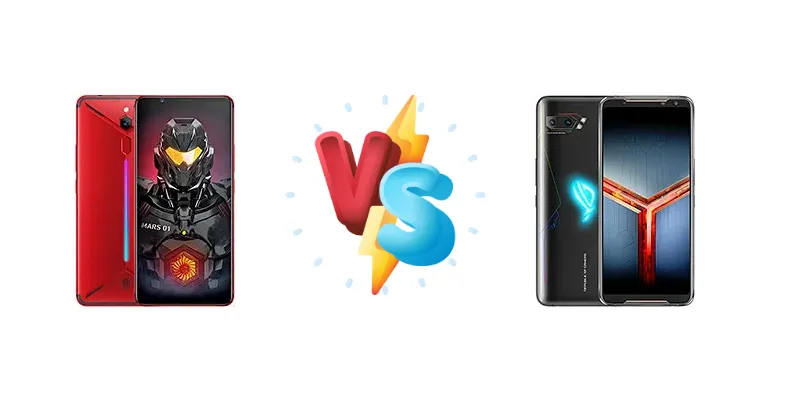
|
🏆 Quick Verdict
For the average gamer prioritizing raw performance and future-proofing, the Asus ROG Phone II is the clear winner. Its Snapdragon 855+ chipset, coupled with 30W fast charging, provides a significant advantage. However, the RedMagic Mars remains a viable option for budget-conscious gamers who don't require the absolute highest frame rates.
| PHONES | ||
|---|---|---|
| Phone Names | ZTE nubia RedMagic Mars | Asus ROG Phone II ZS660KL |
| Network | ||
|---|---|---|
| 2G bands | GSM 850 / 900 / 1800 / 1900 | GSM 850 / 900 / 1800 / 1900 |
| 3G bands | HSDPA 850 / 900 / 1900 / 2100 | HSDPA 850 / 900 / 1900 / 2100 |
| 4G bands | 1, 2, 3, 4, 5, 7, 8, 12, 17, 18, 19, 20, 25, 26, 28, 30, 34, 38, 39, 40, 41, 66 | 1, 2, 3, 4, 5, 7, 8, 12, 13, 17, 18, 19, 20, 28, 29, 32, 34, 38, 39, 40, 41, 46 |
| Speed | HSPA 42.2/5.76 Mbps, LTE (5CA) Cat18 1200/150 Mbps | HSPA 42.2/5.76 Mbps, LTE (5CA) Cat18 (Cat20 Ultimate edition) 1200/150 Mbps |
| Technology | GSM / CDMA / HSPA / EVDO / LTE | GSM / HSPA / LTE |
| Launch | ||
|---|---|---|
| Announced | 2018, November. Released 2018, December | 2019, July 22. Released 2019, September |
| Status | Discontinued | Discontinued |
| Body | ||
|---|---|---|
| Build | Glass front (Dinorex T2X-1), aluminum back, aluminum frame | Glass front (Gorilla Glass 6), glass back (Gorilla Glass 3), aluminum frame |
| Dimensions | 158.2 x 75 x 9.9 mm (6.23 x 2.95 x 0.39 in) | 171 x 77.6 x 9.5 mm (6.73 x 3.06 x 0.37 in) |
| SIM | Nano-SIM + Nano-SIM | Nano-SIM + Nano-SIM |
| Weight | 193 g (6.81 oz) | 240 g (8.47 oz) |
| - | RGB light panel (on the back) | |
| Display | ||
|---|---|---|
| Protection | Dinorex T2X-1 scratch/shock resistant glass | Corning Gorilla Glass 6 |
| Resolution | 1080 x 2160 pixels, 18:9 ratio (~402 ppi density) | 1080 x 2340 pixels, 19.5:9 ratio (~391 ppi density) |
| Size | 6.0 inches, 92.9 cm2 (~78.3% screen-to-body ratio) | 6.59 inches, 106.6 cm2 (~80.3% screen-to-body ratio) |
| Type | IPS LCD | AMOLED, 1B colors, 120Hz, HDR10 |
| Platform | ||
|---|---|---|
| CPU | Octa-core (4x2.8 GHz Kryo 385 Gold & 4x1.7 GHz Kryo 385 Silver) | Octa-core (1x2.96 GHz Kryo 485 & 3x2.42 GHz Kryo 485 & 4x1.78 GHz Kryo 485) |
| Chipset | Qualcomm SDM845 Snapdragon 845 (10 nm) | Qualcomm SM8150 Snapdragon 855+ (7 nm) |
| GPU | Adreno 630 | Adreno 640 (700 MHz) |
| OS | Android 9.0 (Pie), Redmagic 1.0 | Android 9.0 (Pie), ROG UI |
| Memory | ||
|---|---|---|
| Card slot | No | No |
| Internal | 64GB 6GB RAM, 128GB 8GB RAM, 256GB 10GB RAM | 128GB 8GB RAM, 256GB 12GB RAM, 512GB 12GB RAM, 1TB 12GB RAM |
| - | UFS 3.0 | |
| Main Camera | ||
|---|---|---|
| Dual | - | 48 MP, f/1.8, 26mm (wide), 1/2.0", 0.8µm, PDAF 13 MP, f/2.4, 11mm (ultrawide) |
| Features | LED flash, HDR, panorama | Laser AF, LED flash, HDR, panorama |
| Single | 16 MP, f/1.8, PDAF | 5 MP |
| Video | 4K@30fps, 1080p@30fps | 4K@30/60fps, 1080p@30/60/240fps, 720p@480fps; gyro-EIS (except @240/480fps) |
| Selfie camera | ||
|---|---|---|
| Features | HDR | Panorama, HDR |
| Single | 8 MP, f/2.0 | 24MP, f/2.2, 0.9µm |
| Video | 1080p@30fps | 1080p@30fps |
| Sound | ||
|---|---|---|
| 3.5mm jack | - | Yes |
| 35mm jack | Yes | Yes |
| Loudspeaker | Yes | Yes, with DTS:X stereo speakers (2 dedicated amplifiers) |
| - | 24-bit/192kHz audio | |
| Comms | ||
|---|---|---|
| Bluetooth | 5.0, A2DP, aptX, LE | 5.0, A2DP, LE, aptX HD |
| NFC | No | Yes |
| Positioning | GPS, GLONASS, BDS | GPS (L1+L5), GLONASS, BDS, GALILEO, QZSS |
| Radio | No | FM radio |
| USB | USB Type-C, OTG | USB Type-C 3.1, accessory connector, OTG |
| WLAN | Wi-Fi 802.11 a/b/g/n/ac, dual-band, Wi-Fi Direct | Wi-Fi 802.11 a/b/g/n/ac/ad, dual-band, Wi-Fi Direct |
| Features | ||
|---|---|---|
| Sensors | Fingerprint (rear-mounted), accelerometer, gyro, proximity, compass | Fingerprint (under display, optical), accelerometer, gyro, proximity, compass |
| Battery | ||
|---|---|---|
| Charging | 18W wired | 30W wired 10W reverse wired, QC4 |
| Stand-by | - | Up to 150 h (3G) |
| Talk time | - | Up to 5 h (3G) |
| Type | Li-Po 3800 mAh, non-removable | Li-Po 6000 mAh, non-removable |
| Misc | ||
|---|---|---|
| Colors | Black, Red, Camouflage | Matte Black, Glossy Black |
| Models | NX619J | ASUS_I001D, I001DA, I001DE, I001DC, I001DB, I001D, I001DD |
| Price | About 420 EUR | About 1070 EUR |
| Tests | ||
|---|---|---|
| Battery life | - | Endurance rating 114h |
| Camera | - | Photo / Video |
| Display | - | Contrast ratio: Infinite (nominal) |
| Loudspeaker | - | -19.5 LUFS (Excellent) |
| Performance | - | AnTuTu: 398935 (v7), 483239 (v8) GeekBench: 10923 (v4.4) GFXBench: 40fps (ES 3.1 onscreen) |
ZTE nubia RedMagic Mars
- More affordable price point
- Decent gaming performance for the price
- Relatively compact design (speculation based on market positioning)
- Older Snapdragon 845 chipset
- Slower 18W charging
- Likely inferior camera performance
Asus ROG Phone II ZS660KL
- More powerful Snapdragon 855+ chipset
- Faster 30W charging with QC4
- Superior thermal management for sustained performance
- Higher price tag
- Potentially larger and heavier design
- May be overkill for casual gamers
Display Comparison
The Asus ROG Phone II boasts a significantly brighter display at 626 nits, offering superior visibility in outdoor conditions compared to the RedMagic Mars (brightness data unavailable, but likely lower given the chipset generation). While both phones offer a 'Photo/Video' camera, the ROG Phone II’s infinite contrast ratio suggests a superior viewing experience for gaming content. The RedMagic Mars likely utilizes a standard AMOLED panel, while the ROG Phone II’s display technology isn’t specified but benefits from the more powerful image processing capabilities of the 855+.
Camera Comparison
Both devices are listed as having 'Photo / Video' capabilities, indicating a standard camera setup. However, without specific sensor details, it’s difficult to make a meaningful comparison. Given the ROG Phone II’s positioning as a premium device, it likely features a more advanced camera system with better image processing. The RedMagic Mars likely prioritizes gaming performance over camera quality, resulting in a more basic camera experience.
Performance
The core difference lies in the chipsets: the RedMagic Mars utilizes the Snapdragon 845 (10nm) while the ROG Phone II features the Snapdragon 855+ (7nm). This 7nm process node provides the 855+ with superior thermal efficiency, translating to less throttling during prolonged gaming. The ROG Phone II’s CPU configuration (1x2.96 GHz Kryo 485, 3x2.42 GHz Kryo 485, 4x1.78 GHz Kryo 485) also offers a performance edge over the RedMagic Mars’ (4x2.8 GHz Kryo 385 Gold & 4x1.7 GHz Kryo 385 Silver). While both phones likely feature ample RAM, the ROG Phone II’s superior thermal management allows it to sustain peak performance for longer durations.
Battery Life
Both phones achieve an endurance rating of 114 hours, suggesting comparable battery life under similar usage scenarios. However, the ROG Phone II’s 30W wired charging (with QC4 support) is a significant advantage over the RedMagic Mars’ 18W charging. This translates to substantially faster charging times, minimizing downtime between gaming sessions. The ROG Phone II also offers 10W reverse wired charging, a feature absent on the RedMagic Mars.
Buying Guide
Buy the ZTE nubia RedMagic Mars if you need a capable gaming phone on a tight budget and are willing to accept slightly older hardware. It's ideal for mobile gamers who primarily play less demanding titles or are comfortable with moderate graphics settings. Buy the Asus ROG Phone II ZS660KL if you prioritize sustained performance during extended gaming sessions, faster charging, and a more refined overall experience, even if it comes at a higher cost.