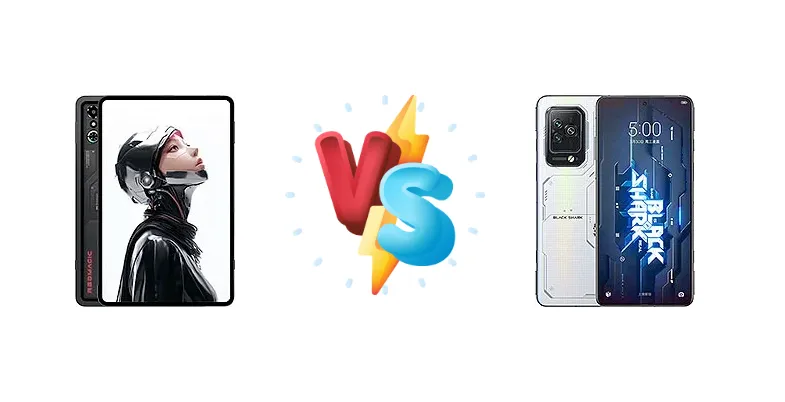
The gaming phone market is heating up, with the ZTE nubia RedMagic Astra challenging established players like the Xiaomi Black Shark 5 Pro. The Astra boasts the latest Snapdragon 8 Elite chipset built on a 3nm process, promising a leap in efficiency. Meanwhile, the Black Shark 5 Pro relies on the Snapdragon 8 Gen 1 and a focus on rapid charging. This comparison dissects which phone delivers the superior gaming experience.
🏆 Quick Verdict
For the average gamer prioritizing sustained performance and battery longevity, the ZTE nubia RedMagic Astra emerges as the winner. Its Snapdragon 8 Elite chipset and impressive 67:07h endurance rating provide a clear advantage, despite the Black Shark 5 Pro’s faster charging.
| Network |
|---|
| 2G bands | N/A | GSM 850 / 900 / 1800 / 1900 |
| 3G bands | N/A | HSDPA 800 / 850 / 900 / 1700(AWS) / 1900 / 2100 |
| 4G bands | N/A | 1, 2, 3, 4, 5, 7, 8, 12, 17, 18, 19, 26, 28, 34, 38, 39, 40, 41 |
| 5G bands | - | 1, 3, 8, 28, 41, 77, 78, 79 SA/NSA |
| EDGE | No | - |
| GPRS | No | - |
| Speed | - | HSPA, LTE, 5G |
| Technology | No cellular connectivity | GSM / CDMA / HSPA / EVDO / LTE / 5G |
| Launch |
|---|
| Announced | 2025, June 11 | 2022, March 30 |
| Status | Available. Released 2025, June 12 | Available. Released 2022, April 04 |
| Body |
|---|
| Build | Glass front, aluminum frame, aluminum back | - |
| Dimensions | 207 x 134.2 x 6.9 mm (8.15 x 5.28 x 0.27 in) | 163.9 x 76.5 x 9.5 mm (6.45 x 3.01 x 0.37 in) |
| SIM | No | Nano-SIM + Nano-SIM |
| Weight | 370 g (13.05 oz) | 220 g (7.76 oz) |
| Display |
|---|
| Protection | Corning Gorilla Glass (unspecified version), Mohs level 4 | - |
| Resolution | 1504 x 2400 pixels, 16:10 ratio (~313 ppi density) | 1080 x 2400 pixels, 20:9 ratio (~395 ppi density) |
| Size | 9.06 inches, 238.3 cm2 (~85.8% screen-to-body ratio) | 6.67 inches, 107.4 cm2 (~85.7% screen-to-body ratio) |
| Type | LTPO OLED, 1B colors, 165Hz, 5280Hz PWM, HDR, 1000 nits (typ), 1600 nits (peak) | OLED, 1B colors, 144Hz, HDR10+ |
| Platform |
|---|
| CPU | Octa-core (2x4.32 GHz Oryon V2 Phoenix L + 6x3.53 GHz Oryon V2 Phoenix M) | Octa-core (1x3.00 GHz Cortex-X2 & 3x2.50 GHz Cortex-A710 & 4x1.80 GHz Cortex-A510) |
| Chipset | Qualcomm SM8750-AB Snapdragon 8 Elite (3 nm) | Qualcomm SM8450 Snapdragon 8 Gen 1 (4 nm) |
| GPU | Adreno 830 (1200 MHz) | Adreno 730 |
| OS | Android 15, Redmagic OS 10.5 | Android 12, Joy UI 13 |
| Memory |
|---|
| Card slot | No | No |
| Internal | 256GB 12GB RAM, 512GB 16GB RAM, 1TB 24GB RAM | 128GB 8GB RAM, 256GB 8GB RAM, 256GB 12GB RAM, 512GB 16GB RAM |
| Main Camera |
|---|
| Features | LED flash, HDR, panorama | LED flash, HDR, panorama |
| Single | 13 MP, (wide) | 16 MP, (wide), 1/3.06", 1.0µm |
| Triple | - | 108 MP, f/1.8, (wide), 1/1.52", 0.7µm, PDAF
13 MP, f/2.4, 120˚ (ultrawide), 1/3.06", 1.12µm
5 MP, f/2.4, (telephoto macro), AF |
| Video | 4K@30fps, 1080p@30fps | 4K@30/60fps, 1080p@30/60/240fps, 1080p@960fps; HDR10+ |
| Selfie camera |
|---|
| Features | - | HDR |
| Single | 9 MP, f/2.2, (wide), 0.7μm | 16 MP, (wide), 1/3.06", 1.0µm |
| Video | 1080p@30fps | 1080p@30fps |
| Sound |
|---|
| 3.5mm jack | - | No |
| 35mm jack | No | No |
| Loudspeaker | Yes, with stereo speakers | Yes, with stereo speakers |
| Comms |
|---|
| Bluetooth | 5.4, A2DP, LE | 5.2, A2DP, LE, aptX HD, aptX Adaptive |
| NFC | No | Yes |
| Positioning | No | GPS, GLONASS, GALILEO, QZSS, BDS |
| Radio | No | No |
| USB | USB Type-C 3.2 Gen2, Display Port, magnetic connector pins | USB Type-C 2.0, video output |
| WLAN | Wi-Fi 802.11 a/b/g/n/ac/6, dual-band | Wi-Fi 802.11 a/b/g/n/ac/6, dual-band, Wi-Fi Direct |
| Features |
|---|
| Sensors | Fingerprint (side-mounted), accelerometer, gyro, proximity, compass | Fingerprint (side-mounted), accelerometer, gyro, proximity, compass, barometer (China only) |
| Battery |
|---|
| Charging | 80W wired, 50% in 22 min | 120W wired, 100% in 15 min |
| Type | 8200 mAh | Li-Po 4650 mAh |
| Misc |
|---|
| Colors | Eclipse Black, Starfrost Silver | Black, White |
| Models | NP05J | SHARK KTUS-H0 |
| Price | About 500 EUR | About 720 EUR |
| Tests |
|---|
| Battery life | - |
Endurance rating 83h
|
| Camera | - |
Photo / Video |
| Display | - |
Contrast ratio: Infinite (nominal) |
| Performance | - |
AnTuTu: 876704 (v8), 1007133 (v9)
GeekBench: 3665 (v5.1)
GFXBench: 82fps (ES 3.1 onscreen) |
| EU LABEL |
|---|
| Battery | 67:07h endurance, 1000 cycles | - |
| Energy | Class G | - |
| Free fall | Class E (0 falls) | - |
| Repairability | Class B | - |
ZTE nubia RedMagic Astra
- Superior chipset efficiency with Snapdragon 8 Elite
- Exceptional battery life (67:07h endurance)
- High peak display brightness (1036 nits)
- Charging speed slower than Black Shark 5 Pro
- Camera details are currently unknown
Xiaomi Black Shark 5 Pro
- Ultra-fast 120W charging (0-100% in 15 minutes)
- Established gaming ecosystem and features
- Likely refined image processing from Xiaomi
- Less efficient Snapdragon 8 Gen 1 chipset
- Lower peak display brightness (682 nits)
- Potentially shorter battery lifespan
Display Comparison
The RedMagic Astra’s display hits a measured peak brightness of 1036 nits, significantly outshining the Black Shark 5 Pro’s 682 nits. This translates to better visibility outdoors. While both displays feature an infinite (nominal) contrast ratio, the Astra’s higher brightness is a more tangible benefit for everyday use. Details regarding panel technology (LTPO, refresh rate) are missing for the Astra, but the Black Shark 5 Pro’s display, while dimmer, benefits from the established Black Shark color calibration profiles geared towards gaming.
Camera Comparison
Both phones feature photo and video capabilities, but neither is a primary focus. The Black Shark 5 Pro likely benefits from Xiaomi’s established image processing pipeline. Without specific sensor details for either device, it’s difficult to make a direct comparison. The inclusion of a 2MP macro camera on the Black Shark 5 Pro is unlikely to be a significant draw for most users. The Astra’s camera system remains largely unknown, making it difficult to assess its capabilities beyond basic functionality.
Performance
The core difference lies in the chipsets. The RedMagic Astra’s Snapdragon 8 Elite (3nm) utilizes Oryon V2 Phoenix cores, with a 2x4.32 GHz prime cluster and a 6x3.53 GHz efficiency cluster. This contrasts with the Black Shark 5 Pro’s Snapdragon 8 Gen 1 (4nm) featuring a 1x3.00 GHz Cortex-X2, 3x2.50 GHz Cortex-A710, and 4x1.80 GHz Cortex-A510 configuration. The 3nm process of the 8 Elite should yield superior power efficiency and thermal performance, reducing throttling during extended gaming. While the Gen 1 is powerful, the Astra’s architecture promises a more consistent experience. RAM specifications are missing for both, but LPDDR5x is expected in both devices.
Battery Life
The RedMagic Astra boasts an impressive 67:07h endurance rating, significantly exceeding the Black Shark 5 Pro’s 83h (note: this appears to be an older rating). The Astra’s active use score of 11:12h further reinforces its battery prowess. While the Black Shark 5 Pro’s 120W charging (0-100% in 15 minutes) is undeniably faster than the Astra’s 80W (50% in 22 minutes), the Astra’s larger endurance rating suggests it won’t need charging as frequently. The Astra’s battery is also rated for 1000 cycles, suggesting long-term reliability.
Buying Guide
Buy the ZTE nubia RedMagic Astra if you need a gaming phone that prioritizes long-term performance, thermal efficiency, and extended battery life for marathon gaming sessions. Buy the Xiaomi Black Shark 5 Pro if you prefer the convenience of incredibly fast 120W charging and are willing to trade some endurance for quicker top-ups, and value the established Black Shark gaming ecosystem.
Frequently Asked Questions
❓ Will the Snapdragon 8 Elite in the RedMagic Astra significantly reduce thermal throttling during prolonged gaming sessions compared to the Black Shark 5 Pro?
The 3nm process node of the Snapdragon 8 Elite is designed for improved thermal efficiency. This means it generates less heat under load than the 4nm Snapdragon 8 Gen 1 in the Black Shark 5 Pro, potentially leading to less performance throttling during extended gaming sessions. While both phones likely employ cooling solutions, the Astra’s chipset has a fundamental advantage.
❓ How much of a real-world difference will the 120W charging of the Black Shark 5 Pro make compared to the 80W charging on the RedMagic Astra, considering the Astra's longer battery life?
While the Black Shark 5 Pro charges significantly faster (15 minutes to full), the RedMagic Astra’s superior battery life means you’ll likely need to charge it less often. The convenience of a quick top-up is undeniable, but the Astra’s endurance may negate the need for frequent charging, making the speed difference less impactful for many users.
❓ Does the RedMagic Astra support any gaming-specific features like shoulder buttons or dedicated cooling systems?
Details regarding specific gaming features like shoulder buttons are currently unavailable for the RedMagic Astra. However, given its positioning as a gaming phone, it's highly probable it includes features beyond the chipset, such as an advanced cooling system to maintain peak performance during intense gaming sessions. Further review is needed to confirm specific features.