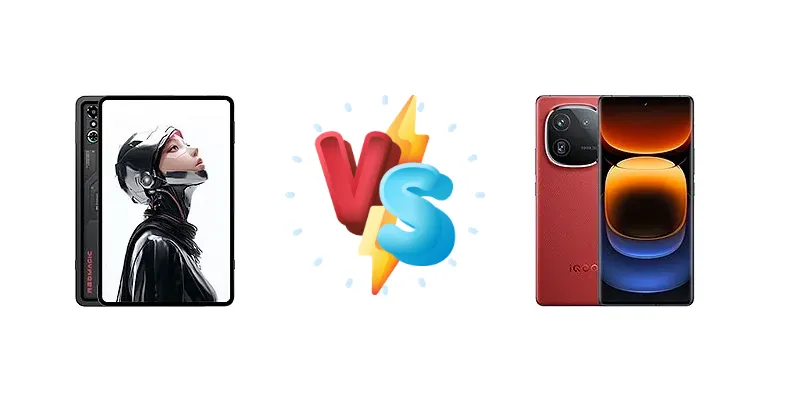
The ZTE nubia RedMagic Astra and the vivo iQOO 12 Pro represent distinct approaches to the high-end smartphone market. The RedMagic Astra, powered by Qualcomm’s new Snapdragon 8 Elite, prioritizes raw performance and sustained gaming, while the iQOO 12 Pro leverages the established Snapdragon 8 Gen 3 platform with a focus on broader usability and rapid charging. This comparison dissects their key differences to determine which device best suits your needs.
🏆 Quick Verdict
For the average user prioritizing all-around performance and convenience, the vivo iQOO 12 Pro emerges as the winner. Its 120W charging and wireless charging capabilities, combined with the Snapdragon 8 Gen 3’s efficiency, offer a more balanced experience. However, gamers seeking maximum sustained performance will find the RedMagic Astra’s Snapdragon 8 Elite a compelling choice.
| Network |
|---|
| 2G bands | N/A | GSM 850 / 900 / 1800 / 1900 |
| 3G bands | N/A | HSDPA 800 / 850 / 900 / 1700(AWS) / 1900 / 2100 |
| 4G bands | N/A | 1, 2, 3, 4, 5, 7, 8, 12, 17, 18, 19, 20, 25, 26, 28, 34, 38, 39, 40, 41, 42, 66 |
| 5G bands | - | 1, 2, 3, 5, 7, 8, 12, 20, 25, 26, 28, 66, 38, 40, 41, 77, 78 SA/NSA |
| EDGE | No | - |
| GPRS | No | - |
| Speed | - | HSPA, LTE, 5G |
| Technology | No cellular connectivity | GSM / CDMA / HSPA / CDMA2000 / LTE / 5G |
| Launch |
|---|
| Announced | 2025, June 11 | 2023, November 07 |
| Status | Available. Released 2025, June 12 | Available. Released 2023, November 14 |
| Body |
|---|
| Build | Glass front, aluminum frame, aluminum back | - |
| Dimensions | 207 x 134.2 x 6.9 mm (8.15 x 5.28 x 0.27 in) | 164.6 x 75.4 x 8.6 mm or 8.8 mm |
| SIM | No | Nano-SIM + Nano-SIM |
| Weight | 370 g (13.05 oz) | 205 g or 210 g (7.23 oz) |
| Display |
|---|
| Protection | Corning Gorilla Glass (unspecified version), Mohs level 4 | - |
| Resolution | 1504 x 2400 pixels, 16:10 ratio (~313 ppi density) | 1440 x 3200 pixels, 20:9 ratio (~518 ppi density) |
| Size | 9.06 inches, 238.3 cm2 (~85.8% screen-to-body ratio) | 6.78 inches, 111.0 cm2 (~89.4% screen-to-body ratio) |
| Type | LTPO OLED, 1B colors, 165Hz, 5280Hz PWM, HDR, 1000 nits (typ), 1600 nits (peak) | LTPO AMOLED, 1B colors, 144Hz, HDR10+, 1600 nits (HBM), 3000 nits (peak) |
| Platform |
|---|
| CPU | Octa-core (2x4.32 GHz Oryon V2 Phoenix L + 6x3.53 GHz Oryon V2 Phoenix M) | Octa-core (1x3.3 GHz Cortex-X4 & 3x3.2 GHz Cortex-A720 & 2x3.0 GHz Cortex-A720 & 2x2.3 GHz Cortex-A520) |
| Chipset | Qualcomm SM8750-AB Snapdragon 8 Elite (3 nm) | Qualcomm SM8650-AB Snapdragon 8 Gen 3 (4 nm) |
| GPU | Adreno 830 (1200 MHz) | Adreno 750 |
| OS | Android 15, Redmagic OS 10.5 | Android 14, up to 2 major Android upgrades, Funtouch 14 (International), OriginOS 4 (China) |
| Memory |
|---|
| Card slot | No | No |
| Internal | 256GB 12GB RAM, 512GB 16GB RAM, 1TB 24GB RAM | 256GB 16GB RAM, 512GB 16GB RAM, 1TB 16GB RAM |
| Main Camera |
|---|
| Features | LED flash, HDR, panorama | Color spectrum sensor, Dual-LED flash, HDR, panorama |
| Single | 13 MP, (wide) | - |
| Triple | - | 50 MP, f/1.7, 23mm (wide), 1/1.3", 1.2µm, ulti-directional PDAF, OIS
64 MP, f/2.6, 70mm (periscope telephoto), 1/2.0", PDAF, OIS, 3x optical zoom
50 MP, f/2.0, 15mm, 119˚ (ultrawide), AF |
| Video | 4K@30fps, 1080p@30fps | 8K@30fps, 4K@24/30/60fps, 1080p@30/60/120/240fps, gyro-EIS |
| Selfie camera |
|---|
| Features | - | HDR |
| Single | 9 MP, f/2.2, (wide), 0.7μm | 16 MP, f/2.5, (wide) |
| Video | 1080p@30fps | 1080p@30fps, gyro-EIS |
| Sound |
|---|
| 35mm jack | No | No |
| Loudspeaker | Yes, with stereo speakers | Yes, with stereo speakers |
| Comms |
|---|
| Bluetooth | 5.4, A2DP, LE | 5.4, A2DP, LE, aptX HD, aptX Adaptive, aptX Lossless |
| Infrared port | - | Yes |
| NFC | No | Yes |
| Positioning | No | GPS (L1+L5), GLONASS (G1), BDS (B1I+B1c+B2a), GALILEO (E1+E5a), QZSS (L1+L5) |
| Radio | No | No |
| USB | USB Type-C 3.2 Gen2, Display Port, magnetic connector pins | USB Type-C 2.0, OTG |
| WLAN | Wi-Fi 802.11 a/b/g/n/ac/6, dual-band | Wi-Fi 802.11 a/b/g/n/ac/6/7, tri-band, Wi-Fi Direct |
| Features |
|---|
| Sensors | Fingerprint (side-mounted), accelerometer, gyro, proximity, compass | Fingerprint (under display, ultrasonic), accelerometer, gyro, proximity, compass |
| Battery |
|---|
| Charging | 80W wired, 50% in 22 min | 120W wired
50W wireless
10W reverse wireless |
| Type | 8200 mAh | 5100 mAh |
| Misc |
|---|
| Colors | Eclipse Black, Starfrost Silver | Black, Red, White (BMW M branding) |
| Models | NP05J | V2329A |
| Price | About 500 EUR | About 650 EUR |
| EU LABEL |
|---|
| Battery | 67:07h endurance, 1000 cycles | - |
| Energy | Class G | - |
| Free fall | Class E (0 falls) | - |
| Repairability | Class B | - |
ZTE nubia RedMagic Astra
- Potentially higher peak CPU performance with Snapdragon 8 Elite
- Excellent battery endurance (67:07h)
- Fast 80W wired charging
- Lacks wireless charging
- Camera likely less advanced than iQOO 12 Pro
vivo iQOO 12 Pro
- Incredibly fast 120W wired charging
- Convenient 50W wireless charging
- Likely more versatile camera system
- Snapdragon 8 Gen 3 may throttle more under sustained load
- Battery endurance not explicitly stated
Display Comparison
The RedMagic Astra boasts a display capable of reaching 1036 nits of peak brightness, ensuring excellent visibility even in direct sunlight. While the iQOO 12 Pro’s display specs aren’t provided, vivo typically employs high-quality AMOLED panels. The Astra’s display is likely a standard refresh rate panel, while the iQOO 12 Pro, given its flagship status, is expected to feature an adaptive refresh rate (LTPO) for improved power efficiency. The Astra’s brightness is a strong point, but the iQOO 12 Pro’s potential for adaptive refresh rate and color accuracy could give it an edge in overall viewing experience.
Camera Comparison
Unfortunately, detailed camera specifications are absent for both devices. However, given the iQOO brand’s history, it’s reasonable to expect a sophisticated camera system with a large main sensor and optical image stabilization (OIS). The RedMagic Astra, being gaming-focused, likely prioritizes camera functionality less, potentially resulting in a more modest setup. Without specific sensor sizes and lens apertures, it’s difficult to make a definitive judgment, but the iQOO 12 Pro is likely to offer a more versatile and capable camera experience.
Performance
This is where the core battle lies. The RedMagic Astra’s Qualcomm SM8750-AB Snapdragon 8 Elite (3nm) features a unique CPU configuration with 2x 4.32 GHz Oryon V2 Phoenix L cores and 6x 3.53 GHz Oryon V2 Phoenix M cores. This architecture is designed for peak performance. The iQOO 12 Pro utilizes the Snapdragon 8 Gen 3 (4nm) with a more conventional octa-core setup (1x 3.3 GHz Cortex-X4, 3x 3.2 GHz Cortex-A720, 2x 3.0 GHz Cortex-A720, 2x 2.3 GHz Cortex-A520). While the Gen 3 is a powerful chip, the 3nm process and Oryon architecture of the 8 Elite *should* deliver superior single-core and multi-core performance, especially in tasks optimized for the Oryon cores. However, the 4nm process of the Gen 3 may offer better thermal efficiency, potentially leading to more consistent performance under sustained load. The Astra’s focus is on raw power, while the iQOO 12 Pro aims for a balance of power and efficiency.
Battery Life
The RedMagic Astra offers a commendable 67:07h endurance rating and supports 80W wired charging, reaching 50% charge in 22 minutes. The iQOO 12 Pro significantly ups the ante with 120W wired charging, alongside 50W wireless and 10W reverse wireless charging. While the Astra’s endurance is impressive, the iQOO 12 Pro’s charging speed is a game-changer, allowing for incredibly quick top-ups. The addition of wireless charging provides added convenience. The Astra’s 1000 cycle battery claim is a positive, suggesting long-term battery health, but the iQOO 12 Pro’s charging ecosystem is undeniably more advanced.
Buying Guide
Buy the ZTE nubia RedMagic Astra if you are a hardcore mobile gamer who demands the highest possible frame rates and sustained performance over extended gaming sessions, and value a focus on cooling and raw power. Buy the vivo iQOO 12 Pro if you prioritize a more versatile flagship experience with incredibly fast charging, wireless charging, and a broader feature set for everyday use, even if it means slightly less peak gaming performance.
Frequently Asked Questions
❓ Will the Snapdragon 8 Elite in the RedMagic Astra overheat during prolonged gaming sessions?
While the Snapdragon 8 Elite offers exceptional performance, the potential for thermal throttling is a concern. The RedMagic Astra likely incorporates advanced cooling solutions to mitigate this, but sustained peak performance may still result in some throttling. The iQOO 12 Pro’s Snapdragon 8 Gen 3, with its 4nm process, may exhibit better thermal management under similar conditions.
❓ How much faster is the 120W charging on the iQOO 12 Pro compared to the 80W charging on the RedMagic Astra?
The iQOO 12 Pro’s 120W charging is significantly faster. While the Astra reaches 50% in 22 minutes, the iQOO 12 Pro is expected to achieve a full charge in under 30 minutes, and 50% in considerably less time. This difference is substantial for users who frequently need to quickly top up their battery.
❓ Does the iQOO 12 Pro support high refresh rate gaming, and can it maintain stable frame rates?
The iQOO 12 Pro is expected to support high refresh rate gaming, likely up to 144Hz, depending on the game. The Snapdragon 8 Gen 3 is capable of delivering high frame rates, but sustained performance will depend on the game’s optimization and the device’s thermal management. The iQOO 12 Pro’s cooling system will play a crucial role in maintaining stable frame rates during extended gaming sessions.