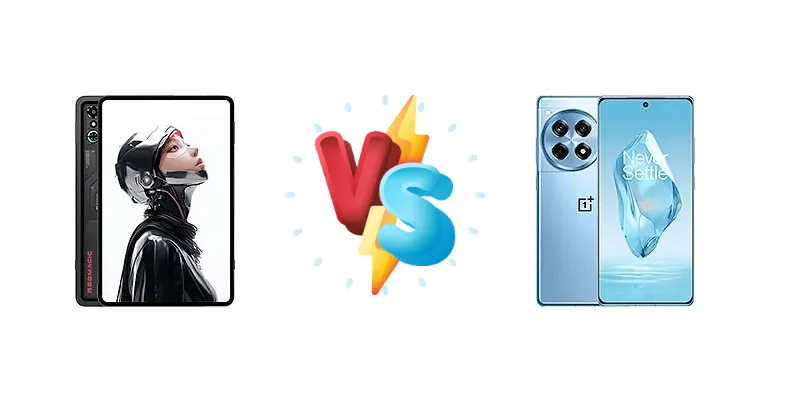
The ZTE nubia RedMagic Astra and the OnePlus 12R represent distinct approaches to the upper-midrange smartphone market. The RedMagic Astra prioritizes raw processing power with the latest Snapdragon 8 Elite, while the OnePlus 12R focuses on a balanced experience with the Snapdragon 8 Gen 2 and a larger battery. This comparison dissects their key differences to determine which device best suits your needs.
🏆 Quick Verdict
For the average user prioritizing all-day battery life and a consistently smooth experience, the OnePlus 12R emerges as the winner. Its 14:32h active use score and 100W charging significantly outperform the RedMagic Astra. However, gamers and power users will find the Astra's Snapdragon 8 Elite a compelling choice.
| Network |
|---|
| 2G bands | N/A | GSM 850 / 900 / 1800 / 1900 |
| 3G bands | N/A | HSDPA 850 / 900 / 1700(AWS) / 1900 / 2100 |
| 4G bands | N/A | 1, 2, 3, 4, 5, 7, 8, 12, 17, 18, 19, 20, 26, 28, 32, 38, 39, 40, 41, 66 |
| 5G bands | - | 1, 2, 3, 5, 7, 8, 12, 20, 28, 38, 40, 41, 66, 77, 78 SA/NSA |
| EDGE | No | - |
| GPRS | No | - |
| Speed | - | HSPA, LTE, 5G |
| Technology | No cellular connectivity | GSM / CDMA / HSPA / LTE / 5G |
| Launch |
|---|
| Announced | 2025, June 11 | 2024, January 23 |
| Status | Available. Released 2025, June 12 | Available. Released 2024, February 06 |
| Body |
|---|
| Build | Glass front, aluminum frame, aluminum back | Glass front (Gorilla Glass Victus 2), aluminum frame, glass back |
| Dimensions | 207 x 134.2 x 6.9 mm (8.15 x 5.28 x 0.27 in) | 163.3 x 75.3 x 8.8 mm (6.43 x 2.96 x 0.35 in) |
| SIM | No | · Nano-SIM + Nano-SIM + eSIM (max 2 at a time)· Nano-SIM + Nano-SIM |
| Weight | 370 g (13.05 oz) | 207 g (7.30 oz) |
| Display |
|---|
| Protection | Corning Gorilla Glass (unspecified version), Mohs level 4 | Corning Gorilla Glass Victus 2 |
| Resolution | 1504 x 2400 pixels, 16:10 ratio (~313 ppi density) | 1264 x 2780 pixels (~450 ppi density) |
| Size | 9.06 inches, 238.3 cm2 (~85.8% screen-to-body ratio) | 6.78 inches, 111.7 cm2 (~90.9% screen-to-body ratio) |
| Type | LTPO OLED, 1B colors, 165Hz, 5280Hz PWM, HDR, 1000 nits (typ), 1600 nits (peak) | LTPO4 AMOLED, 1B colors, 120Hz, HDR10+, Dolby Vision, 1600 nits (HBM), 4500 nits (peak) |
| Platform |
|---|
| CPU | Octa-core (2x4.32 GHz Oryon V2 Phoenix L + 6x3.53 GHz Oryon V2 Phoenix M) | Octa-core (1x3.2 GHz Cortex-X3 & 2x2.8 GHz Cortex-A715 & 2x2.8 GHz Cortex-A710 & 3x2.0 GHz Cortex-A510) |
| Chipset | Qualcomm SM8750-AB Snapdragon 8 Elite (3 nm) | Qualcomm SM8550-AB Snapdragon 8 Gen 2 (4 nm) |
| GPU | Adreno 830 (1200 MHz) | Adreno 740 |
| OS | Android 15, Redmagic OS 10.5 | Android 14, up to 3 major Android upgrades, OxygenOS 15 |
| Memory |
|---|
| Card slot | No | No |
| Internal | 256GB 12GB RAM, 512GB 16GB RAM, 1TB 24GB RAM | 128GB 8GB RAM, 256GB 8GB RAM, 256GB 12GB RAM, 256GB 16GB RAM |
| Main Camera |
|---|
| Features | LED flash, HDR, panorama | Laser AF, color spectrum sensor, LED flash, HDR, panorama |
| Single | 13 MP, (wide) | - |
| Triple | - | 50 MP, f/1.8, 24mm (wide), 1/1.56", 1.0µm, multi-directional PDAF, OIS
8 MP, f/2.2, 16mm, 112˚ (ultrawide), 1/4.0", 1.12µm
2 MP (macro) |
| Video | 4K@30fps, 1080p@30fps | 4K@30/60fps, 1080p@30/60/120/240fps, gyro-EIS, OIS |
| Selfie camera |
|---|
| Features | - | HDR, panorama |
| Single | 9 MP, f/2.2, (wide), 0.7μm | 16 MP, f/2.4, 26mm (wide), 1/3", 1.0µm |
| Video | 1080p@30fps | 1080p@30fps, gyro-EIS |
| Sound |
|---|
| 35mm jack | No | No |
| Loudspeaker | Yes, with stereo speakers | Yes, with stereo speakers |
| Comms |
|---|
| Bluetooth | 5.4, A2DP, LE | 5.3, A2DP, LE, aptX HD |
| Infrared port | - | Yes |
| NFC | No | Yes |
| Positioning | No | GPS, GALILEO, GLONASS, BDS, QZSS |
| Radio | No | No |
| USB | USB Type-C 3.2 Gen2, Display Port, magnetic connector pins | USB Type-C 2.0 |
| WLAN | Wi-Fi 802.11 a/b/g/n/ac/6, dual-band | Wi-Fi 802.11 a/b/g/n/ac/6/7, dual-band |
| Features |
|---|
| Sensors | Fingerprint (side-mounted), accelerometer, gyro, proximity, compass | Fingerprint (under display, optical), accelerometer, gyro, proximity, compass |
| Battery |
|---|
| Charging | 80W wired, 50% in 22 min | 100W wired, 100% in 26 min |
| Type | 8200 mAh | Li-Ion 5500 mAh |
| Misc |
|---|
| Colors | Eclipse Black, Starfrost Silver | Iron Gray, Cool Blue, Electric Violet, Sunset Dune |
| Models | NP05J | CPH2609, CPH2585, CPH2611 |
| Price | About 500 EUR | € 410.84 / $ 399.95 / £ 649.00 |
| SAR | - | 1.19 W/kg (head) 0.82 W/kg (body) |
| EU LABEL |
|---|
| Battery | 67:07h endurance, 1000 cycles | - |
| Energy | Class G | - |
| Free fall | Class E (0 falls) | - |
| Repairability | Class B | - |
ZTE nubia RedMagic Astra
- Unmatched CPU performance with Snapdragon 8 Elite
- Potentially better long-term battery health (1000 cycles)
- Gaming-focused design and optimization
- Shorter battery life in active use
- Slower charging speed compared to OnePlus 12R
- Camera likely less refined than OnePlus 12R
OnePlus 12R
- Excellent battery life (14:32h active use)
- Faster 100W charging
- Brighter display (1181 nits)
- Less powerful CPU than Snapdragon 8 Elite
- May throttle under sustained heavy load
- Camera performance may not match dedicated camera phones
Display Comparison
The OnePlus 12R boasts a brighter display, reaching 1181 nits compared to the RedMagic Astra’s 1036 nits, offering superior visibility in direct sunlight. While both likely utilize AMOLED panels, the OnePlus 12R’s higher peak brightness is a tangible advantage. Details regarding refresh rate and panel technology (LTPO vs standard) are missing, but the OnePlus 12R’s brightness suggests a more premium display experience. Bezels are assumed to be comparable given the market segment, but color accuracy data is unavailable for either device.
Camera Comparison
Context data lacks camera specifics, forcing analysis based on brand positioning. OnePlus typically emphasizes image processing and color science, suggesting the 12R will deliver more consistently pleasing photos in various conditions. The RedMagic Astra, being a gaming phone, likely prioritizes camera functionality less, potentially resulting in a less refined camera experience. Without sensor size or aperture information, it’s difficult to make a definitive statement, but the OnePlus 12R is likely to offer a more versatile and user-friendly camera system.
Performance
The core difference lies in the chipsets. The RedMagic Astra’s Snapdragon 8 Elite (3nm) features a unique Oryon V2 Phoenix CPU architecture (2x4.32 GHz + 6x3.53 GHz) designed for peak performance. This contrasts with the OnePlus 12R’s Snapdragon 8 Gen 2 (4nm) which utilizes a more traditional Cortex-X3, A715, A710, and A510 configuration (1x3.2 GHz + 2x2.8 GHz + 2x2.8 GHz + 3x2.0 GHz). The 3nm process of the 8 Elite should offer improved power efficiency *at peak load*, but the 4nm Gen 2 is likely more efficient during sustained, moderate tasks. The Astra is geared towards short bursts of extreme performance, while the 12R prioritizes sustained performance and thermal management.
Battery Life
The OnePlus 12R’s 14:32h active use score significantly surpasses the RedMagic Astra’s 11:12h, indicating a substantial advantage in battery endurance. While the Astra boasts 80W wired charging (50% in 22 minutes), the 12R’s 100W charging (100% in 26 minutes) is faster overall. The Astra’s claim of 1000 battery cycles suggests a focus on long-term battery health, but the 12R’s faster charging and longer runtime make it the more practical choice for most users.
Buying Guide
Buy the ZTE nubia RedMagic Astra if you absolutely need the highest possible Android gaming performance and are willing to compromise on battery life. Its Snapdragon 8 Elite chipset delivers unmatched processing power. Buy the OnePlus 12R if you value a well-rounded experience with excellent battery endurance, fast charging, and a brighter display, making it ideal for everyday use and moderate gaming.
Frequently Asked Questions
❓ Will the Snapdragon 8 Elite in the RedMagic Astra overheat during extended gaming sessions?
The Snapdragon 8 Elite's high performance comes with a thermal challenge. While the 3nm process helps, sustained peak loads will generate heat. The RedMagic Astra likely incorporates advanced cooling solutions, but throttling is still possible during prolonged, demanding gaming. The OnePlus 12R’s Snapdragon 8 Gen 2 is less prone to overheating due to its more efficient architecture.
❓ How does the 100W charging on the OnePlus 12R compare to the 80W charging on the RedMagic Astra in real-world use?
While both offer fast charging, the OnePlus 12R’s 100W charging is demonstrably faster, achieving a full charge in 26 minutes compared to the Astra’s partial charge in 22 minutes. This means less downtime and more time using your phone, especially important for users who frequently need to top up their battery.
❓ Is the difference in CPU performance between the Snapdragon 8 Elite and 8 Gen 2 noticeable in everyday tasks?
For typical daily use – browsing, social media, video streaming – the difference will be minimal. Both chipsets are incredibly powerful. The Snapdragon 8 Elite’s advantage becomes apparent in demanding tasks like video editing, high-end gaming, and running complex applications. The 12R will feel snappy and responsive, but the Astra offers headroom for future-proofing and power-intensive workloads.