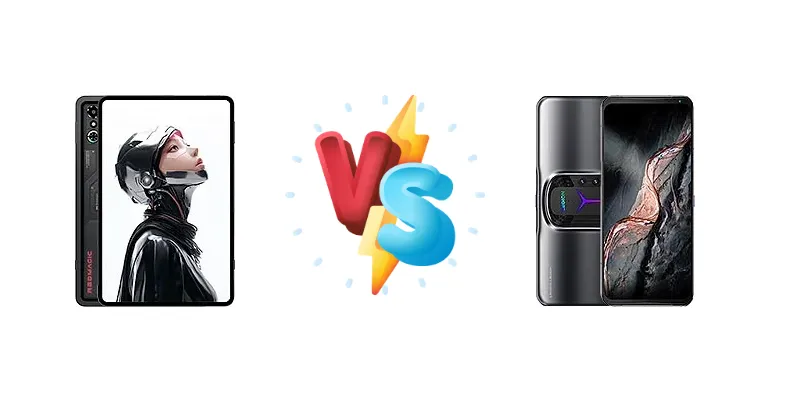
The gaming phone market is heating up, with the ZTE nubia RedMagic Astra and Lenovo Legion Y90 representing distinct approaches to mobile gaming dominance. The Astra arrives with Qualcomm’s latest Snapdragon 8 Elite, built on a 3nm process, while the Legion Y90 leverages the established Snapdragon 8 Gen 1. This comparison dissects their core differences, focusing on performance, battery life, and the user experience each delivers.
🏆 Quick Verdict
For the average gamer prioritizing sustained performance and battery longevity, the ZTE nubia RedMagic Astra emerges as the winner. Its Snapdragon 8 Elite chipset, fabricated on a more efficient 3nm node, promises superior thermal management and longer gaming sessions. While the Legion Y90 offers faster charging, the Astra’s endurance and cutting-edge processor give it the edge.
| Network |
|---|
| 2G bands | N/A | GSM 850 / 900 / 1800 / 1900 |
| 3G bands | N/A | HSDPA 800 / 850 / 900 / 1900 / 2100 |
| 4G bands | N/A | LTE |
| 5G bands | - | SA/NSA/Sub6 |
| EDGE | No | - |
| GPRS | No | - |
| Speed | - | HSPA, LTE, 5G |
| Technology | No cellular connectivity | GSM / CDMA / HSPA / CDMA2000 / LTE / 5G |
| | - | CDMA2000 1x |
| Launch |
|---|
| Announced | 2025, June 11 | 2022, March 01 |
| Status | Available. Released 2025, June 12 | Available. Released 2022, March 10 |
| Body |
|---|
| Build | Glass front, aluminum frame, aluminum back | - |
| Dimensions | 207 x 134.2 x 6.9 mm (8.15 x 5.28 x 0.27 in) | 177 x 78.4 x 10.1 mm (6.97 x 3.09 x 0.40 in) |
| SIM | No | Nano-SIM + Nano-SIM |
| Weight | 370 g (13.05 oz) | 252 g (8.89 oz) |
| | - | Built-in two cooling fans
RGB light panel (on the back)
4 ultrasonic buttons (Gaming triggers) |
| Display |
|---|
| Protection | Corning Gorilla Glass (unspecified version), Mohs level 4 | - |
| Resolution | 1504 x 2400 pixels, 16:10 ratio (~313 ppi density) | 1080 x 2460 pixels (~388 ppi density) |
| Size | 9.06 inches, 238.3 cm2 (~85.8% screen-to-body ratio) | 6.92 inches, 113.7 cm2 (~81.9% screen-to-body ratio) |
| Type | LTPO OLED, 1B colors, 165Hz, 5280Hz PWM, HDR, 1000 nits (typ), 1600 nits (peak) | AMOLED, 144Hz, HDR10+, 1300 nits (peak) |
| Platform |
|---|
| CPU | Octa-core (2x4.32 GHz Oryon V2 Phoenix L + 6x3.53 GHz Oryon V2 Phoenix M) | Octa-core (1x3.00 GHz Cortex-X2 & 3x2.50 GHz Cortex-A710 & 4x1.80 GHz Cortex-A510) |
| Chipset | Qualcomm SM8750-AB Snapdragon 8 Elite (3 nm) | Qualcomm SM8450 Snapdragon 8 Gen 1 (4 nm) |
| GPU | Adreno 830 (1200 MHz) | Adreno 730 |
| OS | Android 15, Redmagic OS 10.5 | Android 12, ZUI 13 |
| Memory |
|---|
| Card slot | No | No |
| Internal | 256GB 12GB RAM, 512GB 16GB RAM, 1TB 24GB RAM | 256GB 12GB RAM, 256GB 16GB RAM, 640GB 18GB RAM |
| | - | UFS 3.1
640GB (512GB UFS + 128GB SSD) |
| Main Camera |
|---|
| Dual | - | 64 MP, f/1.9, 25mm (wide), 1/1.32", 1.0µm, PDAF
13 MP, 120˚ (ultrawide) |
| Features | LED flash, HDR, panorama | Dual-LED flash, panorama, HDR |
| Single | 13 MP, (wide) | - |
| Video | 4K@30fps, 1080p@30fps | 8K@24fps, 4K@30/60fps, 1080p@30/60/240fps, gyro-EIS, HDR10+ rec. |
| Selfie camera |
|---|
| Features | - | HDR |
| Single | 9 MP, f/2.2, (wide), 0.7μm | 16 MP |
| Video | 1080p@30fps | 4K@30/60fps, 1080p@30/60/120fps |
| Sound |
|---|
| 3.5mm jack | - | No |
| 35mm jack | No | No |
| Loudspeaker | Yes, with stereo speakers | Yes, with stereo speakers |
| Comms |
|---|
| Bluetooth | 5.4, A2DP, LE | 5.2, A2DP, LE |
| NFC | No | Yes |
| Positioning | No | GPS (L1+L5), GLONASS, GALILEO, BDS, QZSS |
| Radio | No | No |
| USB | USB Type-C 3.2 Gen2, Display Port, magnetic connector pins | USB Type-C 3.1 Gen2, USB Type-C 2.0, OTG |
| WLAN | Wi-Fi 802.11 a/b/g/n/ac/6, dual-band | Wi-Fi 802.11 a/b/g/n/ac/6, dual-band, Wi-Fi Direct |
| Features |
|---|
| Sensors | Fingerprint (side-mounted), accelerometer, gyro, proximity, compass | Fingerprint (under display, optical), accelerometer, gyro, proximity, compass |
| Battery |
|---|
| Charging | 80W wired, 50% in 22 min | 68W wired, 100% in 35 min |
| Type | 8200 mAh | Li-Po 5600 mAh |
| Misc |
|---|
| Colors | Eclipse Black, Starfrost Silver | Gray |
| Models | NP05J | L71061 |
| Price | About 500 EUR | About 570 EUR |
| EU LABEL |
|---|
| Battery | 67:07h endurance, 1000 cycles | - |
| Energy | Class G | - |
| Free fall | Class E (0 falls) | - |
| Repairability | Class B | - |
ZTE nubia RedMagic Astra
- Superior chipset performance with Snapdragon 8 Elite
- Exceptional battery life (67:07h endurance)
- Long battery lifespan (1000 charge cycles)
- Camera likely not a priority
- Gaming-focused design may not appeal to all
Lenovo Legion Y90
- Faster charging speed (68W, 100% in 35 min)
- Established Snapdragon 8 Gen 1 platform
- Likely robust cooling system (typical of Legion)
- Inferior chipset efficiency compared to Snapdragon 8 Elite
- Shorter battery life expected
Display Comparison
The RedMagic Astra boasts a measured peak brightness of 1036 nits, providing excellent visibility even in bright conditions. While the Legion Y90’s display specs aren’t provided, Lenovo typically equips its Legion devices with high-refresh-rate panels. The Astra’s brightness advantage is significant, and the absence of LTPO information for the Legion Y90 suggests it may not dynamically adjust refresh rates for optimal power efficiency. This could impact battery life during less demanding tasks. Bezels are likely comparable given both phones target the gaming demographic, but color accuracy data is missing for both.
Camera Comparison
Camera details are sparse for both devices. Given their gaming focus, neither is likely to prioritize camera capabilities. We can assume both will feature adequate sensors for casual photography, but neither is expected to compete with flagship camera phones. Without specific sensor size or aperture information, a meaningful comparison is impossible. The absence of details suggests camera performance isn’t a key selling point for either device.
Performance
The core differentiator lies in the chipsets. The RedMagic Astra’s Qualcomm SM8750-AB Snapdragon 8 Elite (3nm) features an octa-core configuration with Oryon V2 Phoenix L and M cores clocked at up to 4.32 GHz. This architecture, combined with the 3nm process, should deliver significantly improved performance per watt compared to the Lenovo Legion Y90’s Snapdragon 8 Gen 1 (4nm). The Gen 1 utilizes a more traditional octa-core setup with Cortex-X2, A710, and A510 cores, maxing out at 3.00 GHz. The 3nm process of the Astra’s chip allows for higher transistor density and reduced power consumption, translating to less thermal throttling during prolonged gaming. While the Gen 1 is a capable chip, the Astra’s newer architecture and process node provide a clear advantage.
Battery Life
The RedMagic Astra demonstrates exceptional battery endurance with a measured 67:07h of total usage and 11:12h of active use. This is likely due to the efficiency of the Snapdragon 8 Elite and its 3nm fabrication. The Legion Y90, while offering 68W wired charging (reaching 100% in 35 minutes), lacks comparable endurance data. The Astra’s 80W charging (50% in 22 minutes) is competitive, but the Astra’s superior battery life means users will rely on charging less frequently. The Astra also boasts a claimed 1000 charge cycles, suggesting a longer lifespan for the battery itself.
Buying Guide
Buy the ZTE nubia RedMagic Astra if you need uncompromising performance for extended gaming sessions, value long-term battery health, and prioritize a cooler operating temperature under load. Buy the Lenovo Legion Y90 if you prefer a quicker top-up with its 68W charging, and are willing to trade some sustained performance for faster recharge times. The Legion Y90 is also a better choice for users who frequently game in short bursts.
Frequently Asked Questions
❓ Will the Snapdragon 8 Elite in the RedMagic Astra experience significant thermal throttling during extended Genshin Impact sessions?
The Snapdragon 8 Elite’s 3nm process is designed to mitigate thermal throttling. While some throttling is inevitable under extreme load, it should be considerably less pronounced than with the 4nm Snapdragon 8 Gen 1 in the Legion Y90, allowing for more sustained peak performance.
❓ How does the 80W charging on the RedMagic Astra compare to the 68W charging on the Legion Y90 in real-world usage?
While the Legion Y90 reaches 100% faster (35 minutes vs. Astra’s partial charge time), the Astra’s superior battery life means you’ll likely need to charge it less often. The Astra’s 80W is sufficient for a quick top-up when needed, and the longer battery life reduces the overall reliance on fast charging.
❓ Does the Lenovo Legion Y90 support frame rate boosting or other gaming-specific software enhancements?
Lenovo Legion devices typically include software features designed to optimize gaming performance, such as frame rate boosters and performance profiles. However, the effectiveness of these features will be limited by the underlying hardware (Snapdragon 8 Gen 1) compared to the Astra’s more powerful chipset.