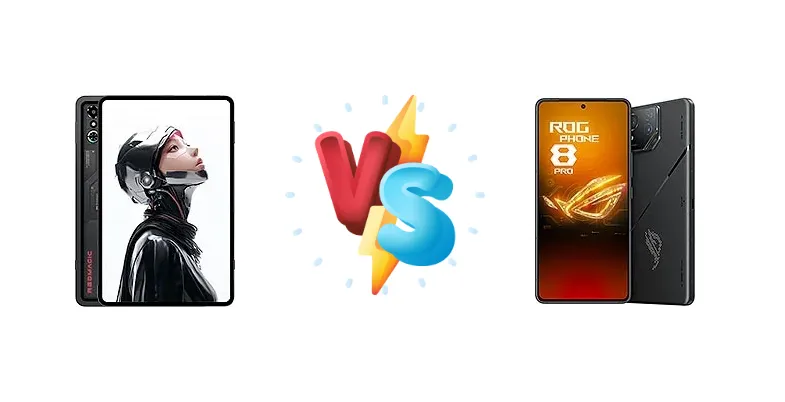
The gaming phone market is heating up, with the ZTE nubia RedMagic Astra challenging Asus’s long-held dominance with its new Snapdragon 8 Elite chipset. This comparison pits the Astra’s focus on raw performance against the ROG Phone 8 Pro’s more holistic approach, encompassing display quality, battery endurance, and a refined software experience.
🏆 Quick Verdict
For the user prioritizing absolute, sustained performance and a potentially lower price, the ZTE RedMagic Astra is the winner. However, the Asus ROG Phone 8 Pro offers a more complete package with a significantly brighter display, longer battery life, and more versatile charging options, making it the better choice for most gamers.
| Network |
|---|
| 2G bands | N/A | GSM 850 / 900 / 1800 / 1900 |
| 3G bands | N/A | HSDPA 850 / 900 / 1700(AWS) / 1800 / 1900 / 2100 - International |
| 4G bands | N/A | 1, 2, 3, 4, 5, 7, 8, 12, 17, 18, 19, 20, 25, 26, 28, 32, 34, 38, 39, 40, 41, 42, 43, 48, 66 - International |
| 5G bands | - | 1, 2, 3, 5, 7, 8, 12, 18, 20, 25, 26, 28, 38, 40, 41, 48, 66, 77, 78, 79 SA/NSA/Sub6 - International |
| EDGE | No | - |
| GPRS | No | - |
| Speed | - | HSPA, LTE (Up to 7CA), 5G |
| Technology | No cellular connectivity | GSM / CDMA / HSPA / LTE / 5G |
| Launch |
|---|
| Announced | 2025, June 11 | 2024, January 08 |
| Status | Available. Released 2025, June 12 | Available. Released 2024, January 18 |
| Body |
|---|
| Build | Glass front, aluminum frame, aluminum back | Glass front (Gorilla Glass Victus 2), glass back (Gorilla Glass), aluminum frame |
| Dimensions | 207 x 134.2 x 6.9 mm (8.15 x 5.28 x 0.27 in) | 163.8 x 76.8 x 8.9 mm (6.45 x 3.02 x 0.35 in) |
| SIM | No | Nano-SIM + Nano-SIM |
| Weight | 370 g (13.05 oz) | 225 g (7.94 oz) |
| Display |
|---|
| Protection | Corning Gorilla Glass (unspecified version), Mohs level 4 | Corning Gorilla Glass Victus 2 |
| Resolution | 1504 x 2400 pixels, 16:10 ratio (~313 ppi density) | 1080 x 2400 pixels, 20:9 ratio (~388 ppi density) |
| Size | 9.06 inches, 238.3 cm2 (~85.8% screen-to-body ratio) | 6.78 inches, 111.0 cm2 (~88.2% screen-to-body ratio) |
| Type | LTPO OLED, 1B colors, 165Hz, 5280Hz PWM, HDR, 1000 nits (typ), 1600 nits (peak) | LTPO AMOLED, 1B colors, 165Hz, HDR10, 1600 nits (HBM), 2500 nits (peak) |
| Platform |
|---|
| CPU | Octa-core (2x4.32 GHz Oryon V2 Phoenix L + 6x3.53 GHz Oryon V2 Phoenix M) | Octa-core (1x3.3 GHz Cortex-X4 & 3x3.2 GHz Cortex-A720 & 2x3.0 GHz Cortex-A720 & 2x2.3 GHz Cortex-A520) |
| Chipset | Qualcomm SM8750-AB Snapdragon 8 Elite (3 nm) | Qualcomm SM8650-AB Snapdragon 8 Gen 3 (4 nm) |
| GPU | Adreno 830 (1200 MHz) | Adreno 750 |
| OS | Android 15, Redmagic OS 10.5 | Android 14, up to 2 major Android upgrades |
| Memory |
|---|
| Card slot | No | No |
| Internal | 256GB 12GB RAM, 512GB 16GB RAM, 1TB 24GB RAM | 512GB 16GB RAM, 1TB 24GB RAM |
| Main Camera |
|---|
| Features | LED flash, HDR, panorama | LED flash, HDR, panorama |
| Single | 13 MP, (wide) | - |
| Triple | - | 50 MP, f/1.9, 24mm (wide), 1/1.56", 1.0µm, PDAF, gimbal OIS
32 MP, f/2.4, (telephoto), 1/3.2", 0.7µm, PDAF, OIS, 3x optical zoom
13 MP, f/2.2, 13mm, 120˚ (ultrawide) |
| Video | 4K@30fps, 1080p@30fps | 8K@24fps, 4K@30/60fps, 1080p@30/60/120/240fps, 720p@480fps; gyro-EIS, HDR10+ |
| Selfie camera |
|---|
| Features | - | Panorama, HDR |
| Single | 9 MP, f/2.2, (wide), 0.7μm | 32 MP, f/2.5, 22mm (wide), 1/3.2", 0.7µm |
| Video | 1080p@30fps | 1080p@30fps |
| Sound |
|---|
| 35mm jack | No | Yes |
| Loudspeaker | Yes, with stereo speakers | Yes, with stereo speakers |
| Comms |
|---|
| Bluetooth | 5.4, A2DP, LE | 5.4, A2DP, LE, aptX HD, aptX Adaptive, aptX Lossless |
| NFC | No | Yes |
| Positioning | No | GPS (L1+L5), BDS (B1I+B1c+B2a), GALILEO (E1+E5a), QZSS (L1+L5), NavIC (L5), GLONASS |
| Radio | No | No |
| USB | USB Type-C 3.2 Gen2, Display Port, magnetic connector pins | USB Type-C (side), DisplayPort 1.4; USB Type-C (bottom), OTG |
| WLAN | Wi-Fi 802.11 a/b/g/n/ac/6, dual-band | Wi-Fi 802.11 a/b/g/n/ac/6e/7, tri-band, Wi-Fi Direct |
| Features |
|---|
| Sensors | Fingerprint (side-mounted), accelerometer, gyro, proximity, compass | Fingerprint (under display, optical), accelerometer, gyro, proximity, compass |
| Battery |
|---|
| Charging | 80W wired, 50% in 22 min | 65W wired, PD3.0, PPS, QC5, 100% in 39 min - International
30W wired, PD3.0, PPS - India
15W wireless (Qi)
10W reverse wired |
| Type | 8200 mAh | 5500 mAh |
| Misc |
|---|
| Colors | Eclipse Black, Starfrost Silver | Phantom Black |
| Models | NP05J | AI2401, AI2401_A, AI2401_D |
| Price | About 500 EUR | $ 1,157.98 / £ 1,693.75 / € 632.66 |
| EU LABEL |
|---|
| Battery | 67:07h endurance, 1000 cycles | - |
| Energy | Class G | - |
| Free fall | Class E (0 falls) | - |
| Repairability | Class B | - |
ZTE nubia RedMagic Astra
- Potentially higher CPU/GPU performance with Snapdragon 8 Elite
- Faster wired charging (80W)
- Likely more affordable price point
- Shorter battery life
- Dimmer display
- Limited camera information suggests lower quality
Asus ROG Phone 8 Pro
- Significantly brighter display (1765 nits)
- Longer battery life (14:43h active use)
- Versatile charging options (wired, wireless, reverse)
- Slightly slower CPU/GPU performance compared to Astra
- Higher price point
- Wired charging speed varies by region
Display Comparison
The Asus ROG Phone 8 Pro immediately distinguishes itself with a peak brightness of 1765 nits, nearly 70% brighter than the RedMagic Astra’s 1036 nits. This translates to significantly better visibility outdoors and a more vibrant HDR experience. While both likely employ high refresh rate panels (spec not provided for Astra, standard for ROG), the ROG Phone 8 Pro’s superior brightness and likely color calibration give it a clear advantage. The Astra’s display, while adequate, feels comparatively dim.
Camera Comparison
The context data for the RedMagic Astra lacks camera details, suggesting it’s not a primary focus. The Asus ROG Phone 8 Pro, however, is explicitly noted as having a Photo/Video capability, implying a more developed camera system. While specific sensor details are missing, Asus typically prioritizes camera quality in its ROG Phone line. Given the Astra’s gaming-centric design, it’s reasonable to assume its camera will be adequate for casual use but won’t compete with the ROG Phone 8 Pro’s expected image quality and features.
Performance
The core battleground is the chipset. The RedMagic Astra boasts the Qualcomm SM8750-AB Snapdragon 8 Elite (3nm), featuring a unique octa-core configuration with Oryon V2 Phoenix cores clocked up to 4.32 GHz. This architecture is designed for peak single-core and multi-core performance. The ROG Phone 8 Pro utilizes the Snapdragon 8 Gen 3 (4nm), a more conventional octa-core design. While the Gen 3 is powerful, the 3nm process and Oryon cores of the 8 Elite *should* deliver a performance edge, particularly in CPU-bound tasks. However, the 4nm node of the Gen 3 may offer better thermal efficiency, potentially mitigating throttling during extended gaming sessions. The Astra’s performance advantage will be most noticeable in tasks that fully utilize all cores.
Battery Life
The ROG Phone 8 Pro demonstrates a significant advantage in battery endurance, achieving an active use score of 14:43h compared to the RedMagic Astra’s 11:12h. This translates to nearly 3 extra hours of real-world usage. While the Astra offers faster wired charging at 80W (50% in 22 minutes), the ROG Phone 8 Pro provides more versatile charging options: 65W wired (with varying speeds depending on region), 15W wireless, and 10W reverse wired charging. The ROG Phone 8 Pro’s larger battery capacity and more efficient chipset contribute to its superior battery life, making it the better choice for users who prioritize all-day usage.
Buying Guide
Buy the ZTE nubia RedMagic Astra if you need uncompromising CPU and GPU power for demanding games and emulation, and are willing to trade off some battery life and display brightness. Buy the Asus ROG Phone 8 Pro if you prefer a balanced experience with exceptional display quality, all-day battery life, and a wider range of features like wireless charging and a more polished camera system.
Frequently Asked Questions
❓ Does the Snapdragon 8 Elite in the RedMagic Astra generate excessive heat during prolonged gaming sessions?
While the Snapdragon 8 Elite offers impressive performance, the 3nm process and advanced cooling solutions (not detailed in the provided data) will be crucial in managing thermals. The ROG Phone 8 Pro’s 4nm Snapdragon 8 Gen 3 may have a slight advantage in thermal efficiency, potentially leading to less throttling during extended gameplay. Independent testing will be needed to determine the Astra’s real-world thermal performance.
❓ What charging standards does the ROG Phone 8 Pro support in India, and how does it compare to the international version?
The ROG Phone 8 Pro supports 30W wired charging in India, utilizing PD3.0 and PPS standards. This is significantly slower than the 65W wired charging available in international markets, which also supports PD3.0, PPS, and QC5. Indian users will experience considerably longer charging times compared to those in other regions.
❓ How does the Astra's 1000-cycle battery longevity claim translate to real-world usage?
The 1000-cycle claim suggests the Astra’s battery is designed to retain a significant portion of its capacity after 1000 full charge/discharge cycles. This is a positive indicator of long-term battery health, but actual degradation will depend on usage patterns and charging habits. It doesn't guarantee the battery will be 'like new' after 1000 cycles, but it implies a slower decline than batteries with lower cycle ratings.