
ZTE nubia RedMagic 9S Pro+ vs. Samsung Galaxy S24 Ultra: A Deep Dive Comparison
| Phones Images | |||||
|---|---|---|---|---|---|
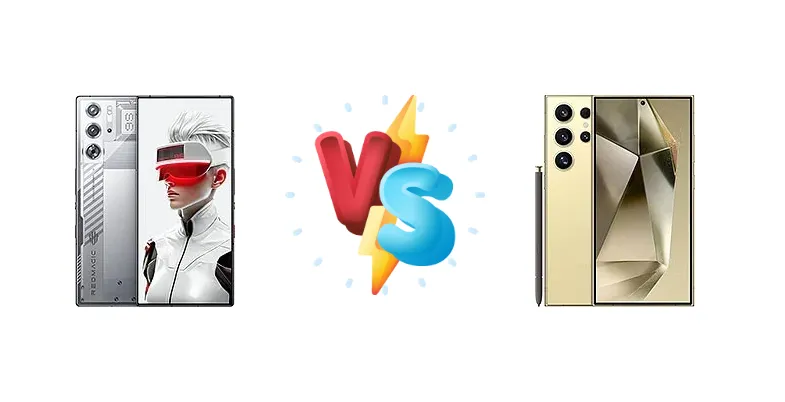
|
🏆 Quick Verdict
For the average user, the Samsung Galaxy S24 Ultra emerges as the more well-rounded choice. Its superior camera system, longer battery life (13:49h active use), and broader feature set outweigh the RedMagic 9S Pro+'s gaming focus. However, dedicated mobile gamers will find the RedMagic’s performance and cooling capabilities unmatched.
| PHONES | ||
|---|---|---|
| Phone Names | ZTE nubia RedMagic 9S Pro+ | Samsung Galaxy S24 Ultra |
| Network | ||
|---|---|---|
| 2G bands | GSM 850 / 900 / 1800 / 1900 | GSM 850 / 900 / 1800 / 1900 |
| 3G bands | HSDPA 800 / 850 / 900 / 1700(AWS) / 1900 / 2100 | HSDPA 850 / 900 / 1700(AWS) / 1900 / 2100 |
| 4G bands | 1, 2, 3, 4, 5, 7, 8, 12, 17, 18, 19, 20, 26, 28, 34, 38, 39, 40, 41, 42, 66 | 1, 2, 3, 4, 5, 7, 8, 12, 13, 17, 18, 19, 20, 25, 26, 28, 32, 38, 39, 40, 41, 66 - International |
| 5G bands | 1, 3, 5, 6, 7, 8, 20, 28, 38, 41, 65, 77, 78 SA/NSA | 1, 2, 3, 5, 7, 8, 12, 20, 25, 26, 28, 38, 40, 41, 66, 75, 77, 78 SA/NSA/Sub6 - International |
| Speed | HSPA, LTE, 5G | HSPA, LTE (up to 7CA), 5G |
| Technology | GSM / CDMA / HSPA / EVDO / LTE / 5G | GSM / CDMA / HSPA / EVDO / LTE / 5G |
| Launch | ||
|---|---|---|
| Announced | 2024, July 03 | 2024, January 17 |
| Status | Available. Released 2024, July 09 | Available. Released 2024, January 24 |
| Body | ||
|---|---|---|
| Build | Glass front (Gorilla Glass 5), aluminum frame, glass back | Glass front (Corning Gorilla Armor), glass back (Corning Gorilla Armor), titanium frame (grade 2) |
| Dimensions | 164 x 76.4 x 8.9 mm (6.46 x 3.01 x 0.35 in) | 162.3 x 79 x 8.6 mm (6.39 x 3.11 x 0.34 in) |
| SIM | Nano-SIM + Nano-SIM | · Nano-SIM + Nano-SIM + eSIM + eSIM (max 2 at a time) - INT· Nano-SIM + eSIM + eSIM (max 2 at a time) - USA· Nano-SIM + Nano-SIM - CN |
| Weight | 229 g (8.08 oz) | 232 g or 233 g (8.18 oz) |
| Display | ||
|---|---|---|
| Protection | Corning Gorilla Glass 5 | Corning Gorilla Armor |
| Resolution | 1116 x 2480 pixels, 20:9 ratio (~400 ppi density) | 1440 x 3120 pixels, 19.5:9 ratio (~505 ppi density) |
| Size | 6.8 inches, 111.6 cm2 (~89.1% screen-to-body ratio) | 6.8 inches, 113.5 cm2 (~88.5% screen-to-body ratio) |
| Type | AMOLED, 1B colors, 120Hz, 1600 nits (peak) | Dynamic LTPO AMOLED 2X, 120Hz, HDR10+, 2600 nits (peak) |
| Platform | ||
|---|---|---|
| CPU | Octa-core (1x3.4 GHz Cortex-X4 & 3x3.2 GHz Cortex-A720 & 2x3.0 GHz Cortex-A720 & 2x2.3 GHz Cortex-A520) | 8-core (1x3.39GHz Cortex-X4 & 3x3.1GHz Cortex-A720 & 2x2.9GHz Cortex-A720 & 2x2.2GHz Cortex-A520) |
| Chipset | Qualcomm SM8650-AC Snapdragon 8 Gen 3 (4 nm) | Qualcomm SM8650-AC Snapdragon 8 Gen 3 (4 nm) |
| GPU | Adreno 750 (1 GHz) | Adreno 750 (1 GHz) |
| OS | Android 14, Redmagic OS 9.5 | Android 14, up to 7 major Android upgrades, One UI 8.0 |
| Memory | ||
|---|---|---|
| Card slot | No | No |
| Internal | 512GB 16GB RAM, 1TB 24GB RAM | 256GB 12GB RAM, 512GB 12GB RAM, 1TB 12GB RAM |
| Main Camera | ||
|---|---|---|
| Features | LED flash, HDR, panorama | Laser AF, LED flash, auto-HDR, panorama |
| Quad | - | 200 MP, f/1.7, 24mm (wide), 1/1.3", 0.6µm, multi-directional PDAF, OIS 10 MP, f/2.4, 67mm (telephoto), 1/3.52", 1.12µm, PDAF, OIS, 3x optical zoom 50 MP, f/3.4, 111mm (periscope telephoto), 1/2.52", 0.7µm, PDAF, OIS, 5x optical zoom 12 MP, f/2.2, 13mm, 120˚ (ultrawide), 1/2.55", 1.4µm, dual pixel PDAF, Super Steady video |
| Triple | 50 MP, f/1.9, (wide), 1/1.57", 1.0µm, PDAF, OIS 50 MP, f/2.2, (ultrawide), 1/2.76", 0.64µm Auxiliary lens | - |
| Video | 8K@30fps, 4K@30/60fps, 1080p@30/60/120/240fps | 8K@24/30fps, 4K@30/60/120fps, 1080p@30/60/120/240fps, HDR10+, stereo sound rec., gyro-EIS |
| Selfie camera | ||
|---|---|---|
| Features | HDR | HDR, HDR10+ |
| Single | 16 MP, f/2.0, (wide), 1/2.8", 1.12µm, under display | 12 MP, f/2.2, 26mm (wide), 1/3.2", 1.12µm, dual pixel PDAF |
| Video | 1080p@30/60fps | 4K@30/60fps, 1080p@30fps |
| Sound | ||
|---|---|---|
| 35mm jack | Yes | No |
| Loudspeaker | Yes, with stereo speakers | Yes, with stereo speakers |
| Comms | ||
|---|---|---|
| Bluetooth | 5.2, A2DP, LE | 5.3, A2DP, LE |
| Infrared port | Yes | - |
| NFC | Yes (market/region dependent) | Yes |
| Positioning | GPS (L1+L5), GLONASS, BDS, GALILEO | GPS, GLONASS, BDS, GALILEO, QZSS |
| Radio | No | No |
| USB | USB Type-C 3.2 Gen 2, OTG, accessory connector, DisplayPort | USB Type-C 3.2, DisplayPort 1.2, OTG |
| WLAN | Wi-Fi 802.11 a/b/g/n/ac/6e/7, tri-band, Wi-Fi Direct | Wi-Fi 802.11 a/b/g/n/ac/6e/7, tri-band, Wi-Fi Direct |
| Features | ||
|---|---|---|
| Sensors | Fingerprint (under display, optical), accelerometer, gyro, proximity, compass | Fingerprint (under display, ultrasonic), accelerometer, gyro, proximity, compass, barometer |
| Battery | ||
|---|---|---|
| Charging | 165W wired, PD3.0, 100% in 16 min | 45W wired, PD3.0, 65% in 30 min 15W wireless (Qi) 4.5W reverse wireless |
| Type | Li-Ion 5500 mAh | Li-Ion 5000 mAh |
| Misc | ||
|---|---|---|
| Colors | Design Sleet (Black Version), Snowfall (Silver Version), Cyclone (Transparent Black Version), Frost (White Version) | Titanium Black, Titanium Gray, Titanium Violet, Titanium Yellow, Titanium Blue, Titanium Green, Titanium Orange |
| Models | - | SM-S928B, SM-S928B/DS, SM-S928U, SM-S928U1, SM-S928W, SM-S928N, SM-S9280, SM-S928E, SM-S928E/DS |
| Price | About 740 EUR | $ 514.94 / C$ 929.99 / £ 630.00 / € 658.53 / ₹ 84,999 |
| SAR | - | 1.26 W/kg (head) 0.62 W/kg (body) |
| SAR EU | - | 1.06 W/kg (head) 1.30 W/kg (body) |
ZTE nubia RedMagic 9S Pro+
- Blazing-fast 165W charging
- Superior cooling for sustained gaming
- Potentially higher peak CPU clock speed
- Likely weaker camera system
- Potentially shorter battery life
Samsung Galaxy S24 Ultra
- Exceptional camera performance
- Longer battery life (13:49h active use)
- Brighter display (1447 nits)
- Slower charging speed (45W)
- Less aggressive cooling system
Display Comparison
Both devices utilize the Qualcomm SM8650-AC Snapdragon 8 Gen 3 (4nm) chipset, but their displays diverge significantly. The S24 Ultra reaches a measured peak brightness of 1447 nits, ensuring excellent visibility even in direct sunlight. While the RedMagic 9S Pro+’s display specs aren’t provided, nubia typically focuses on high refresh rates for gaming. The S24 Ultra’s LTPO panel dynamically adjusts refresh rates, contributing to battery efficiency, a feature likely absent in the RedMagic to maximize sustained performance. Bezels are expected to be slimmer on the S24 Ultra, reflecting Samsung’s display expertise.
Camera Comparison
The S24 Ultra’s camera system is a clear differentiator. While specific details are missing for the RedMagic 9S Pro+, Samsung’s flagship is renowned for its versatile camera array, including a high-resolution main sensor and advanced image processing. The S24 Ultra excels in both photo and video capture, offering features like Space Zoom and enhanced low-light performance. The RedMagic, while likely equipped with a capable camera, prioritizes gaming features over photographic prowess. We can expect a focus on computational photography for gaming-related features, rather than a pursuit of best-in-class image quality.
Performance
Both phones are powered by the Snapdragon 8 Gen 3, but subtle CPU clock speed differences exist. The S24 Ultra’s CPU peaks at 3.39GHz (1x Cortex-X4), while the RedMagic 9S Pro+ reaches 3.4 GHz. This marginal difference is unlikely to be noticeable in most applications. However, the RedMagic’s active cooling system – a hallmark of the brand – is crucial. This allows the Snapdragon 8 Gen 3 to sustain peak performance for longer periods, avoiding thermal throttling during extended gaming sessions. The S24 Ultra relies on Samsung’s vapor chamber cooling, which is effective but less aggressive. Both utilize LPDDR5x RAM, but the RedMagic’s cooling allows it to push that RAM harder for longer.
Battery Life
The S24 Ultra boasts a significant advantage in battery endurance, achieving 13 hours and 49 minutes of active use. The RedMagic 9S Pro+ compensates with incredibly fast 165W wired charging, reaching 100% in just 16 minutes. The S24 Ultra’s 45W charging takes 30 minutes to reach 65%, a substantial difference. The RedMagic also offers 100W wireless charging (not specified on the S24 Ultra), and 4.5W reverse wireless charging on the S24 Ultra. The trade-off is clear: the S24 Ultra offers longer runtimes, while the RedMagic prioritizes rapid replenishment.
Buying Guide
Buy the ZTE nubia RedMagic 9S Pro+ if you demand the absolute highest frame rates in mobile games, prioritize cooling to avoid throttling, and value incredibly fast 165W charging. Buy the Samsung Galaxy S24 Ultra if you prefer a premium camera experience, all-day battery life, a polished software experience, and a device that excels at a wider range of tasks beyond gaming.