
ZTE nubia RedMagic 9S Pro+ vs. OnePlus 12R: A Deep Dive into Gaming and Battery Life
| Phones Images | |||||
|---|---|---|---|---|---|
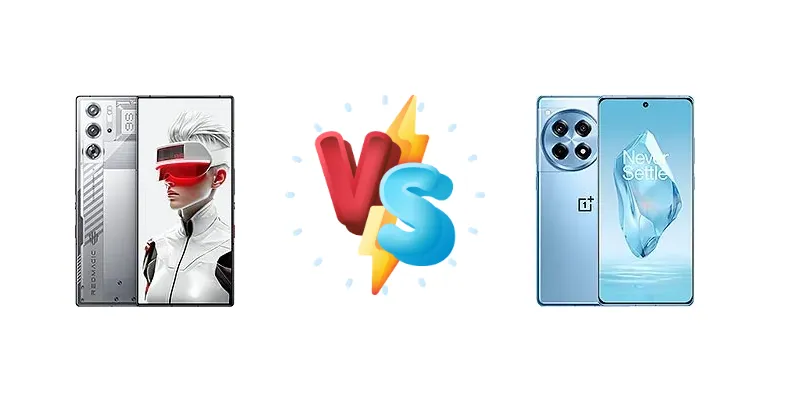
|
🏆 Quick Verdict
For the hardcore mobile gamer, the ZTE nubia RedMagic 9S Pro+ is the clear winner, thanks to its Snapdragon 8 Gen 3 and blistering 165W charging. However, the OnePlus 12R delivers exceptional battery life (14:32h active use) and a refined experience for everyday users, making it the better choice for those prioritizing longevity and value.
| PHONES | ||
|---|---|---|
| Phone Names | ZTE nubia RedMagic 9S Pro+ | OnePlus 12R |
| Network | ||
|---|---|---|
| 2G bands | GSM 850 / 900 / 1800 / 1900 | GSM 850 / 900 / 1800 / 1900 |
| 3G bands | HSDPA 800 / 850 / 900 / 1700(AWS) / 1900 / 2100 | HSDPA 850 / 900 / 1700(AWS) / 1900 / 2100 |
| 4G bands | 1, 2, 3, 4, 5, 7, 8, 12, 17, 18, 19, 20, 26, 28, 34, 38, 39, 40, 41, 42, 66 | 1, 2, 3, 4, 5, 7, 8, 12, 17, 18, 19, 20, 26, 28, 32, 38, 39, 40, 41, 66 |
| 5G bands | 1, 3, 5, 6, 7, 8, 20, 28, 38, 41, 65, 77, 78 SA/NSA | 1, 2, 3, 5, 7, 8, 12, 20, 28, 38, 40, 41, 66, 77, 78 SA/NSA |
| Speed | HSPA, LTE, 5G | HSPA, LTE, 5G |
| Technology | GSM / CDMA / HSPA / EVDO / LTE / 5G | GSM / CDMA / HSPA / LTE / 5G |
| Launch | ||
|---|---|---|
| Announced | 2024, July 03 | 2024, January 23 |
| Status | Available. Released 2024, July 09 | Available. Released 2024, February 06 |
| Body | ||
|---|---|---|
| Build | Glass front (Gorilla Glass 5), aluminum frame, glass back | Glass front (Gorilla Glass Victus 2), aluminum frame, glass back |
| Dimensions | 164 x 76.4 x 8.9 mm (6.46 x 3.01 x 0.35 in) | 163.3 x 75.3 x 8.8 mm (6.43 x 2.96 x 0.35 in) |
| SIM | Nano-SIM + Nano-SIM | · Nano-SIM + Nano-SIM + eSIM (max 2 at a time)· Nano-SIM + Nano-SIM |
| Weight | 229 g (8.08 oz) | 207 g (7.30 oz) |
| Display | ||
|---|---|---|
| Protection | Corning Gorilla Glass 5 | Corning Gorilla Glass Victus 2 |
| Resolution | 1116 x 2480 pixels, 20:9 ratio (~400 ppi density) | 1264 x 2780 pixels (~450 ppi density) |
| Size | 6.8 inches, 111.6 cm2 (~89.1% screen-to-body ratio) | 6.78 inches, 111.7 cm2 (~90.9% screen-to-body ratio) |
| Type | AMOLED, 1B colors, 120Hz, 1600 nits (peak) | LTPO4 AMOLED, 1B colors, 120Hz, HDR10+, Dolby Vision, 1600 nits (HBM), 4500 nits (peak) |
| Platform | ||
|---|---|---|
| CPU | Octa-core (1x3.4 GHz Cortex-X4 & 3x3.2 GHz Cortex-A720 & 2x3.0 GHz Cortex-A720 & 2x2.3 GHz Cortex-A520) | Octa-core (1x3.2 GHz Cortex-X3 & 2x2.8 GHz Cortex-A715 & 2x2.8 GHz Cortex-A710 & 3x2.0 GHz Cortex-A510) |
| Chipset | Qualcomm SM8650-AC Snapdragon 8 Gen 3 (4 nm) | Qualcomm SM8550-AB Snapdragon 8 Gen 2 (4 nm) |
| GPU | Adreno 750 (1 GHz) | Adreno 740 |
| OS | Android 14, Redmagic OS 9.5 | Android 14, up to 3 major Android upgrades, OxygenOS 15 |
| Memory | ||
|---|---|---|
| Card slot | No | No |
| Internal | 512GB 16GB RAM, 1TB 24GB RAM | 128GB 8GB RAM, 256GB 8GB RAM, 256GB 12GB RAM, 256GB 16GB RAM |
| Main Camera | ||
|---|---|---|
| Features | LED flash, HDR, panorama | Laser AF, color spectrum sensor, LED flash, HDR, panorama |
| Triple | 50 MP, f/1.9, (wide), 1/1.57", 1.0µm, PDAF, OIS 50 MP, f/2.2, (ultrawide), 1/2.76", 0.64µm Auxiliary lens | 50 MP, f/1.8, 24mm (wide), 1/1.56", 1.0µm, multi-directional PDAF, OIS 8 MP, f/2.2, 16mm, 112˚ (ultrawide), 1/4.0", 1.12µm 2 MP (macro) |
| Video | 8K@30fps, 4K@30/60fps, 1080p@30/60/120/240fps | 4K@30/60fps, 1080p@30/60/120/240fps, gyro-EIS, OIS |
| Selfie camera | ||
|---|---|---|
| Features | HDR | HDR, panorama |
| Single | 16 MP, f/2.0, (wide), 1/2.8", 1.12µm, under display | 16 MP, f/2.4, 26mm (wide), 1/3", 1.0µm |
| Video | 1080p@30/60fps | 1080p@30fps, gyro-EIS |
| Sound | ||
|---|---|---|
| 35mm jack | Yes | No |
| Loudspeaker | Yes, with stereo speakers | Yes, with stereo speakers |
| Comms | ||
|---|---|---|
| Bluetooth | 5.2, A2DP, LE | 5.3, A2DP, LE, aptX HD |
| Infrared port | Yes | Yes |
| NFC | Yes (market/region dependent) | Yes |
| Positioning | GPS (L1+L5), GLONASS, BDS, GALILEO | GPS, GALILEO, GLONASS, BDS, QZSS |
| Radio | No | No |
| USB | USB Type-C 3.2 Gen 2, OTG, accessory connector, DisplayPort | USB Type-C 2.0 |
| WLAN | Wi-Fi 802.11 a/b/g/n/ac/6e/7, tri-band, Wi-Fi Direct | Wi-Fi 802.11 a/b/g/n/ac/6/7, dual-band |
| Features | ||
|---|---|---|
| Sensors | Fingerprint (under display, optical), accelerometer, gyro, proximity, compass | Fingerprint (under display, optical), accelerometer, gyro, proximity, compass |
| Battery | ||
|---|---|---|
| Charging | 165W wired, PD3.0, 100% in 16 min | 100W wired, 100% in 26 min |
| Type | Li-Ion 5500 mAh | Li-Ion 5500 mAh |
| Misc | ||
|---|---|---|
| Colors | Design Sleet (Black Version), Snowfall (Silver Version), Cyclone (Transparent Black Version), Frost (White Version) | Iron Gray, Cool Blue, Electric Violet, Sunset Dune |
| Models | - | CPH2609, CPH2585, CPH2611 |
| Price | About 740 EUR | € 410.84 / $ 399.95 / £ 649.00 |
| SAR | - | 1.19 W/kg (head) 0.82 W/kg (body) |
ZTE nubia RedMagic 9S Pro+
- Unmatched gaming performance with Snapdragon 8 Gen 3
- Blazing-fast 165W charging
- Likely high refresh rate display optimized for gaming
- Potentially compromised camera quality
- Battery life likely shorter than OnePlus 12R
OnePlus 12R
- Excellent all-day battery life (14:32h active use)
- Fast 100W charging
- Bright and vibrant display (1181 nits)
- Less powerful Snapdragon 8 Gen 2 chipset
- May not deliver the highest frame rates in demanding games
Display Comparison
The OnePlus 12R boasts a bright display, reaching a measured peak brightness of 1181 nits, ensuring excellent visibility even outdoors. While the RedMagic 9S Pro+’s display specs aren’t provided, its focus on gaming suggests a high refresh rate panel. However, the OnePlus 12R’s brightness is a concrete advantage for general use. The absence of LTPO technology in the 12R might mean slightly higher power consumption at lower refresh rates compared to a potential LTPO panel on the RedMagic, but the difference is likely minimal for most users.
Camera Comparison
Context data lacks detailed camera specifications for both devices. Given the RedMagic’s gaming focus, its camera system is likely optimized for convenience rather than flagship-level image quality. The OnePlus 12R, benefiting from OnePlus’s established camera expertise, likely offers a more refined and versatile camera experience. Without specific sensor sizes or aperture details, it’s reasonable to assume the OnePlus 12R will deliver superior image quality, particularly in low-light conditions.
Performance
The core difference lies in the chipsets: the RedMagic 9S Pro+ utilizes the Qualcomm SM8650-AC Snapdragon 8 Gen 3 (4nm), while the OnePlus 12R features the older, but still potent, Snapdragon 8 Gen 2 (4nm). The Gen 3’s Cortex-X4 prime core, clocked at 3.4 GHz, represents a significant architectural upgrade over the Gen 2’s Cortex-X3 (3.2 GHz), promising faster single-core performance. The RedMagic’s CPU configuration (1+3+2+2) also suggests a more aggressive performance profile. While both are 4nm chips, the Gen 3’s improved efficiency and raw power will translate to higher frame rates and smoother gameplay, especially in demanding titles. The OnePlus 12R, however, will still provide a very smooth experience for most tasks.
Battery Life
The OnePlus 12R shines in battery endurance, achieving an impressive 14:32 hours of active use. The RedMagic 9S Pro+, while featuring incredibly fast 165W wired charging (100% in 16 minutes), doesn’t disclose its battery capacity. The OnePlus 12R’s 100W charging (100% in 26 minutes) is still very fast, but the RedMagic’s speed is a clear advantage for those who need to quickly top up. The OnePlus 12R’s longer battery life is more valuable for users who prioritize minimizing charging frequency.
Buying Guide
Buy the ZTE nubia RedMagic 9S Pro+ if you demand the absolute highest mobile gaming performance, need the fastest possible charging speeds, and are willing to accept potential trade-offs in camera quality and software polish. Buy the OnePlus 12R if you prioritize all-day battery life, a smooth and reliable user experience, and a more balanced feature set at a more accessible price point.