
ZTE nubia RedMagic 9S Pro vs. Xiaomi 14 Pro: A Deep Dive into Gaming and Charging
| Phones Images | |||||
|---|---|---|---|---|---|
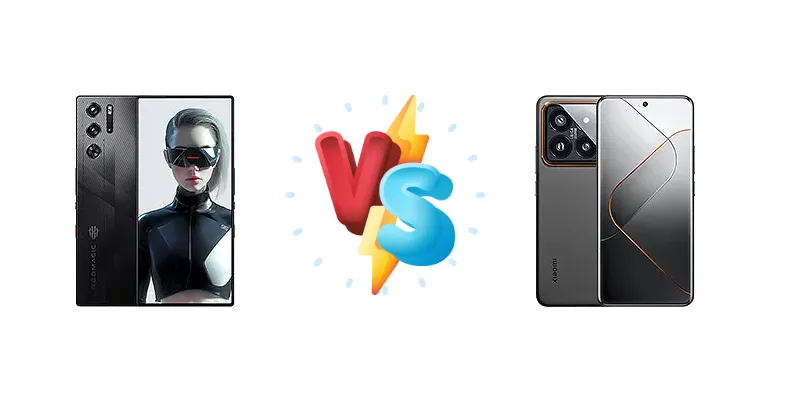
|
🏆 Quick Verdict
For dedicated mobile gamers prioritizing marathon sessions, the ZTE nubia RedMagic 9S Pro is the clear winner, boasting a significantly longer active use battery life of 17:08h. However, the Xiaomi 14 Pro appeals to users who value the convenience of incredibly fast 120W wired and 50W wireless charging.
| PHONES | ||
|---|---|---|
| Phone Names | ZTE nubia RedMagic 9S Pro | Xiaomi 14 Pro |
| Network | ||
|---|---|---|
| 2G bands | GSM 850 / 900 / 1800 / 1900 | GSM 850 / 900 / 1800 / 1900 |
| 3G bands | HSDPA 800 / 850 / 900 / 1700(AWS) / 1900 / 2100 | HSDPA 800 / 850 / 900 / 1700(AWS) / 1900 / 2100 |
| 4G bands | 1, 2, 3, 4, 5, 7, 8, 12, 17, 18, 19, 20, 26, 28, 34, 38, 39, 40, 41, 42, 66 | 1, 3, 4, 5, 7, 8, 18, 19, 26, 28, 34, 38, 39, 40, 41, 42, 48, 66 |
| 5G bands | 1, 3, 5, 6, 7, 8, 20, 28, 38, 41, 65, 77, 78 SA/NSA | 1, 3, 5, 7, 8, 28, 38, 40, 41, 48, 66, 77, 78, 79 SA/NSA |
| Speed | HSPA, LTE, 5G | HSPA, LTE, 5G |
| Technology | GSM / CDMA / HSPA / EVDO / LTE / 5G | GSM / CDMA / HSPA / CDMA2000 / LTE / 5G |
| Launch | ||
|---|---|---|
| Announced | 2024, July 03 | 2023, October 26 |
| Status | Available. Released 2024, July 09 | Available. Released 2023, November 01 |
| Body | ||
|---|---|---|
| Build | Glass front (Gorilla Glass 5), aluminum frame, glass back | Glass front, aluminum frame or titanium frame, glass back |
| Dimensions | 164 x 76.4 x 8.9 mm (6.46 x 3.01 x 0.35 in) | 161.4 x 75.3 x 8.5 mm |
| SIM | Nano-SIM + Nano-SIM | Nano-SIM + Nano-SIM |
| Weight | 229 g (8.08 oz) | 223 g or 230 g (7.87 oz) |
| Display | ||
|---|---|---|
| Protection | Corning Gorilla Glass 5 | Shatterproof glass |
| Resolution | 1116 x 2480 pixels, 20:9 ratio (~400 ppi density) | 1440 x 3200 pixels, 20:9 ratio (~522 ppi density) |
| Size | 6.8 inches, 111.6 cm2 (~89.1% screen-to-body ratio) | 6.73 inches, 108.9 cm2 (~89.6% screen-to-body ratio) |
| Type | AMOLED, 1B colors, 120Hz, 1600 nits (peak) | LTPO AMOLED, 68B colors, 120Hz, Dolby Vision, HDR10+, 3000 nits (peak) |
| Platform | ||
|---|---|---|
| CPU | Octa-core (1x3.4 GHz Cortex-X4 & 3x3.2 GHz Cortex-A720 & 2x3.0 GHz Cortex-A720 & 2x2.3 GHz Cortex-A520) | Octa-core (1x3.3 GHz Cortex-X4 & 3x3.2 GHz Cortex-A720 & 2x3.0 GHz Cortex-A720 & 2x2.3 GHz Cortex-A520) |
| Chipset | Qualcomm SM8650-AC Snapdragon 8 Gen 3 (4 nm) | Qualcomm SM8650-AB Snapdragon 8 Gen 3 (4 nm) |
| GPU | Adreno 750 (1 GHz) | Adreno 750 |
| OS | Android 14, Redmagic OS 9.5 | Android 14, HyperOS |
| Memory | ||
|---|---|---|
| Card slot | No | No |
| Internal | 256GB 12GB RAM, 512GB 12GB RAM, 512GB 16GB RAM | 256GB 12GB RAM, 512GB 16GB RAM, 1TB 16GB RAM |
| Main Camera | ||
|---|---|---|
| Features | LED flash, HDR, panorama | Laser AF, color spectrum sensor, Leica lens, Dual-LED dual-tone flash, HDR, panorama |
| Triple | 50 MP, f/1.9, (wide), 1/1.57", 1.0µm, PDAF, OIS 50 MP, f/2.2, (ultrawide), 1/2.76", 0.64µm Auxiliary lens | 50 MP, f/1.4-f/4.0, 23mm (wide), 1/1.31", 1.2µm, dual pixel PDAF, OIS 50 MP, f/2.0, 75mm (telephoto), PDAF (10cm - ∞), OIS, 3.2x optical zoom 50 MP, f/2.2, 14mm, 115˚ (ultrawide), AF |
| Video | 8K@30fps, 4K@30/60fps, 1080p@30/60/120/240fps | 8K@24fps (HDR), 4K@24/30/60fps (HDR10+, 10-bit Dolby Vision HDR, 10-bit LOG), 1080p@30/60/120/240/960fps, 720p@1920fps, gyro-EIS |
| Selfie camera | ||
|---|---|---|
| Features | HDR | HDR, panorama |
| Single | 16 MP, f/2.0, (wide), 1/2.8", 1.12µm, under display | 32 MP, f/2.0, 22mm (wide), 0.7µm |
| Video | 1080p@30/60fps | 4K@30/60fps, 1080p@30/60fps, gyro-EIS |
| Sound | ||
|---|---|---|
| 35mm jack | Yes | No |
| Loudspeaker | Yes, with stereo speakers | Yes, with stereo speakers |
| Comms | ||
|---|---|---|
| Bluetooth | 5.2, A2DP, LE | 5.4, A2DP, LE, aptX HD, aptX Adaptive |
| Infrared port | Yes | Yes |
| NFC | Yes (market/region dependent) | Yes |
| Positioning | GPS (L1+L5), GLONASS, BDS, GALILEO | GPS (L1+L5), GLONASS (G1), BDS (B1I+B1c+B2a), GALILEO (E1+E5a), QZSS (L1+L5), NavIC (L5) |
| Radio | No | No |
| USB | USB Type-C 3.2 Gen 2, OTG, accessory connector, DisplayPort | USB Type-C 3.2 Gen 2, OTG |
| WLAN | Wi-Fi 802.11 a/b/g/n/ac/6e/7, tri-band, Wi-Fi Direct | Wi-Fi 802.11 a/b/g/n/ac/6e/7, dual-band, Wi-Fi Direct |
| Features | ||
|---|---|---|
| Sensors | Fingerprint (under display, optical), accelerometer, gyro, proximity, compass | Fingerprint (under display, optical), accelerometer, proximity, gyro, compass, barometer |
| Battery | ||
|---|---|---|
| Charging | 80W wired, PD3.0, 100% in 35 min | 120W wired, PD3.0, QC4, 100% in 18 min 50W wireless, 100% in 40 min 10W reverse wireless |
| Type | 6500 mAh | Li-Po 4880 mAh |
| Misc | ||
|---|---|---|
| Colors | Design Sleet (Black Version), Snowfall (Silver Version), Cyclone (Transparent Black Version), Frost (White Version) | Black, Silver, Titanium, Green |
| Models | - | 23116PN5BC |
| Price | About 700 EUR | About 650 EUR |
ZTE nubia RedMagic 9S Pro
- Exceptional battery life (17:08h active use)
- Slightly faster CPU clock speed (3.4 GHz)
- Optimized for sustained gaming performance
- Slower charging speed (80W wired)
- Potentially less refined camera system
Xiaomi 14 Pro
- Ultra-fast 120W wired charging (18 minutes 0-100%)
- 50W wireless charging and 10W reverse wireless
- Likely superior camera system (based on brand reputation)
- Shorter battery life compared to RedMagic 9S Pro
- Slightly slower CPU clock speed (3.3 GHz)
Display Comparison
Both devices utilize the Qualcomm Snapdragon 8 Gen 3, but the display characteristics differ. The RedMagic 9S Pro reaches a measured peak brightness of 1058 nits, providing good visibility. While Xiaomi 14 Pro specs aren't provided, Xiaomi typically employs high-brightness panels. The RedMagic's focus on gaming suggests a potentially higher refresh rate and lower response time, crucial for competitive play, though this isn't explicitly stated. The absence of LTPO information for either device makes it difficult to assess power efficiency gains from variable refresh rates.
Camera Comparison
Context data lacks camera specifications for both devices. However, Xiaomi is renowned for its camera technology, and the 14 Pro is expected to feature a high-resolution main sensor with advanced image processing. The RedMagic, while likely capable, typically prioritizes other features over camera prowess. Without sensor size, aperture, or OIS details, a direct comparison is impossible, but Xiaomi’s history suggests a more versatile and feature-rich camera experience.
Performance
Both phones are powered by the Qualcomm SM8650-AC/AB Snapdragon 8 Gen 3 (4nm), but subtle CPU clock speed differences exist. The RedMagic 9S Pro features a slightly faster primary core at 3.4 GHz compared to the Xiaomi 14 Pro’s 3.3 GHz. While this difference is unlikely to be noticeable in most everyday tasks, it *could* translate to a marginal performance advantage in sustained, CPU-intensive gaming scenarios. Both share the same Cortex-A720 and A520 core configurations, ensuring similar multi-core performance. Thermal management will be key; the RedMagic’s gaming focus suggests a more robust cooling solution to mitigate throttling under load.
Battery Life
The ZTE nubia RedMagic 9S Pro shines with an impressive 17:08h of active use, indicating exceptional battery endurance. The Xiaomi 14 Pro compensates with significantly faster charging: 120W wired (0-100% in 18 minutes), 50W wireless (0-100% in 40 minutes), and 10W reverse wireless. The RedMagic 9S Pro’s 80W wired charging is respectable, taking 35 minutes for a full charge, but lags behind the Xiaomi’s speed. This trade-off – longer runtime versus faster replenishment – is a central decision point for buyers.
Buying Guide
Buy the ZTE nubia RedMagic 9S Pro if you need uncompromising gaming performance, exceptional battery life for extended play, and don't mind a more gamer-centric aesthetic. Buy the Xiaomi 14 Pro if you prefer a more polished, mainstream flagship experience with the fastest charging speeds available, a versatile camera system, and a premium design.