
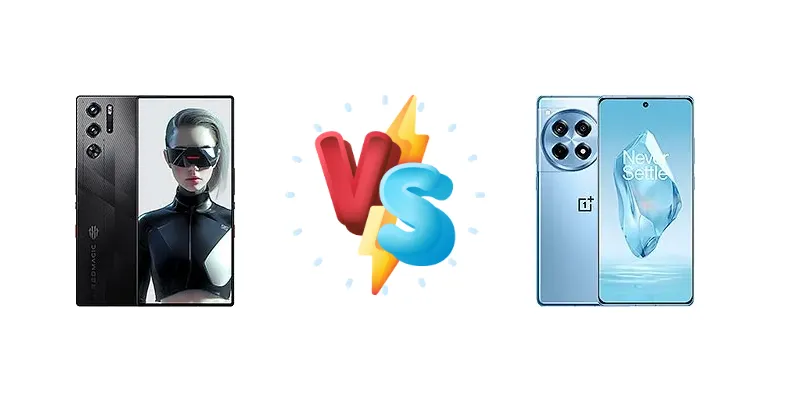
ZTE nubia RedMagic 9S Pro vs. OnePlus 12R: A Deep Dive into Gaming and All-Day Use
| Phones Images | |||||
|---|---|---|---|---|---|
|
🏆 Quick Verdict
For dedicated mobile gamers, the ZTE nubia RedMagic 9S Pro is the clear winner, thanks to its Snapdragon 8 Gen 3 chipset and focus on sustained performance. However, the OnePlus 12R provides a more versatile experience with its brighter display and faster charging, making it the better choice for everyday users.
| PHONES | ||
|---|---|---|
| Phone Names | ZTE nubia RedMagic 9S Pro | OnePlus 12R |
| Network | ||
|---|---|---|
| 2G bands | GSM 850 / 900 / 1800 / 1900 | GSM 850 / 900 / 1800 / 1900 |
| 3G bands | HSDPA 800 / 850 / 900 / 1700(AWS) / 1900 / 2100 | HSDPA 850 / 900 / 1700(AWS) / 1900 / 2100 |
| 4G bands | 1, 2, 3, 4, 5, 7, 8, 12, 17, 18, 19, 20, 26, 28, 34, 38, 39, 40, 41, 42, 66 | 1, 2, 3, 4, 5, 7, 8, 12, 17, 18, 19, 20, 26, 28, 32, 38, 39, 40, 41, 66 |
| 5G bands | 1, 3, 5, 6, 7, 8, 20, 28, 38, 41, 65, 77, 78 SA/NSA | 1, 2, 3, 5, 7, 8, 12, 20, 28, 38, 40, 41, 66, 77, 78 SA/NSA |
| Speed | HSPA, LTE, 5G | HSPA, LTE, 5G |
| Technology | GSM / CDMA / HSPA / EVDO / LTE / 5G | GSM / CDMA / HSPA / LTE / 5G |
| Launch | ||
|---|---|---|
| Announced | 2024, July 03 | 2024, January 23 |
| Status | Available. Released 2024, July 09 | Available. Released 2024, February 06 |
| Body | ||
|---|---|---|
| Build | Glass front (Gorilla Glass 5), aluminum frame, glass back | Glass front (Gorilla Glass Victus 2), aluminum frame, glass back |
| Dimensions | 164 x 76.4 x 8.9 mm (6.46 x 3.01 x 0.35 in) | 163.3 x 75.3 x 8.8 mm (6.43 x 2.96 x 0.35 in) |
| SIM | Nano-SIM + Nano-SIM | · Nano-SIM + Nano-SIM + eSIM (max 2 at a time)· Nano-SIM + Nano-SIM |
| Weight | 229 g (8.08 oz) | 207 g (7.30 oz) |
| Display | ||
|---|---|---|
| Protection | Corning Gorilla Glass 5 | Corning Gorilla Glass Victus 2 |
| Resolution | 1116 x 2480 pixels, 20:9 ratio (~400 ppi density) | 1264 x 2780 pixels (~450 ppi density) |
| Size | 6.8 inches, 111.6 cm2 (~89.1% screen-to-body ratio) | 6.78 inches, 111.7 cm2 (~90.9% screen-to-body ratio) |
| Type | AMOLED, 1B colors, 120Hz, 1600 nits (peak) | LTPO4 AMOLED, 1B colors, 120Hz, HDR10+, Dolby Vision, 1600 nits (HBM), 4500 nits (peak) |
| Platform | ||
|---|---|---|
| CPU | Octa-core (1x3.4 GHz Cortex-X4 & 3x3.2 GHz Cortex-A720 & 2x3.0 GHz Cortex-A720 & 2x2.3 GHz Cortex-A520) | Octa-core (1x3.2 GHz Cortex-X3 & 2x2.8 GHz Cortex-A715 & 2x2.8 GHz Cortex-A710 & 3x2.0 GHz Cortex-A510) |
| Chipset | Qualcomm SM8650-AC Snapdragon 8 Gen 3 (4 nm) | Qualcomm SM8550-AB Snapdragon 8 Gen 2 (4 nm) |
| GPU | Adreno 750 (1 GHz) | Adreno 740 |
| OS | Android 14, Redmagic OS 9.5 | Android 14, up to 3 major Android upgrades, OxygenOS 15 |
| Memory | ||
|---|---|---|
| Card slot | No | No |
| Internal | 256GB 12GB RAM, 512GB 12GB RAM, 512GB 16GB RAM | 128GB 8GB RAM, 256GB 8GB RAM, 256GB 12GB RAM, 256GB 16GB RAM |
| Main Camera | ||
|---|---|---|
| Features | LED flash, HDR, panorama | Laser AF, color spectrum sensor, LED flash, HDR, panorama |
| Triple | 50 MP, f/1.9, (wide), 1/1.57", 1.0µm, PDAF, OIS 50 MP, f/2.2, (ultrawide), 1/2.76", 0.64µm Auxiliary lens | 50 MP, f/1.8, 24mm (wide), 1/1.56", 1.0µm, multi-directional PDAF, OIS 8 MP, f/2.2, 16mm, 112˚ (ultrawide), 1/4.0", 1.12µm 2 MP (macro) |
| Video | 8K@30fps, 4K@30/60fps, 1080p@30/60/120/240fps | 4K@30/60fps, 1080p@30/60/120/240fps, gyro-EIS, OIS |
| Selfie camera | ||
|---|---|---|
| Features | HDR | HDR, panorama |
| Single | 16 MP, f/2.0, (wide), 1/2.8", 1.12µm, under display | 16 MP, f/2.4, 26mm (wide), 1/3", 1.0µm |
| Video | 1080p@30/60fps | 1080p@30fps, gyro-EIS |
| Sound | ||
|---|---|---|
| 35mm jack | Yes | No |
| Loudspeaker | Yes, with stereo speakers | Yes, with stereo speakers |
| Comms | ||
|---|---|---|
| Bluetooth | 5.2, A2DP, LE | 5.3, A2DP, LE, aptX HD |
| Infrared port | Yes | Yes |
| NFC | Yes (market/region dependent) | Yes |
| Positioning | GPS (L1+L5), GLONASS, BDS, GALILEO | GPS, GALILEO, GLONASS, BDS, QZSS |
| Radio | No | No |
| USB | USB Type-C 3.2 Gen 2, OTG, accessory connector, DisplayPort | USB Type-C 2.0 |
| WLAN | Wi-Fi 802.11 a/b/g/n/ac/6e/7, tri-band, Wi-Fi Direct | Wi-Fi 802.11 a/b/g/n/ac/6/7, dual-band |
| Features | ||
|---|---|---|
| Sensors | Fingerprint (under display, optical), accelerometer, gyro, proximity, compass | Fingerprint (under display, optical), accelerometer, gyro, proximity, compass |
| Battery | ||
|---|---|---|
| Charging | 80W wired, PD3.0, 100% in 35 min | 100W wired, 100% in 26 min |
| Type | 6500 mAh | Li-Ion 5500 mAh |
| Misc | ||
|---|---|---|
| Colors | Design Sleet (Black Version), Snowfall (Silver Version), Cyclone (Transparent Black Version), Frost (White Version) | Iron Gray, Cool Blue, Electric Violet, Sunset Dune |
| Models | - | CPH2609, CPH2585, CPH2611 |
| Price | About 700 EUR | € 410.84 / $ 399.95 / £ 649.00 |
| SAR | - | 1.19 W/kg (head) 0.82 W/kg (body) |
ZTE nubia RedMagic 9S Pro
- Superior gaming performance with Snapdragon 8 Gen 3
- Longer battery life in active use
- Potentially better thermal management for sustained gaming
- Slower charging speed (35 minutes)
- Lower peak display brightness
OnePlus 12R
- Brighter display for outdoor visibility
- Faster 100W charging (26 minutes)
- More balanced feature set for everyday use
- Less powerful chipset (Snapdragon 8 Gen 2)
- Shorter battery life in active use
Display Comparison
The OnePlus 12R boasts a brighter display, reaching 1181 nits measured, compared to the RedMagic 9S Pro’s 1058 nits. This difference translates to better visibility outdoors. While both utilize 4nm chipsets, the RedMagic’s gaming focus doesn’t translate to display superiority. Neither specification details panel technology (LTPO, AMOLED) or refresh rate, but both are expected to be high-quality panels. The OnePlus 12R’s higher peak brightness is a significant advantage for users who consume a lot of media outdoors.
Camera Comparison
Context data doesn't provide sufficient detail for a meaningful camera comparison. Given the RedMagic’s gaming focus, it’s likely the camera system is secondary to performance. The OnePlus 12R, positioned as a more all-around flagship, likely features a more refined camera experience, potentially with larger sensors and more advanced image processing. Without sensor size or aperture information, it’s difficult to draw definitive conclusions, but OnePlus generally prioritizes camera quality in its flagship and near-flagship devices.
Performance
The core difference lies in the chipsets: the RedMagic 9S Pro features the Snapdragon 8 Gen 3 (4nm) with a peak clock speed of 3.4 GHz on its Cortex-X4 prime core, while the OnePlus 12R utilizes the Snapdragon 8 Gen 2 (4nm) with a 3.2 GHz Cortex-X3 core. This generational leap gives the RedMagic a performance edge, particularly in sustained workloads. The RedMagic’s CPU configuration (1+3+2+2) also suggests a more aggressive performance profile. However, the 8 Gen 2 in the OnePlus 12R remains incredibly capable, and its thermal efficiency might result in less throttling during extended gaming sessions. Both phones utilize LPDDR5x RAM, but the specific speed isn't provided.
Battery Life
The RedMagic 9S Pro achieves an impressive 17:08 hours of active use, while the OnePlus 12R manages 14:32 hours. This suggests superior battery optimization or a larger battery capacity in the RedMagic. However, the OnePlus 12R compensates with significantly faster charging: 100W wired, achieving a full charge in just 26 minutes, compared to the RedMagic’s 80W charging which takes 35 minutes. The OnePlus 12R’s faster charging is a major convenience factor, especially for users who frequently need to top up their battery.
Buying Guide
Buy the ZTE nubia RedMagic 9S Pro if you prioritize maximum gaming performance, need the latest Snapdragon processor, and value features like active cooling. Buy the OnePlus 12R if you want a well-rounded flagship experience with excellent battery life, incredibly fast charging, and a brighter, more visible display in direct sunlight, without the gaming-centric design.