
ZTE nubia RedMagic 9S Pro vs. Honor Magic6 Pro: A Deep Dive into Gaming and Display Tech
| Phones Images | |||||
|---|---|---|---|---|---|
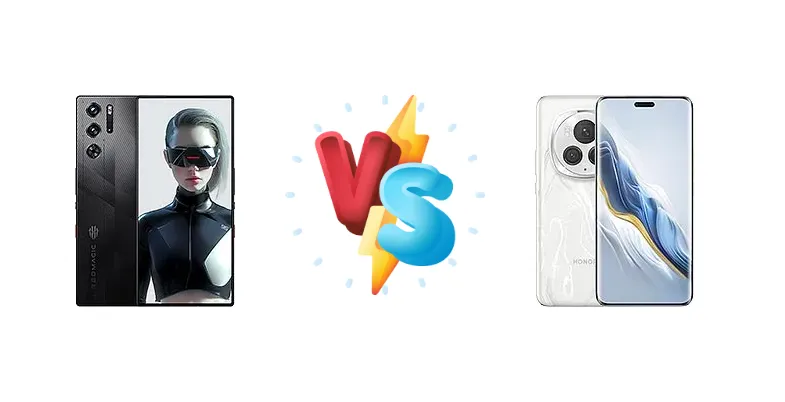
|
🏆 Quick Verdict
For dedicated mobile gamers prioritizing sustained performance and all-day battery life, the ZTE nubia RedMagic 9S Pro is the clear winner. However, users who value a brighter, more vibrant display and the convenience of wireless charging will find the Honor Magic6 Pro a more compelling choice.
| PHONES | ||
|---|---|---|
| Phone Names | ZTE nubia RedMagic 9S Pro | Honor Magic6 Pro |
| Network | ||
|---|---|---|
| 2G bands | GSM 850 / 900 / 1800 / 1900 | GSM 850 / 900 / 1800 / 1900 |
| 3G bands | HSDPA 800 / 850 / 900 / 1700(AWS) / 1900 / 2100 | HSDPA 800 / 850 / 900 / 1700(AWS) / 1900 / 2100 |
| 4G bands | 1, 2, 3, 4, 5, 7, 8, 12, 17, 18, 19, 20, 26, 28, 34, 38, 39, 40, 41, 42, 66 | LTE |
| 5G bands | 1, 3, 5, 6, 7, 8, 20, 28, 38, 41, 65, 77, 78 SA/NSA | SA/NSA |
| Speed | HSPA, LTE, 5G | HSPA, LTE, 5G |
| Technology | GSM / CDMA / HSPA / EVDO / LTE / 5G | GSM / CDMA / HSPA / CDMA2000 / LTE / 5G |
| Launch | ||
|---|---|---|
| Announced | 2024, July 03 | 2024, January 11 |
| Status | Available. Released 2024, July 09 | Available. Released 2024, January 18 |
| Body | ||
|---|---|---|
| Build | Glass front (Gorilla Glass 5), aluminum frame, glass back | Glass front (NanoCrystal Shield), glass back or silicone polymer back (eco leather) |
| Dimensions | 164 x 76.4 x 8.9 mm (6.46 x 3.01 x 0.35 in) | 162.5 x 75.8 x 8.9 mm (6.40 x 2.98 x 0.35 in) |
| SIM | Nano-SIM + Nano-SIM | · Nano-SIM + eSIM· Nano-SIM + Nano-SIM |
| Weight | 229 g (8.08 oz) | 225 g or 229 g (7.94 oz) |
| Display | ||
|---|---|---|
| Protection | Corning Gorilla Glass 5 | NanoCrystal Shield |
| Resolution | 1116 x 2480 pixels, 20:9 ratio (~400 ppi density) | 1280 x 2800 pixels, 19.5:9 ratio (~453 ppi density) |
| Size | 6.8 inches, 111.6 cm2 (~89.1% screen-to-body ratio) | 6.8 inches, 112.8 cm2 (~91.6% screen-to-body ratio) |
| Type | AMOLED, 1B colors, 120Hz, 1600 nits (peak) | LTPO OLED, 1B colors, 120Hz, Dolby Vision, HDR, 1600 nits (HBM), 5000 nits (peak) |
| Platform | ||
|---|---|---|
| CPU | Octa-core (1x3.4 GHz Cortex-X4 & 3x3.2 GHz Cortex-A720 & 2x3.0 GHz Cortex-A720 & 2x2.3 GHz Cortex-A520) | Octa-core (1x3.3 GHz Cortex-X4 & 3x3.2 GHz Cortex-A720 & 2x3.0 GHz Cortex-A720 & 2x2.3 GHz Cortex-A520) |
| Chipset | Qualcomm SM8650-AC Snapdragon 8 Gen 3 (4 nm) | Qualcomm SM8650-AB Snapdragon 8 Gen 3 (4 nm) |
| GPU | Adreno 750 (1 GHz) | Adreno 750 |
| OS | Android 14, Redmagic OS 9.5 | Android 14, up to 4 major Android upgrades, MagicOS 8 |
| Memory | ||
|---|---|---|
| Card slot | No | No |
| Internal | 256GB 12GB RAM, 512GB 12GB RAM, 512GB 16GB RAM | 256GB 12GB RAM, 256GB 16GB RAM, 512GB 12GB RAM, 512GB 16GB RAM, 1TB 16GB RAM |
| Main Camera | ||
|---|---|---|
| Features | LED flash, HDR, panorama | Laser AF, color spectrum sensor, LED flash, HDR, panorama |
| Triple | 50 MP, f/1.9, (wide), 1/1.57", 1.0µm, PDAF, OIS 50 MP, f/2.2, (ultrawide), 1/2.76", 0.64µm Auxiliary lens | 50 MP, f/1.4-2.0, 23mm (wide), 1/1.3", 1.2µm, PDAF, OIS 180 MP, f/2.6, (periscope telephoto), 1/1.49", 0.56µm, PDAF, OIS, 2.5x optical zoom 50 MP, f/2.0, 13mm, 122˚ (ultrawide), 1/2.88", 0.61µm, AF |
| Video | 8K@30fps, 4K@30/60fps, 1080p@30/60/120/240fps | 4K@24/30/60fps, 1080p@30/60/120/240fps, gyro-EIS, OIS, HDR, 10-bit video |
| Selfie camera | ||
|---|---|---|
| Features | HDR | - |
| Single | 16 MP, f/2.0, (wide), 1/2.8", 1.12µm, under display | 50 MP, f/2.0, 22mm (wide), 1/2.93", 0.6µm, AF TOF 3D, (depth/biometrics sensor) |
| Video | 1080p@30/60fps | 4K@30fps, 1080p@30/60fps, gyro-EIS |
| Sound | ||
|---|---|---|
| 35mm jack | Yes | No |
| Loudspeaker | Yes, with stereo speakers | Yes, with stereo speakers |
| Comms | ||
|---|---|---|
| Bluetooth | 5.2, A2DP, LE | 5.3, A2DP, LE, aptX HD |
| Infrared port | Yes | Yes |
| NFC | Yes (market/region dependent) | Yes |
| Positioning | GPS (L1+L5), GLONASS, BDS, GALILEO | GPS (L1+L5), GLONASS, BDS (B1I+B1c+B2a), GALILEO (E1+E5a) |
| Radio | No | No |
| USB | USB Type-C 3.2 Gen 2, OTG, accessory connector, DisplayPort | USB Type-C 3.2, DisplayPort 1.2, OTG |
| WLAN | Wi-Fi 802.11 a/b/g/n/ac/6e/7, tri-band, Wi-Fi Direct | Wi-Fi 802.11 a/b/g/n/ac/6/7, dual-band, Wi-Fi Direct |
| Features | ||
|---|---|---|
| Sensors | Fingerprint (under display, optical), accelerometer, gyro, proximity, compass | Fingerprint (under display, optical), Face ID, accelerometer, gyro, proximity, compass |
| Battery | ||
|---|---|---|
| Charging | 80W wired, PD3.0, 100% in 35 min | 80W wired 66W wireless Reverse wireless 5W reverse wired |
| Type | 6500 mAh | Si/C Li-Ion 5600 mAh |
| Misc | ||
|---|---|---|
| Colors | Design Sleet (Black Version), Snowfall (Silver Version), Cyclone (Transparent Black Version), Frost (White Version) | Black, Green, Blue, Purple, White |
| Models | - | BVL-AN16, BVL-N49 |
| Price | About 700 EUR | € 455.54 / $ 899.00 / £ 598.99 |
ZTE nubia RedMagic 9S Pro
- Exceptional battery life (17:08h active use)
- Slightly faster CPU clock speed
- Active cooling system for sustained performance
- Lower peak display brightness
- Lacks wireless charging
Honor Magic6 Pro
- Significantly brighter display (1578 nits)
- Wireless and reverse wireless charging
- Likely more versatile camera system
- Shorter battery life (14:06h active use)
- Potentially more thermal throttling under sustained load
Display Comparison
The Honor Magic6 Pro boasts a significantly brighter display, reaching a measured 1578 nits compared to the RedMagic 9S Pro’s 1058 nits. This translates to superior visibility in direct sunlight. While both utilize OLED technology, the Magic6 Pro’s higher peak brightness and likely wider color gamut will appeal to users who consume a lot of HDR content. The RedMagic 9S Pro, while still excellent, prioritizes refresh rate and potentially lower latency for gaming, but lacks the sheer visual punch of the Magic6 Pro. We'd need panel specs to determine PWM dimming rates, but this is a critical factor for users sensitive to flicker.
Camera Comparison
Context data doesn't provide camera details, so analysis relies on brand positioning. Honor typically emphasizes camera capabilities, and the Magic6 Pro is likely to feature a more versatile camera system with advanced image processing. The RedMagic 9S Pro, geared towards gaming, likely prioritizes camera functionality less, potentially offering a competent but not class-leading setup. Sensor size and aperture are critical factors; a larger sensor with a wider aperture will perform better in low-light conditions. We expect the Magic6 Pro to offer more advanced features like computational photography and potentially higher video recording capabilities.
Performance
Both devices are powered by the Qualcomm Snapdragon 8 Gen 3 (4nm), but the RedMagic 9S Pro’s CPU configuration features a slightly higher peak clock speed on the prime Cortex-X4 core (3.4 GHz vs 3.3 GHz). While this difference is often marginal in real-world use, it could provide a small edge in CPU-intensive tasks. Both utilize the same core architecture for the A720 and A520 clusters. The RedMagic’s active cooling system is a key differentiator, designed to maintain sustained performance under heavy load, mitigating thermal throttling. The Magic6 Pro likely relies on more conventional passive cooling, potentially leading to performance dips during prolonged gaming sessions. Both devices likely use LPDDR5x RAM, but the speed and configuration (e.g., 12GB vs 16GB) would further refine the performance gap.
Battery Life
The RedMagic 9S Pro delivers a remarkable 17:08 hours of active use, significantly outperforming the Honor Magic6 Pro’s 14:06 hours. This advantage is likely due to a combination of software optimization and a focus on power efficiency. Both support 80W wired charging, achieving a 100% charge in approximately 35 minutes. However, the Magic6 Pro adds 66W wireless charging and reverse wireless charging, offering greater convenience and flexibility. The RedMagic’s longer battery life is a boon for gamers and power users, while the Magic6 Pro’s wireless charging adds a layer of usability.
Buying Guide
Buy the ZTE nubia RedMagic 9S Pro if you need uncompromising gaming performance, exceptional battery life for extended play sessions, and a cooling system designed to prevent throttling. Buy the Honor Magic6 Pro if you prefer a brighter, more color-accurate display for media consumption, the convenience of wireless charging, and a more polished, mainstream smartphone experience.