
ZTE nubia RedMagic 9 Pro vs. Sony Xperia 1 VII: A Deep Dive into Gaming and Cinematic Flagships
| Phones Images | |||||
|---|---|---|---|---|---|
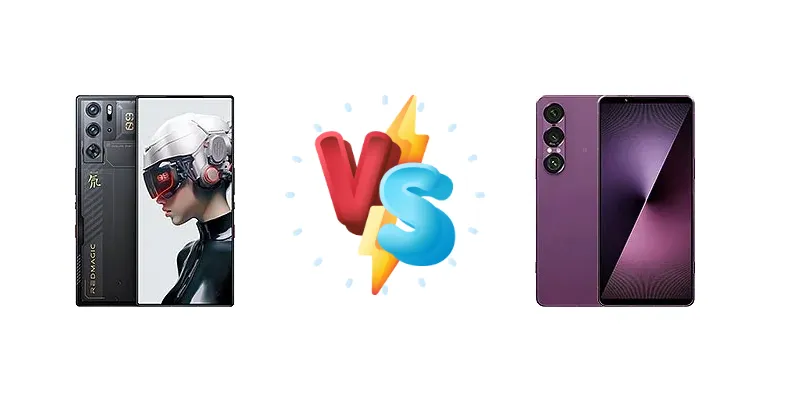
|
🏆 Quick Verdict
For the average user prioritizing all-around performance and longevity, the Sony Xperia 1 VII emerges as the winner. Its significantly superior battery life (43:30h vs 17:38h) and brighter display (1475 nits vs 1016 nits) offer a more consistently enjoyable experience, despite the RedMagic’s gaming focus.
| PHONES | ||
|---|---|---|
| Phone Names | ZTE nubia RedMagic 9 Pro | Sony Xperia 1 VII |
| Network | ||
|---|---|---|
| 2G bands | GSM 850 / 900 / 1800 / 1900 | GSM 850 / 900 / 1800 / 1900 |
| 3G bands | HSDPA 850 / 900 / 1700(AWS) / 1900 / 2100 | HSDPA 800 / 850 / 900 / 1700(AWS) / 1900 / 2100 |
| 4G bands | 1, 2, 3, 4, 5, 7, 8, 12, 17, 18, 19, 20, 26, 28, 34, 38, 39, 40, 41, 42, 66 | 1, 2, 3, 4, 5, 7, 8, 12, 13, 17, 19, 20, 25, 26, 28, 32, 34, 38, 39, 40, 41, 66 - Europe |
| 5G bands | 1, 2, 3, 5, 7, 8, 20, 26, 28, 38, 40, 41, 66, 77, 78 SA/NSA | 1, 3, 5, 7, 8, 20, 28, 38, 40, 41, 75, 77, 78 SA/NSA/Sub6 - Europe |
| Speed | HSPA, LTE, 5G | HSPA, LTE, 5G |
| Technology | GSM / CDMA / HSPA / CDMA2000 / LTE / 5G | GSM / HSPA / LTE / 5G |
| Launch | ||
|---|---|---|
| Announced | 2023, November 23 | 2025, May 13 |
| Status | Available. Released 2023, November 23 | Available. Released 2025, June 04 |
| Body | ||
|---|---|---|
| Build | Glass front (Gorilla Glass 5), aluminum frame, glass back | Glass front (Gorilla Glass Victus 2), glass back (Gorilla Glass Victus), aluminum frame |
| Dimensions | 164 x 76.4 x 8.9 mm (6.46 x 3.01 x 0.35 in) | 162 x 74 x 8.2 mm (6.38 x 2.91 x 0.32 in) |
| SIM | Nano-SIM + Nano-SIM | · Nano-SIM + eSIM· Nano-SIM + Nano-SIM |
| Weight | 229 g (8.08 oz) | 197 g (6.95 oz) |
| Display | ||
|---|---|---|
| Protection | Corning Gorilla Glass 5 | Corning Gorilla Glass Victus 2, Mohs level 5 |
| Resolution | 1116 x 2480 pixels, 20:9 ratio (~400 ppi density) | 1080 x 2340 pixels, 19.5:9 ratio (~396 ppi density) |
| Size | 6.8 inches, 111.6 cm2 (~89.1% screen-to-body ratio) | 6.5 inches, 103.7 cm2 (~86.5% screen-to-body ratio) |
| Type | AMOLED, 1B colors (China only), 120Hz, 1600 nits (peak) | LTPO OLED, 1B colors, 120Hz, HDR BT.2020 |
| Platform | ||
|---|---|---|
| CPU | Octa-core (1x3.3 GHz Cortex-X4 & 3x3.2 GHz Cortex-A720 & 2x3.0 GHz Cortex-A720 & 2x2.3 GHz Cortex-A520) | Octa-core (2x4.32 GHz Oryon V2 Phoenix L + 6x3.53 GHz Oryon V2 Phoenix M) |
| Chipset | Qualcomm SM8650-AB Snapdragon 8 Gen 3 (4 nm) | Qualcomm SM8750-AB Snapdragon 8 Elite (3 nm) |
| GPU | Adreno 750 | Adreno 830 |
| OS | Android 14, Redmagic OS 9 | Android 15, up to 4 major Android upgrades |
| Memory | ||
|---|---|---|
| Card slot | No | microSDXC (uses shared SIM slot) |
| Internal | 256GB 8GB RAM, 256GB 12GB RAM, 512GB 12GB RAM, 512GB 16GB RAM | 256GB 12GB RAM, 512GB 12GB RAM |
| Main Camera | ||
|---|---|---|
| Features | LED flash, HDR, panorama | Zeiss optics, Zeiss T* lens coating, color spectrum sensor, LED flash, panorama, HDR, eye tracking |
| Triple | 50 MP, (wide), 1/1.57", 1.0µm, PDAF, OIS 50 MP, f/2.2, (ultrawide), 1/2.76", 0.64µm 2 MP (macro) | 48 MP, f/1.9, 24mm (wide), 1/1.35", 1.12µm, dual pixel PDAF, OIS 12 MP, f/2.3, 85mm (telephoto), f/3.5, 170mm (telephoto), 1/3.5", 1.0µm, dual pixel PDAF, 3.5x-7.1x continuous optical zoom, OIS, 4cm macro @ 120mm, no AF 48 MP, f/2.0, 16mm (ultrawide), 1/1.56", 1.0µm, PDAF |
| Video | 8K@30fps, 4K@30/60fps, 1080p@30/60/120/240fps | 4K@24/30/60/120fps HDR, 1080p@30/60/120fps; 5-axis gyro-EIS, OIS |
| Selfie camera | ||
|---|---|---|
| Features | HDR | HDR |
| Single | 16 MP, f/2.0, (wide), 1.12µm, under display | 12 MP, f/2.0, 24mm (wide), 1/2.9", 1.22µm |
| Video | 1080p@30/60fps | 4K@30/60fps, 1080p@30/60fps, 5-axis gyro-EIS |
| Sound | ||
|---|---|---|
| 35mm jack | Yes | Yes |
| Loudspeaker | Yes, with stereo speakers | Yes, with stereo speakers |
| Comms | ||
|---|---|---|
| Bluetooth | 5.3, A2DP, LE, aptX HD, aptX Adaptive, aptX Lossless | 6.0, A2DP, LE Audio, aptX HD, aptX Adaptive, aptX Lossless |
| Infrared port | Yes | - |
| NFC | Yes (market/region dependent) | Yes |
| Positioning | GPS (L1+L5), GLONASS, BDS, GALILEO | GPS, GLONASS, BDS, GALILEO, QZSS |
| Radio | No | No |
| USB | USB Type-C 3.2 Gen 2, OTG, accessory connector, DisplayPort | USB Type-C 3.2, OTG, video output |
| WLAN | Wi-Fi 802.11 a/b/g/n/ac/6e/7, tri-band, Wi-Fi Direct | Wi-Fi 802.11 a/b/g/n/ac/6e/7, tri-band, Wi-Fi Direct, DLNA |
| Features | ||
|---|---|---|
| Sensors | Fingerprint (under display, optical), accelerometer, gyro, proximity, compass | Fingerprint (side-mounted), accelerometer, gyro, proximity, barometer, compass |
| Battery | ||
|---|---|---|
| Charging | 80W wired, PD3.0, 100% in 35 min | 30W wired, PD3.0, PPS, 50% in 30 min 15W wireless Reverse wireless |
| Type | 6500 mAh | 5000 mAh |
| Misc | ||
|---|---|---|
| Colors | Sleet (Black), Snowfall (Silver), Cyclone (Transparent Black) | Moss Green, Orchid Purple, Slate Black |
| Models | NX769J | XQ-FS54, XQFS54EUKCG.GC, XQFS54EUKCV.GC, XQFS54EUKCB.GC, PDX256 |
| Price | About 850 EUR | € 1,338.99 / $ 1,394.99 / £ 1,149.94 |
| EU LABEL | ||
|---|---|---|
| Battery | - | 43:30h endurance, 1400 cycles |
| Energy | - | Class B |
| Free fall | - | Class B (181 falls) |
| Repairability | - | Class D |
ZTE nubia RedMagic 9 Pro
- Superior gaming performance due to Snapdragon 8 Gen 3
- Faster wired charging (80W)
- Likely features dedicated gaming triggers and cooling systems
- Significantly shorter battery life
- Lower peak display brightness
- Camera likely not a primary focus
Sony Xperia 1 VII
- Exceptional battery life (43:30h endurance)
- Brighter display (1475 nits)
- More efficient Snapdragon 8 Elite chipset
- Slower wired charging (30W)
- Higher price point (likely)
- Gaming performance not optimized to the same degree as RedMagic
Display Comparison
The Sony Xperia 1 VII boasts a brighter display, reaching 1475 nits compared to the RedMagic 9 Pro’s 1016 nits, making it more visible outdoors. While both utilize advanced panel technology, the Xperia’s likely employs a more color-accurate calibration geared towards content creation. The RedMagic, however, will likely prioritize a higher refresh rate for smoother gaming, though this isn’t specified in the data. Bezels are a key differentiator, with Sony historically focusing on minimal bezels for a more immersive experience, while the RedMagic may prioritize cooling solutions that necessitate slightly larger frames.
Camera Comparison
The provided data lacks specific camera details, but Sony’s Xperia line is renowned for its image processing and commitment to photographic fidelity. We can expect the Xperia 1 VII to prioritize natural color reproduction and dynamic range, catering to professional photographers. The RedMagic 9 Pro, while capable of taking photos and videos, likely focuses on computational photography features geared towards social media sharing rather than professional-grade results. Sensor size and lens apertures will be critical differentiators, with Sony likely employing a larger sensor for superior low-light performance. The absence of details on the RedMagic’s camera suggests it’s not a primary selling point.
Performance
The Xperia 1 VII’s Qualcomm SM8750-AB Snapdragon 8 Elite, built on a 3nm process, represents a significant architectural leap over the RedMagic 9 Pro’s 4nm Snapdragon 8 Gen 3. The Oryon V2 Phoenix cores in the Xperia promise superior single-core performance (4.32 GHz) compared to the RedMagic’s Cortex-X4 (3.3 GHz), impacting responsiveness in everyday tasks. While the RedMagic’s chipset is still incredibly powerful, the Xperia’s more efficient 3nm node translates to better thermal management and sustained performance during demanding workloads. The RedMagic’s focus is on maximizing GPU output for gaming, potentially at the expense of overall system efficiency.
Battery Life
The Sony Xperia 1 VII’s endurance score of 43:30h is a standout feature, dwarfing the RedMagic 9 Pro’s 17:38h. This difference is likely due to a combination of the more efficient Snapdragon 8 Elite chipset and optimized software. While the RedMagic offers faster wired charging at 80W (100% in 35 min), the Xperia’s 30W charging (50% in 30 min) is adequate given its significantly larger battery capacity and longer lifespan (1400 cycles). The Xperia 1 VII also adds the convenience of 15W wireless and reverse wireless charging, features absent on the RedMagic.
Buying Guide
Buy the ZTE nubia RedMagic 9 Pro if you are a dedicated mobile gamer who demands the highest frame rates, active cooling, and specialized gaming features. Buy the Sony Xperia 1 VII if you are a content creator, photography enthusiast, or simply value exceptional battery life, a stunning display, and a refined, premium smartphone experience.