
ZTE nubia RedMagic 9 Pro vs. OnePlus 12R: A Deep Dive into Gaming and All-Day Use
| Phones Images | |||||
|---|---|---|---|---|---|
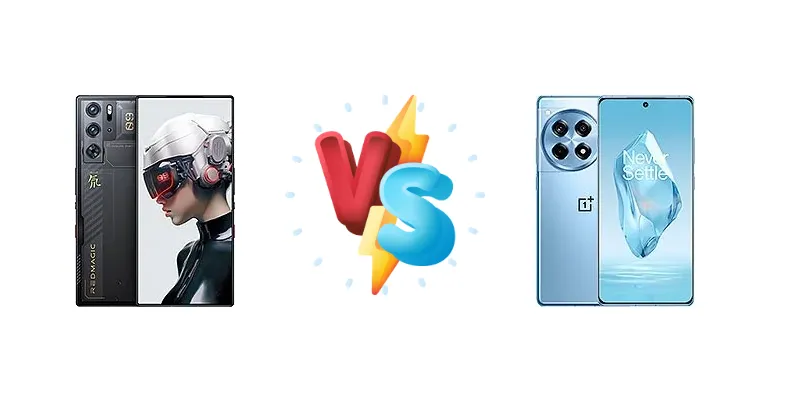
|
🏆 Quick Verdict
For dedicated mobile gamers, the ZTE nubia RedMagic 9 Pro is the clear winner, thanks to its Snapdragon 8 Gen 3 chipset and focus on sustained performance. However, the OnePlus 12R provides a more versatile experience with a brighter display and faster charging, making it the better choice for everyday users who occasionally game.
| PHONES | ||
|---|---|---|
| Phone Names | ZTE nubia RedMagic 9 Pro | OnePlus 12R |
| Network | ||
|---|---|---|
| 2G bands | GSM 850 / 900 / 1800 / 1900 | GSM 850 / 900 / 1800 / 1900 |
| 3G bands | HSDPA 850 / 900 / 1700(AWS) / 1900 / 2100 | HSDPA 850 / 900 / 1700(AWS) / 1900 / 2100 |
| 4G bands | 1, 2, 3, 4, 5, 7, 8, 12, 17, 18, 19, 20, 26, 28, 34, 38, 39, 40, 41, 42, 66 | 1, 2, 3, 4, 5, 7, 8, 12, 17, 18, 19, 20, 26, 28, 32, 38, 39, 40, 41, 66 |
| 5G bands | 1, 2, 3, 5, 7, 8, 20, 26, 28, 38, 40, 41, 66, 77, 78 SA/NSA | 1, 2, 3, 5, 7, 8, 12, 20, 28, 38, 40, 41, 66, 77, 78 SA/NSA |
| Speed | HSPA, LTE, 5G | HSPA, LTE, 5G |
| Technology | GSM / CDMA / HSPA / CDMA2000 / LTE / 5G | GSM / CDMA / HSPA / LTE / 5G |
| Launch | ||
|---|---|---|
| Announced | 2023, November 23 | 2024, January 23 |
| Status | Available. Released 2023, November 23 | Available. Released 2024, February 06 |
| Body | ||
|---|---|---|
| Build | Glass front (Gorilla Glass 5), aluminum frame, glass back | Glass front (Gorilla Glass Victus 2), aluminum frame, glass back |
| Dimensions | 164 x 76.4 x 8.9 mm (6.46 x 3.01 x 0.35 in) | 163.3 x 75.3 x 8.8 mm (6.43 x 2.96 x 0.35 in) |
| SIM | Nano-SIM + Nano-SIM | · Nano-SIM + Nano-SIM + eSIM (max 2 at a time)· Nano-SIM + Nano-SIM |
| Weight | 229 g (8.08 oz) | 207 g (7.30 oz) |
| Display | ||
|---|---|---|
| Protection | Corning Gorilla Glass 5 | Corning Gorilla Glass Victus 2 |
| Resolution | 1116 x 2480 pixels, 20:9 ratio (~400 ppi density) | 1264 x 2780 pixels (~450 ppi density) |
| Size | 6.8 inches, 111.6 cm2 (~89.1% screen-to-body ratio) | 6.78 inches, 111.7 cm2 (~90.9% screen-to-body ratio) |
| Type | AMOLED, 1B colors (China only), 120Hz, 1600 nits (peak) | LTPO4 AMOLED, 1B colors, 120Hz, HDR10+, Dolby Vision, 1600 nits (HBM), 4500 nits (peak) |
| Platform | ||
|---|---|---|
| CPU | Octa-core (1x3.3 GHz Cortex-X4 & 3x3.2 GHz Cortex-A720 & 2x3.0 GHz Cortex-A720 & 2x2.3 GHz Cortex-A520) | Octa-core (1x3.2 GHz Cortex-X3 & 2x2.8 GHz Cortex-A715 & 2x2.8 GHz Cortex-A710 & 3x2.0 GHz Cortex-A510) |
| Chipset | Qualcomm SM8650-AB Snapdragon 8 Gen 3 (4 nm) | Qualcomm SM8550-AB Snapdragon 8 Gen 2 (4 nm) |
| GPU | Adreno 750 | Adreno 740 |
| OS | Android 14, Redmagic OS 9 | Android 14, up to 3 major Android upgrades, OxygenOS 15 |
| Memory | ||
|---|---|---|
| Card slot | No | No |
| Internal | 256GB 8GB RAM, 256GB 12GB RAM, 512GB 12GB RAM, 512GB 16GB RAM | 128GB 8GB RAM, 256GB 8GB RAM, 256GB 12GB RAM, 256GB 16GB RAM |
| Main Camera | ||
|---|---|---|
| Features | LED flash, HDR, panorama | Laser AF, color spectrum sensor, LED flash, HDR, panorama |
| Triple | 50 MP, (wide), 1/1.57", 1.0µm, PDAF, OIS 50 MP, f/2.2, (ultrawide), 1/2.76", 0.64µm 2 MP (macro) | 50 MP, f/1.8, 24mm (wide), 1/1.56", 1.0µm, multi-directional PDAF, OIS 8 MP, f/2.2, 16mm, 112˚ (ultrawide), 1/4.0", 1.12µm 2 MP (macro) |
| Video | 8K@30fps, 4K@30/60fps, 1080p@30/60/120/240fps | 4K@30/60fps, 1080p@30/60/120/240fps, gyro-EIS, OIS |
| Selfie camera | ||
|---|---|---|
| Features | HDR | HDR, panorama |
| Single | 16 MP, f/2.0, (wide), 1.12µm, under display | 16 MP, f/2.4, 26mm (wide), 1/3", 1.0µm |
| Video | 1080p@30/60fps | 1080p@30fps, gyro-EIS |
| Sound | ||
|---|---|---|
| 35mm jack | Yes | No |
| Loudspeaker | Yes, with stereo speakers | Yes, with stereo speakers |
| Comms | ||
|---|---|---|
| Bluetooth | 5.3, A2DP, LE, aptX HD, aptX Adaptive, aptX Lossless | 5.3, A2DP, LE, aptX HD |
| Infrared port | Yes | Yes |
| NFC | Yes (market/region dependent) | Yes |
| Positioning | GPS (L1+L5), GLONASS, BDS, GALILEO | GPS, GALILEO, GLONASS, BDS, QZSS |
| Radio | No | No |
| USB | USB Type-C 3.2 Gen 2, OTG, accessory connector, DisplayPort | USB Type-C 2.0 |
| WLAN | Wi-Fi 802.11 a/b/g/n/ac/6e/7, tri-band, Wi-Fi Direct | Wi-Fi 802.11 a/b/g/n/ac/6/7, dual-band |
| Features | ||
|---|---|---|
| Sensors | Fingerprint (under display, optical), accelerometer, gyro, proximity, compass | Fingerprint (under display, optical), accelerometer, gyro, proximity, compass |
| Battery | ||
|---|---|---|
| Charging | 80W wired, PD3.0, 100% in 35 min | 100W wired, 100% in 26 min |
| Type | 6500 mAh | Li-Ion 5500 mAh |
| Misc | ||
|---|---|---|
| Colors | Sleet (Black), Snowfall (Silver), Cyclone (Transparent Black) | Iron Gray, Cool Blue, Electric Violet, Sunset Dune |
| Models | NX769J | CPH2609, CPH2585, CPH2611 |
| Price | About 850 EUR | € 410.84 / $ 399.95 / £ 649.00 |
| SAR | - | 1.19 W/kg (head) 0.82 W/kg (body) |
ZTE nubia RedMagic 9 Pro
- Superior gaming performance with Snapdragon 8 Gen 3
- Longer battery life in active use
- Potentially more advanced cooling system
- Lower peak display brightness
- Slower charging speed
OnePlus 12R
- Brighter display for better outdoor visibility
- Faster 100W charging
- More balanced feature set for everyday use
- Less powerful Snapdragon 8 Gen 2 chipset
- Shorter battery life in active use
Display Comparison
The OnePlus 12R boasts a brighter display, reaching 1181 nits measured, compared to the RedMagic 9 Pro’s 1016 nits. This difference is immediately noticeable in direct sunlight. While both utilize high refresh rate panels, the RedMagic 9 Pro’s display technology isn’t specified, suggesting it may lack the LTPO adaptive refresh rate found in many OnePlus devices, potentially impacting power consumption. The OnePlus 12R’s larger display size (assumed, based on market positioning) also contributes to a more immersive viewing experience.
Camera Comparison
The provided data doesn’t offer sufficient detail for a comprehensive camera comparison. Both phones are expected to offer capable camera systems, but the RedMagic 9 Pro’s focus on gaming likely means less emphasis on camera hardware. The OnePlus 12R, following OnePlus’s tradition, is expected to prioritize camera quality with features like OIS and advanced image processing. Without sensor size or aperture information, it’s difficult to make a definitive judgment, but the OnePlus 12R is likely to offer a more refined and versatile camera experience.
Performance
The core difference lies in the chipsets: the RedMagic 9 Pro features the Snapdragon 8 Gen 3 (4nm), while the OnePlus 12R utilizes the Snapdragon 8 Gen 2 (4nm). The Gen 3’s Cortex-X4 prime core, clocked at 3.3 GHz, represents a significant architectural upgrade over the Gen 2’s Cortex-X3 (3.2 GHz), promising improved single-core performance. The RedMagic 9 Pro’s CPU configuration, with its mix of Cortex-A720 and A520 cores, is optimized for sustained workloads, crucial for extended gaming sessions. While the OnePlus 12R’s Gen 2 is still incredibly capable, the RedMagic 9 Pro will deliver superior performance in demanding tasks. The RedMagic 9 Pro’s cooling system (not specified in data, but a key feature) is critical to maintaining peak performance under load, mitigating potential throttling.
Battery Life
The RedMagic 9 Pro achieves an impressive 17:38h of active use, despite its focus on a power-hungry chipset. This suggests efficient software optimization and potentially a larger battery capacity (not specified). The OnePlus 12R, with 14:32h of active use, still provides excellent battery life, but falls short of the RedMagic 9 Pro. However, the OnePlus 12R compensates with significantly faster 100W wired charging, achieving a full charge in just 26 minutes, compared to the RedMagic 9 Pro’s 35 minutes with 80W charging. This faster charging is a significant convenience factor for users who prioritize quick top-ups.
Buying Guide
Buy the ZTE nubia RedMagic 9 Pro if you prioritize maximum gaming performance, need the latest Snapdragon processor, and value features like active cooling. Buy the OnePlus 12R if you want a well-rounded flagship experience with excellent battery life, a vibrant display, and incredibly fast 100W charging, all without the gaming-centric design elements.