
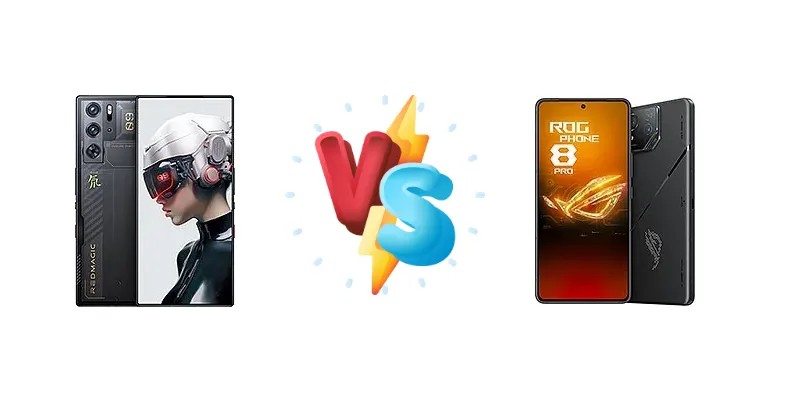
ZTE RedMagic 9 Pro vs. Asus ROG Phone 8 Pro: The Ultimate Gaming Phone Showdown
| Phones Images | |||||
|---|---|---|---|---|---|
|
🏆 Quick Verdict
For the dedicated gamer prioritizing uninterrupted playtime, the ZTE nubia RedMagic 9 Pro emerges as the winner. Its exceptional 17:38 active use battery life significantly outpaces the ROG Phone 8 Pro’s 14:43, making it ideal for extended gaming sessions. However, the ROG Phone 8 Pro’s brighter display is a compelling alternative for those valuing visual fidelity.
| PHONES | ||
|---|---|---|
| Phone Names | ZTE nubia RedMagic 9 Pro | Asus ROG Phone 8 Pro |
| Network | ||
|---|---|---|
| 2G bands | GSM 850 / 900 / 1800 / 1900 | GSM 850 / 900 / 1800 / 1900 |
| 3G bands | HSDPA 850 / 900 / 1700(AWS) / 1900 / 2100 | HSDPA 850 / 900 / 1700(AWS) / 1800 / 1900 / 2100 - International |
| 4G bands | 1, 2, 3, 4, 5, 7, 8, 12, 17, 18, 19, 20, 26, 28, 34, 38, 39, 40, 41, 42, 66 | 1, 2, 3, 4, 5, 7, 8, 12, 17, 18, 19, 20, 25, 26, 28, 32, 34, 38, 39, 40, 41, 42, 43, 48, 66 - International |
| 5G bands | 1, 2, 3, 5, 7, 8, 20, 26, 28, 38, 40, 41, 66, 77, 78 SA/NSA | 1, 2, 3, 5, 7, 8, 12, 18, 20, 25, 26, 28, 38, 40, 41, 48, 66, 77, 78, 79 SA/NSA/Sub6 - International |
| Speed | HSPA, LTE, 5G | HSPA, LTE (Up to 7CA), 5G |
| Technology | GSM / CDMA / HSPA / CDMA2000 / LTE / 5G | GSM / CDMA / HSPA / LTE / 5G |
| Launch | ||
|---|---|---|
| Announced | 2023, November 23 | 2024, January 08 |
| Status | Available. Released 2023, November 23 | Available. Released 2024, January 18 |
| Body | ||
|---|---|---|
| Build | Glass front (Gorilla Glass 5), aluminum frame, glass back | Glass front (Gorilla Glass Victus 2), glass back (Gorilla Glass), aluminum frame |
| Dimensions | 164 x 76.4 x 8.9 mm (6.46 x 3.01 x 0.35 in) | 163.8 x 76.8 x 8.9 mm (6.45 x 3.02 x 0.35 in) |
| SIM | Nano-SIM + Nano-SIM | Nano-SIM + Nano-SIM |
| Weight | 229 g (8.08 oz) | 225 g (7.94 oz) |
| Display | ||
|---|---|---|
| Protection | Corning Gorilla Glass 5 | Corning Gorilla Glass Victus 2 |
| Resolution | 1116 x 2480 pixels, 20:9 ratio (~400 ppi density) | 1080 x 2400 pixels, 20:9 ratio (~388 ppi density) |
| Size | 6.8 inches, 111.6 cm2 (~89.1% screen-to-body ratio) | 6.78 inches, 111.0 cm2 (~88.2% screen-to-body ratio) |
| Type | AMOLED, 1B colors (China only), 120Hz, 1600 nits (peak) | LTPO AMOLED, 1B colors, 165Hz, HDR10, 1600 nits (HBM), 2500 nits (peak) |
| Platform | ||
|---|---|---|
| CPU | Octa-core (1x3.3 GHz Cortex-X4 & 3x3.2 GHz Cortex-A720 & 2x3.0 GHz Cortex-A720 & 2x2.3 GHz Cortex-A520) | Octa-core (1x3.3 GHz Cortex-X4 & 3x3.2 GHz Cortex-A720 & 2x3.0 GHz Cortex-A720 & 2x2.3 GHz Cortex-A520) |
| Chipset | Qualcomm SM8650-AB Snapdragon 8 Gen 3 (4 nm) | Qualcomm SM8650-AB Snapdragon 8 Gen 3 (4 nm) |
| GPU | Adreno 750 | Adreno 750 |
| OS | Android 14, Redmagic OS 9 | Android 14, up to 2 major Android upgrades |
| Memory | ||
|---|---|---|
| Card slot | No | No |
| Internal | 256GB 8GB RAM, 256GB 12GB RAM, 512GB 12GB RAM, 512GB 16GB RAM | 512GB 16GB RAM, 1TB 24GB RAM |
| Main Camera | ||
|---|---|---|
| Features | LED flash, HDR, panorama | LED flash, HDR, panorama |
| Triple | 50 MP, (wide), 1/1.57", 1.0µm, PDAF, OIS 50 MP, f/2.2, (ultrawide), 1/2.76", 0.64µm 2 MP (macro) | 50 MP, f/1.9, 24mm (wide), 1/1.56", 1.0µm, PDAF, gimbal OIS 32 MP, f/2.4, (telephoto), 1/3.2", 0.7µm, PDAF, OIS, 3x optical zoom 13 MP, f/2.2, 13mm, 120˚ (ultrawide) |
| Video | 8K@30fps, 4K@30/60fps, 1080p@30/60/120/240fps | 8K@24fps, 4K@30/60fps, 1080p@30/60/120/240fps, 720p@480fps; gyro-EIS, HDR10+ |
| Selfie camera | ||
|---|---|---|
| Features | HDR | Panorama, HDR |
| Single | 16 MP, f/2.0, (wide), 1.12µm, under display | 32 MP, f/2.5, 22mm (wide), 1/3.2", 0.7µm |
| Video | 1080p@30/60fps | 1080p@30fps |
| Sound | ||
|---|---|---|
| 35mm jack | Yes | Yes |
| Loudspeaker | Yes, with stereo speakers | Yes, with stereo speakers |
| Comms | ||
|---|---|---|
| Bluetooth | 5.3, A2DP, LE, aptX HD, aptX Adaptive, aptX Lossless | 5.4, A2DP, LE, aptX HD, aptX Adaptive, aptX Lossless |
| Infrared port | Yes | - |
| NFC | Yes (market/region dependent) | Yes |
| Positioning | GPS (L1+L5), GLONASS, BDS, GALILEO | GPS (L1+L5), BDS (B1I+B1c+B2a), GALILEO (E1+E5a), QZSS (L1+L5), NavIC (L5), GLONASS |
| Radio | No | No |
| USB | USB Type-C 3.2 Gen 2, OTG, accessory connector, DisplayPort | USB Type-C (side), DisplayPort 1.4; USB Type-C (bottom), OTG |
| WLAN | Wi-Fi 802.11 a/b/g/n/ac/6e/7, tri-band, Wi-Fi Direct | Wi-Fi 802.11 a/b/g/n/ac/6e/7, tri-band, Wi-Fi Direct |
| Features | ||
|---|---|---|
| Sensors | Fingerprint (under display, optical), accelerometer, gyro, proximity, compass | Fingerprint (under display, optical), accelerometer, gyro, proximity, compass |
| Battery | ||
|---|---|---|
| Charging | 80W wired, PD3.0, 100% in 35 min | 65W wired, PD3.0, PPS, QC5, 100% in 39 min - International 30W wired, PD3.0, PPS - India 15W wireless (Qi) 10W reverse wired |
| Type | 6500 mAh | 5500 mAh |
| Misc | ||
|---|---|---|
| Colors | Sleet (Black), Snowfall (Silver), Cyclone (Transparent Black) | Phantom Black |
| Models | NX769J | AI2401, AI2401_A, AI2401_D |
| Price | About 850 EUR | $ 1,157.98 / £ 1,693.75 / € 632.66 |
ZTE nubia RedMagic 9 Pro
- Exceptional battery life (17:38h active use)
- Faster wired charging (80W)
- Potentially superior sustained performance due to cooling focus
- Lower peak display brightness (1016 nits)
- Lacks wireless charging
Asus ROG Phone 8 Pro
- Significantly brighter display (1765 nits)
- Wireless charging and reverse wired charging
- Potentially more versatile camera system
- Shorter battery life (14:43h active use)
- Slower wired charging (65W/30W)
- Regional charging differences (India)
Display Comparison
The Asus ROG Phone 8 Pro boasts a significantly brighter display, reaching a measured 1765 nits compared to the RedMagic 9 Pro’s 1016 nits. This translates to superior visibility in direct sunlight and a more impactful HDR experience. While both utilize high refresh rate panels, the ROG Phone’s brightness advantage is a clear win for outdoor use and media consumption. The RedMagic 9 Pro, however, may offer a different panel technology optimized for lower blue light emission, a detail not specified in the provided data but common in gaming phones targeting eye comfort during prolonged use.
Camera Comparison
Both phones feature capable photo and video capabilities, but the provided data offers limited insight into specific camera hardware. Without sensor size, aperture, or OIS details, a direct comparison is difficult. However, given Asus’s broader smartphone portfolio, the ROG Phone 8 Pro likely benefits from more sophisticated image processing algorithms and a more versatile camera system. The RedMagic 9 Pro, while capable, typically prioritizes gaming features over camera prowess. The inclusion of a 2MP macro camera on either device is largely inconsequential, offering minimal benefit over the main sensor.
Performance
Both devices are equipped with the Qualcomm Snapdragon 8 Gen 3 (4nm), featuring the same CPU core configuration: 1x3.3 GHz Cortex-X4, 3x3.2 GHz Cortex-A720, 2x3.0 GHz Cortex-A720, and 2x2.3 GHz Cortex-A520. Performance will be largely identical in CPU-bound tasks. The key differentiator lies in thermal management. The RedMagic 9 Pro’s design, often incorporating advanced cooling solutions (not detailed in the provided data, but a brand hallmark), is likely tuned for sustained peak performance during extended gaming. The ROG Phone 8 Pro, while also featuring robust cooling, may prioritize a balance between performance and thermal comfort. Both utilize LPDDR5x RAM, ensuring fast memory access for demanding games.
Battery Life
The ZTE nubia RedMagic 9 Pro delivers a substantial advantage in battery life, achieving 17:38 hours of active use compared to the Asus ROG Phone 8 Pro’s 14:43 hours. This nearly 3-hour difference is significant for gamers who frequently play on the go. While the ROG Phone 8 Pro offers wireless charging (15W Qi) and reverse wired charging (10W), features absent on the RedMagic 9 Pro, the faster 80W wired charging (RedMagic) versus 65W (ROG - International, 30W India) partially offsets the smaller battery capacity. The RedMagic 9 Pro reaches 100% charge in 35 minutes, while the ROG Phone 8 Pro takes 39 minutes (International) or longer (India).
Buying Guide
Buy the ZTE nubia RedMagic 9 Pro if you need uncompromising battery life for long gaming sessions, prioritize sustained performance over all else, and appreciate a more aggressive, gamer-centric design. Buy the Asus ROG Phone 8 Pro if you prefer a more refined aesthetic, demand the brightest possible display for vibrant visuals, and value features like wireless charging and a broader ecosystem of accessories.