
ZTE nubia RedMagic 9 Pro vs. Apple iPhone 15 Pro Max: A Deep Dive into Gaming and Ecosystems
| Phones Images | |||||
|---|---|---|---|---|---|
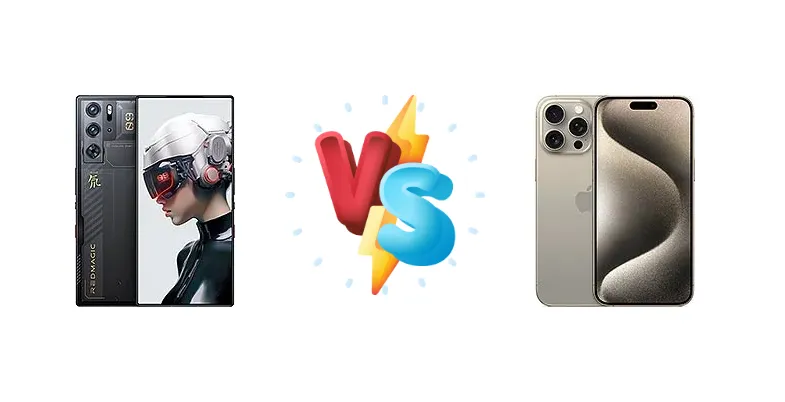
|
🏆 Quick Verdict
For the average user, the Apple iPhone 15 Pro Max is the more well-rounded device, offering a superior camera experience, a refined operating system, and long-term software support. However, gamers and power users will find the RedMagic 9 Pro’s raw performance and exceptional battery life to be compelling advantages.
| PHONES | ||
|---|---|---|
| Phone Names | ZTE nubia RedMagic 9 Pro | Apple iPhone 15 Pro Max |
| Network | ||
|---|---|---|
| 2G bands | GSM 850 / 900 / 1800 / 1900 | GSM 850 / 900 / 1800 / 1900 |
| 3G bands | HSDPA 850 / 900 / 1700(AWS) / 1900 / 2100 | HSDPA 850 / 900 / 1700(AWS) / 1900 / 2100 |
| 4G bands | 1, 2, 3, 4, 5, 7, 8, 12, 17, 18, 19, 20, 26, 28, 34, 38, 39, 40, 41, 42, 66 | 1, 2, 3, 4, 5, 7, 8, 12, 13, 17, 18, 19, 20, 25, 26, 28, 30, 32, 34, 38, 39, 40, 41, 42, 46, 48, 53, 66 - A3106 |
| 5G bands | 1, 2, 3, 5, 7, 8, 20, 26, 28, 38, 40, 41, 66, 77, 78 SA/NSA | 1, 2, 3, 5, 7, 8, 12, 20, 25, 26, 28, 30, 38, 40, 41, 48, 53, 66, 70, 77, 78, 79 SA/NSA/Sub6 - A3106 |
| Speed | HSPA, LTE, 5G | HSPA, LTE, 5G, EV-DO Rev.A 3.1 Mbps |
| Technology | GSM / CDMA / HSPA / CDMA2000 / LTE / 5G | GSM / CDMA / HSPA / EVDO / LTE / 5G |
| Launch | ||
|---|---|---|
| Announced | 2023, November 23 | 2023, September 12 |
| Status | Available. Released 2023, November 23 | Available. Released 2023, September 22 |
| Body | ||
|---|---|---|
| Build | Glass front (Gorilla Glass 5), aluminum frame, glass back | Glass front, glass back, titanium frame (grade 5) |
| Dimensions | 164 x 76.4 x 8.9 mm (6.46 x 3.01 x 0.35 in) | 159.9 x 76.7 x 8.3 mm (6.30 x 3.02 x 0.33 in) |
| SIM | Nano-SIM + Nano-SIM | · Nano-SIM + eSIM + eSIM (max 2 at a time; International)· eSIM + eSIM (8 or more, max 2 at a time; USA)· Nano-SIM + Nano-SIM (China) |
| Weight | 229 g (8.08 oz) | 221 g (7.80 oz) |
| Display | ||
|---|---|---|
| Protection | Corning Gorilla Glass 5 | Ceramic Shield glass |
| Resolution | 1116 x 2480 pixels, 20:9 ratio (~400 ppi density) | 1290 x 2796 pixels, 19.5:9 ratio (~460 ppi density) |
| Size | 6.8 inches, 111.6 cm2 (~89.1% screen-to-body ratio) | 6.7 inches, 110.2 cm2 (~89.8% screen-to-body ratio) |
| Type | AMOLED, 1B colors (China only), 120Hz, 1600 nits (peak) | LTPO Super Retina XDR OLED, 120Hz, HDR10, Dolby Vision, 1000 nits (typ), 2000 nits (HBM) |
| Platform | ||
|---|---|---|
| CPU | Octa-core (1x3.3 GHz Cortex-X4 & 3x3.2 GHz Cortex-A720 & 2x3.0 GHz Cortex-A720 & 2x2.3 GHz Cortex-A520) | Hexa-core (2x3.78 GHz + 4x2.11 GHz) |
| Chipset | Qualcomm SM8650-AB Snapdragon 8 Gen 3 (4 nm) | Apple A17 Pro (3 nm) |
| GPU | Adreno 750 | Apple GPU (6-core graphics) |
| OS | Android 14, Redmagic OS 9 | iOS 17, upgradable to iOS 26.1 |
| Memory | ||
|---|---|---|
| Card slot | No | No |
| Internal | 256GB 8GB RAM, 256GB 12GB RAM, 512GB 12GB RAM, 512GB 16GB RAM | 256GB 8GB RAM, 512GB 8GB RAM, 1TB 8GB RAM |
| Main Camera | ||
|---|---|---|
| Features | LED flash, HDR, panorama | Dual-LED dual-tone flash, HDR (photo/panorama) |
| Triple | 50 MP, (wide), 1/1.57", 1.0µm, PDAF, OIS 50 MP, f/2.2, (ultrawide), 1/2.76", 0.64µm 2 MP (macro) | 48 MP, f/1.8, 24mm (wide), 1/1.28", 1.22µm, dual pixel PDAF, sensor-shift OIS 12 MP, f/2.8, 120mm (periscope telephoto), 1/3.06", 1.12µm, dual pixel PDAF, 3D sensor‑shift OIS, 5x optical zoom 12 MP, f/2.2, 13mm, 120˚ (ultrawide), 1/2.55", 1.4µm, dual pixel PDAF TOF 3D LiDAR scanner (depth) |
| Video | 8K@30fps, 4K@30/60fps, 1080p@30/60/120/240fps | 4K@24/25/30/60fps, 1080p@25/30/60/120/240fps, 10-bit HDR, Dolby Vision HDR (up to 60fps), ProRes, 3D (spatial) video, stereo sound rec. |
| Selfie camera | ||
|---|---|---|
| Features | HDR | HDR, Dolby Vision HDR |
| Single | 16 MP, f/2.0, (wide), 1.12µm, under display | 12 MP, f/1.9, 23mm (wide), 1/3.6", 1.0µm, PDAF, OIS SL 3D, (depth/biometrics sensor) |
| Video | 1080p@30/60fps | 4K@24/25/30/60fps, 1080p@25/30/60/120fps, gyro-EIS |
| Sound | ||
|---|---|---|
| 35mm jack | Yes | No |
| Loudspeaker | Yes, with stereo speakers | Yes, with stereo speakers |
| Comms | ||
|---|---|---|
| Bluetooth | 5.3, A2DP, LE, aptX HD, aptX Adaptive, aptX Lossless | 5.3, A2DP, LE |
| Infrared port | Yes | - |
| NFC | Yes (market/region dependent) | Yes |
| Positioning | GPS (L1+L5), GLONASS, BDS, GALILEO | GPS (L1+L5), GLONASS, GALILEO, BDS, QZSS, NavIC |
| Radio | No | No |
| USB | USB Type-C 3.2 Gen 2, OTG, accessory connector, DisplayPort | USB Type-C 3.2 Gen 2, DisplayPort |
| WLAN | Wi-Fi 802.11 a/b/g/n/ac/6e/7, tri-band, Wi-Fi Direct | Wi-Fi 802.11 a/b/g/n/ac/6e, tri-band, hotspot |
| Features | ||
|---|---|---|
| Sensors | Fingerprint (under display, optical), accelerometer, gyro, proximity, compass | Face ID, accelerometer, gyro, proximity, compass, barometer |
| Battery | ||
|---|---|---|
| Charging | 80W wired, PD3.0, 100% in 35 min | Wired, PD2.0, 50% in 30 min 15W wireless (MagSafe) 15W wireless (Qi2) - requires iOS 17.2 update 4.5W reverse wired |
| Type | 6500 mAh | Li-Ion 4441 mAh |
| Misc | ||
|---|---|---|
| Colors | Sleet (Black), Snowfall (Silver), Cyclone (Transparent Black) | Black Titanium, White Titanium, Blue Titanium, Natural Titanium |
| Models | NX769J | A2849, A3105, A3106, A3108, iPhone16,2 |
| Price | About 850 EUR | € 758.79 / $ 579.87 / £ 628.29 |
| SAR | - | 1.07 W/kg (head) 1.11 W/kg (body) |
| SAR EU | - | 0.98 W/kg (head) 0.98 W/kg (body) |
ZTE nubia RedMagic 9 Pro
- Exceptional battery life (17:38h active use)
- Faster 80W wired charging
- Optimized for mobile gaming with potential high refresh rate display
- Camera likely inferior to iPhone 15 Pro Max
- Software support may be less extensive than Apple
Apple iPhone 15 Pro Max
- Superior camera quality and video recording
- Seamless ecosystem integration with other Apple devices
- Brighter display (1787 nits)
- Slower charging speeds
- Slightly shorter battery life (16:01h active use)
Display Comparison
The iPhone 15 Pro Max boasts a significantly brighter display, reaching 1787 nits compared to the RedMagic 9 Pro’s 1016 nits. This translates to superior visibility in direct sunlight. While both offer excellent color accuracy, the RedMagic 9 Pro’s focus on gaming likely incorporates a higher refresh rate (not specified in the data, but a standard feature for gaming phones) for smoother visuals. The iPhone’s ProMotion technology (LTPO) dynamically adjusts the refresh rate for power efficiency, but the RedMagic’s potentially higher static rate could be preferable for competitive gaming. Bezels are likely comparable, but the RedMagic’s under-display camera (a common feature on RedMagic phones, though not explicitly stated here) could offer a more immersive experience.
Camera Comparison
Both devices are capable of capturing high-quality photos and videos, but their approaches differ. The iPhone 15 Pro Max is renowned for its computational photography and consistent image quality across various lighting conditions. While sensor sizes and apertures aren’t specified, Apple’s image processing pipeline is a key differentiator. The RedMagic 9 Pro, while equipped with a camera system, likely prioritizes other features for its target audience. Details on its sensor and lens quality are crucial for a full assessment, but it’s unlikely to match the iPhone’s overall photographic prowess. The iPhone’s video capabilities are also generally considered superior.
Performance
The core battle lies between the Qualcomm Snapdragon 8 Gen 3 (4nm) in the RedMagic 9 Pro and the Apple A17 Pro (3nm) in the iPhone 15 Pro Max. The A17 Pro’s 3nm process gives it a theoretical efficiency advantage, potentially leading to better sustained performance under heavy load. However, the RedMagic 9 Pro’s active cooling system (again, a standard feature not explicitly stated here, but implied by its gaming focus) is designed to mitigate thermal throttling. The Snapdragon 8 Gen 3’s octa-core configuration (1x3.3 GHz Cortex-X4, 3x3.2 GHz Cortex-A720, 2x3.0 GHz Cortex-A720, 2x2.3 GHz Cortex-A520) offers a diverse range of cores for handling various tasks, while the A17 Pro’s hexa-core design (2x3.78 GHz + 4x2.11 GHz) prioritizes peak performance. The RedMagic likely utilizes faster LPDDR5x RAM to further enhance gaming performance.
Battery Life
The RedMagic 9 Pro delivers an impressive 17:38h of active use, slightly exceeding the iPhone 15 Pro Max’s 16:01h. This, combined with its 80W wired charging (100% in 35 minutes), makes it the clear winner for battery endurance and charging speed. The iPhone 15 Pro Max offers slower wired charging (50% in 30 minutes via PD2.0) and relies on 15W wireless charging (MagSafe/Qi2, requiring iOS 17.2 for Qi2). The RedMagic’s faster charging is a significant advantage for gamers who need to quickly top up their battery between sessions.
Buying Guide
Buy the ZTE nubia RedMagic 9 Pro if you prioritize sustained gaming performance, require exceptional battery life for extended use, and value a high refresh rate display above all else. Buy the Apple iPhone 15 Pro Max if you prefer a seamless user experience, a best-in-class camera system, and tight integration with other Apple devices, even if it means sacrificing some raw gaming horsepower.