
ZTE nubia RedMagic 8S Pro+ vs. Xiaomi 13 Pro: A Deep Dive into Gaming and Flagship Features
| Phones Images | |||||
|---|---|---|---|---|---|
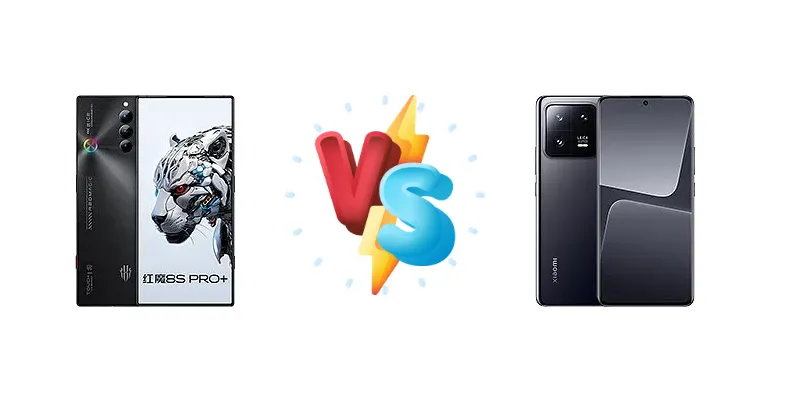
|
🏆 Quick Verdict
For dedicated mobile gamers, the ZTE nubia RedMagic 8S Pro+ is the clear winner, offering superior cooling and a gaming-centric design. However, the Xiaomi 13 Pro excels in overall versatility, boasting a stunning display, a capable camera system, and faster wireless charging, making it the better choice for everyday users.
| PHONES | ||
|---|---|---|
| Phone Names | ZTE nubia RedMagic 8S Pro+ | Xiaomi 13 Pro |
| Network | ||
|---|---|---|
| 2G bands | GSM 850 / 900 / 1800 / 1900 | GSM 850 / 900 / 1800 / 1900 |
| 3G bands | HSDPA 850 / 900 / 1700(AWS) / 1900 / 2100 | HSDPA 800 / 850 / 900 / 1700(AWS) / 1900 / 2100 |
| 4G bands | LTE | 1, 2, 3, 4, 5, 7, 8, 12, 13, 17, 18, 19, 20, 25, 26, 28, 32, 38, 39, 40, 41, 42, 48, 66 - International |
| 5G bands | SA/NSA | 1, 3, 5, 7, 8, 20, 28, 38, 40, 41, 66, 71, 75, 77, 78 SA/NSA - International |
| Speed | HSPA, LTE, 5G | HSPA, LTE, 5G |
| Technology | GSM / CDMA / HSPA / EVDO / LTE / 5G | GSM / CDMA / HSPA / CDMA2000 / LTE / 5G |
| - | 1, 3, 5, 8, 28, 38, 40, 41, 77, 78, 79 SA/NSA - China | |
| Launch | ||
|---|---|---|
| Announced | 2023, June 05 | 2022, December 11 |
| Status | Available. Released 2023, July 11 | Available. Released 2022, December 14 |
| Body | ||
|---|---|---|
| Build | Glass front (Gorilla Glass 5), glass back, aluminum frame | Glass front (Gorilla Glass Victus), ceramic back or silicone polymer back, aluminum frame |
| Dimensions | 164 x 76.4 x 8.9 mm (6.46 x 3.01 x 0.35 in) | 162.9 x 74.6 x 8.4 mm or 8.7 mm |
| SIM | Nano-SIM + Nano-SIM | · Nano-SIM + eSIM· Nano-SIM + Nano-SIM |
| Weight | 230 g (8.11 oz) | 210 g or 229 g (7.41 oz) |
| - | IP68 dust/water resistant (up to 1.5m for 30 min) | |
| Display | ||
|---|---|---|
| Protection | Corning Gorilla Glass 5 | Corning Gorilla Glass Victus |
| Resolution | 1116 x 2480 pixels, 20:9 ratio (~400 ppi density) | 1440 x 3200 pixels, 20:9 ratio (~522 ppi density) |
| Size | 6.8 inches, 111.6 cm2 (~89.1% screen-to-body ratio) | 6.73 inches, 108.9 cm2 (~89.6% screen-to-body ratio) |
| Type | AMOLED, 1B colors (China only), 120Hz, 1300 nits (peak) | LTPO AMOLED, 1B colors, 120Hz, Dolby Vision, HDR10+, 1200 nits (HBM), 1900 nits (peak) |
| Platform | ||
|---|---|---|
| CPU | Octa-core (1x3.36 GHz Cortex-X3 & 2x2.8 GHz Cortex-A715 & 2x2.8 GHz Cortex-A710 & 3x2.0 GHz Cortex-A510) | Octa-core (1x3.2 GHz Cortex-X3 & 2x2.8 GHz Cortex-A715 & 2x2.8 GHz Cortex-A710 & 3x2.0 GHz Cortex-A510) |
| Chipset | Qualcomm SM8550-AC Snapdragon 8 Gen 2 (4 nm) | Qualcomm SM8550-AB Snapdragon 8 Gen 2 (4 nm) |
| GPU | Adreno 740 (719 MHz) | Adreno 740 |
| OS | Android 13, Redmagic OS 8 | Android 13, upgradable to Android 14, HyperOS |
| Memory | ||
|---|---|---|
| Card slot | No | No |
| Internal | 256GB 16GB RAM, 512GB 16GB RAM, 1TB 16GB RAM, 1TB 24GB RAM | 128GB 8GB RAM, 256GB 8GB RAM, 256GB 12GB RAM, 512GB 12GB RAM |
| - | UFS 3.1 - 128GB UFS 4.0 - 256/512GB | |
| Main Camera | ||
|---|---|---|
| Features | LED flash, HDR, panorama | Laser AF, color spectrum sensor, Leica lens, Dual-LED dual-tone flash, HDR, panorama |
| Triple | 50 MP, f/1.9, 25mm (wide), 1/1.57", 1.0µm, PDAF 8 MP, f/2.2, 120˚, 13mm (ultrawide), 1/4.0", 1.12µm 2 MP (macro) | 50.3 MP, f/1.9, 23mm (wide), 1.0"-type, 1.6µm, dual pixel PDAF, OIS 50 MP, f/2.0, 75mm (telephoto), PDAF (10cm - ∞), 3.2x optical zoom 50 MP, f/2.2, 14mm, 115˚ (ultrawide), AF |
| Video | 8K@30fps, 4K@30/60fps, 1080p@30/60/120/240fps | 8K@24fps (HDR), 4K@24/30/60fps (HDR10+, 10-bit Dolby Vision HDR, 10-bit LOG), 1080p@30/120/240/960fps, 1080p@1920fps, gyro-EIS |
| Selfie camera | ||
|---|---|---|
| Features | HDR | HDR, panorama |
| Single | 16 MP, f/2.0, (wide), 1.12µm, under display | 32 MP, f/2.0, 22mm (wide), 1/3.14", 0.7µm |
| Video | 1080p@30/60fps | 1080p@30fps |
| Sound | ||
|---|---|---|
| 3.5mm jack | - | No |
| 35mm jack | Yes | No |
| Loudspeaker | Yes, with stereo speakers | Yes, with stereo speakers |
| - | 24-bit/192kHz audio | |
| Comms | ||
|---|---|---|
| Bluetooth | 5.3, A2DP, LE, aptX HD, aptX Adaptive, aptX Lossless | 5.3, A2DP, aptX HD, aptX Adaptive |
| Infrared port | - | Yes |
| NFC | Yes (market/region dependent) | Yes |
| Positioning | GPS (L1+L5), GLONASS, BDS, GALILEO | GPS (L1+L5), GLONASS (G1), BDS (B1I+B1c+B2a), GALILEO (E1+E5a), QZSS (L1+L5), NavIC (L5) |
| Radio | No | No |
| USB | USB Type-C 3.2 (China), 3.1 (International), OTG, accessory connector, DisplayPort | USB Type-C 2.0, OTG |
| WLAN | Wi-Fi 802.11 a/b/g/n/ac/6e/7, tri-band, Wi-Fi Direct | Wi-Fi 802.11 a/b/g/n/ac/6e, dual-band, Wi-Fi Direct |
| Features | ||
|---|---|---|
| Sensors | Fingerprint (under display, optical), accelerometer, gyro, proximity, compass | Fingerprint (under display, optical), accelerometer, proximity, gyro, compass, barometer |
| Battery | ||
|---|---|---|
| Charging | 165W wired, PD3.0, 100% in 14 min | 120W wired, PD3.0, QC4, 100% in 19 min 50W wireless, 100% in 36 min 10W reverse wireless |
| Type | Li-Po 5000 mAh | Li-Po 4820 mAh |
| Misc | ||
|---|---|---|
| Colors | Midnight, Platinum, Aurora | Ceramic White, Ceramic Black, Ceramic Flora Green, Mountain Blue |
| Models | - | 2210132G, 2210132C |
| Price | About 700 EUR | About 750 EUR |
| Tests | ||
|---|---|---|
| Battery life | - | Endurance rating 115h |
| Camera | - | Photo / Video |
| Display | - | Contrast ratio: Infinite (nominal) |
| Loudspeaker | - | -25.6 LUFS (Very good) |
| Performance | - | AnTuTu: 1281666 (v9) GeekBench: 5087 (v5.1), 5323 (v6) GFXBench: 64fps (ES 3.1 onscreen) |
ZTE nubia RedMagic 8S Pro+
- Faster 165W wired charging
- Potentially higher sustained gaming performance due to cooling
- Slightly higher CPU clock speed
- No wireless charging
- Camera likely not as advanced as the Xiaomi 13 Pro
- Battery life potentially shorter under heavy gaming
Xiaomi 13 Pro
- Versatile charging options (wired, wireless, reverse wireless)
- Excellent display brightness and quality
- Strong camera system
- Slower wired charging than RedMagic 8S Pro+
- Potentially more thermal throttling under sustained load
- Slightly lower CPU clock speed
Display Comparison
The Xiaomi 13 Pro boasts a bright display, reaching a measured 1253 nits peak brightness, ensuring excellent visibility even in direct sunlight. While the RedMagic 8S Pro+’s display specs aren’t provided, its focus isn’t on display fidelity. The Xiaomi’s infinite (nominal) contrast ratio suggests a high-quality OLED panel. The Xiaomi 13 Pro’s display is geared towards content consumption and general use, while the RedMagic likely prioritizes refresh rate and responsiveness for gaming.
Camera Comparison
The Xiaomi 13 Pro is positioned as a photography powerhouse, though specific details are limited to 'Photo / Video'. Its camera system likely features advanced image processing algorithms and potentially larger sensors than the RedMagic. The RedMagic 8S Pro+’s camera is likely adequate but not a primary selling point. The Xiaomi’s focus on camera capabilities makes it the superior choice for photography enthusiasts.
Performance
Both devices are powered by the Qualcomm SM8550-AC/AB Snapdragon 8 Gen 2 (4 nm) chipset, but with slightly different CPU clock speeds. The RedMagic 8S Pro+ edges out the Xiaomi 13 Pro with a 3.36 GHz Cortex-X3 prime core versus the Xiaomi’s 3.2 GHz. This difference, while subtle, could translate to a marginal performance advantage in CPU-intensive tasks. Both utilize the same Cortex-A715, A710, and A510 cores. However, the RedMagic’s integrated cooling system is a significant differentiator, allowing it to sustain peak performance for longer periods, crucial for gaming. The Xiaomi 13 Pro relies on more conventional thermal management.
Battery Life
The Xiaomi 13 Pro offers a more comprehensive charging solution. Its 120W wired charging reaches 100% in 19 minutes, while the RedMagic 8S Pro+ achieves the same in 14 minutes with its 165W charging. However, the Xiaomi adds 50W wireless charging (36 minutes to full) and 10W reverse wireless charging, features absent on the RedMagic. The Xiaomi 13 Pro also boasts an endurance rating of 115 hours and an active use score of 10:55h, indicating strong battery life despite not specifying the battery capacity. The RedMagic’s battery capacity is not provided, but its focus on high performance may result in shorter battery life under heavy load.
Buying Guide
Buy the ZTE nubia RedMagic 8S Pro+ if you demand the highest possible frame rates in demanding mobile games, prioritize sustained performance over extended gaming sessions, and appreciate features like active cooling. Buy the Xiaomi 13 Pro if you value a premium camera experience, a vibrant and bright display for media consumption, and a more refined, all-around smartphone experience with versatile charging options.