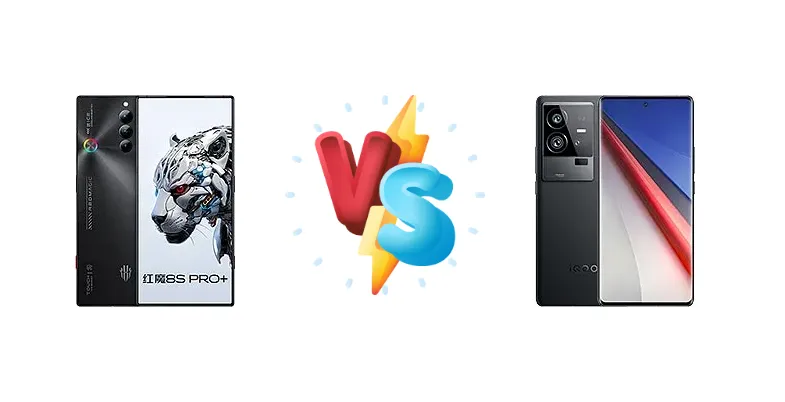
Both the ZTE nubia RedMagic 8S Pro+ and the vivo iQOO 11 Pro represent the pinnacle of Android flagship performance, but they cater to slightly different priorities. The RedMagic focuses relentlessly on gaming, while the iQOO 11 Pro balances power with a broader feature set, notably pushing the boundaries of wired charging technology. This comparison dissects their key differences to determine which device reigns supreme for your needs.
🏆 Quick Verdict
For dedicated mobile gamers, the ZTE nubia RedMagic 8S Pro+ is the clear winner, offering a more focused gaming experience with its optimized cooling and gaming-centric features. However, the vivo iQOO 11 Pro excels in charging speed and offers a more versatile overall package for users who prioritize fast power-ups and broader functionality.
| Network |
|---|
| 2G bands | GSM 850 / 900 / 1800 / 1900 | GSM 850 / 900 / 1800 / 1900 |
| 3G bands | HSDPA 850 / 900 / 1700(AWS) / 1900 / 2100 | HSDPA 800 / 850 / 900 / 1700(AWS) / 1900 / 2100 |
| 4G bands | LTE | 1, 2, 3, 4, 5, 7, 8, 12, 17, 18, 19, 20, 25, 26, 28, 34, 38, 39, 40, 41, 42, 66 |
| 5G bands | SA/NSA | 1, 2, 3, 5, 7, 8, 12, 20, 28, 38, 40, 41, 66, 77, 78, 79 SA/NSA |
| Speed | HSPA, LTE, 5G | HSPA, LTE, 5G |
| Technology | GSM / CDMA / HSPA / EVDO / LTE / 5G | GSM / CDMA / HSPA / CDMA2000 / LTE / 5G |
| | - | CDMA2000 1x |
| Launch |
|---|
| Announced | 2023, June 05 | 2022, December 08 |
| Status | Available. Released 2023, July 11 | Available. Released 2022, December 21 |
| Body |
|---|
| Build | Glass front (Gorilla Glass 5), glass back, aluminum frame | - |
| Dimensions | 164 x 76.4 x 8.9 mm (6.46 x 3.01 x 0.35 in) | 164.8 x 75.3 x 8.9 mm or 9.1 mm |
| SIM | Nano-SIM + Nano-SIM | Nano-SIM + Nano-SIM |
| Weight | 230 g (8.11 oz) | 210.5 g or 213 g (7.44 oz) |
| Display |
|---|
| Protection | Corning Gorilla Glass 5 | - |
| Resolution | 1116 x 2480 pixels, 20:9 ratio (~400 ppi density) | 1440 x 3200 pixels, 20:9 ratio (~518 ppi density) |
| Size | 6.8 inches, 111.6 cm2 (~89.1% screen-to-body ratio) | 6.78 inches, 111.0 cm2 (~89.4% screen-to-body ratio) |
| Type | AMOLED, 1B colors (China only), 120Hz, 1300 nits (peak) | LTPO4 AMOLED, 1B colors, 144Hz, HDR10+, 1800 nits (peak) |
| Platform |
|---|
| CPU | Octa-core (1x3.36 GHz Cortex-X3 & 2x2.8 GHz Cortex-A715 & 2x2.8 GHz Cortex-A710 & 3x2.0 GHz Cortex-A510) | Octa-core (1x3.2 GHz Cortex-X3 & 2x2.8 GHz Cortex-A715 & 2x2.8 GHz Cortex-A710 & 3x2.0 GHz Cortex-A510) |
| Chipset | Qualcomm SM8550-AC Snapdragon 8 Gen 2 (4 nm) | Qualcomm SM8550-AB Snapdragon 8 Gen 2 (4 nm) |
| GPU | Adreno 740 (719 MHz) | Adreno 740 |
| OS | Android 13, Redmagic OS 8 | Android 13, Funtouch 13 (International), OriginOS 3 (China) |
| Memory |
|---|
| Card slot | No | No |
| Internal | 256GB 16GB RAM, 512GB 16GB RAM, 1TB 16GB RAM, 1TB 24GB RAM | 256GB 8GB RAM, 256GB 12GB RAM, 512GB 16GB RAM |
| | - | UFS 4.0 |
| Main Camera |
|---|
| Features | LED flash, HDR, panorama | Dual-LED flash, HDR, panorama |
| Single | - | 16 MP, f/2.5, (wide) |
| Triple | 50 MP, f/1.9, 25mm (wide), 1/1.57", 1.0µm, PDAF
8 MP, f/2.2, 120˚, 13mm (ultrawide), 1/4.0", 1.12µm
2 MP (macro) | 50 MP, f/1.8, (wide), 1/1.49", 1.0µm, PDAF, OIS
13 MP, f/2.5, 50mm (telephoto), PDAF, optical zoom
50 MP, f/2.3, 15mm, 150˚ (ultrawide), 1/2.76", 0.64µm, AF |
| Video | 8K@30fps, 4K@30/60fps, 1080p@30/60/120/240fps | 8K@30fps, 4K@24/30/60fps, 1080p@30/60/120/240fps, gyro-EIS |
| Selfie camera |
|---|
| Features | HDR | HDR |
| Single | 16 MP, f/2.0, (wide), 1.12µm, under display | 16 MP, f/2.5, (wide) |
| Video | 1080p@30/60fps | 1080p@30fps, gyro-EIS |
| Sound |
|---|
| 3.5mm jack | - | No |
| 35mm jack | Yes | No |
| Loudspeaker | Yes, with stereo speakers | Yes, with stereo speakers |
| | - | 32-bit/384kHz audio |
| Comms |
|---|
| Bluetooth | 5.3, A2DP, LE, aptX HD, aptX Adaptive, aptX Lossless | 5.3, A2DP, LE, aptX HD, aptX Adaptive, aptX Lossless |
| Infrared port | - | Yes |
| NFC | Yes (market/region dependent) | Yes |
| Positioning | GPS (L1+L5), GLONASS, BDS, GALILEO | GPS, GLONASS, GALILEO, BDS |
| Radio | No | No |
| USB | USB Type-C 3.2 (China), 3.1 (International), OTG, accessory connector, DisplayPort | USB Type-C 2.0, OTG |
| WLAN | Wi-Fi 802.11 a/b/g/n/ac/6e/7, tri-band, Wi-Fi Direct | Wi-Fi 802.11 a/b/g/n/ac/6, dual-band, Wi-Fi Direct |
| Features |
|---|
| Sensors | Fingerprint (under display, optical), accelerometer, gyro, proximity, compass | Fingerprint (under display, ultrasonic), accelerometer, gyro, proximity, compass |
| Battery |
|---|
| Charging | 165W wired, PD3.0, 100% in 14 min | 200W wired, PD3.0, 100% in 10 min
50W wireless
10W reverse wireless |
| Type | Li-Po 5000 mAh | 4700 mAh |
| Misc |
|---|
| Colors | Midnight, Platinum, Aurora | Black, Green, White (BMW M branding) |
| Models | - | V2254A |
| Price | About 700 EUR | About 800 EUR |
ZTE nubia RedMagic 8S Pro+
- Slightly higher CPU clock speed for potential performance edge.
- Aggressive cooling system for sustained gaming.
- Gaming-centric features like shoulder triggers.
- Slower charging speed compared to iQOO 11 Pro.
- Lacks wireless charging capabilities.
vivo iQOO 11 Pro
- Industry-leading 200W wired charging.
- 50W wireless charging and 10W reverse wireless charging.
- Potentially more refined camera experience.
- Slightly lower CPU clock speed.
- Thermal management potentially less optimized for extreme gaming.
Display Comparison
While both devices utilize high-refresh-rate displays, specific details like panel type and peak brightness are missing. However, both leverage the efficiency of the Snapdragon 8 Gen 2 to drive these displays. The iQOO 11 Pro’s broader feature set suggests a potentially more color-accurate panel tuned for media consumption, while the RedMagic likely prioritizes refresh rate and response time for competitive gaming. Bezels are likely comparable given the flagship status of both devices.
Camera Comparison
Detailed camera specs are absent, but both phones likely feature high-resolution main sensors. The iQOO 11 Pro, given vivo’s camera expertise, likely emphasizes computational photography and image processing for vibrant, shareable photos. The RedMagic, while capable, likely prioritizes camera functionality as a secondary feature. Without specific sensor size or aperture information, it’s difficult to definitively declare a winner, but the iQOO 11 Pro’s brand reputation suggests a more refined camera experience.
Performance
Both phones are powered by the Qualcomm SM8550-AC/AB Snapdragon 8 Gen 2 (4nm), but the RedMagic 8S Pro+ boasts a slightly higher CPU clock speed (3.36 GHz vs 3.2 GHz) on its Cortex-X3 prime core. This marginal difference, combined with the RedMagic’s aggressive cooling system, suggests superior sustained performance during extended gaming sessions. Both utilize LPDDR5x RAM, ensuring ample memory bandwidth. The iQOO 11 Pro’s thermal solution, while likely effective, is geared towards a broader usage profile, potentially leading to more throttling under extreme, prolonged gaming loads.
Battery Life
The iQOO 11 Pro’s 200W wired charging is a game-changer, achieving a 100% charge in just 10 minutes. This is significantly faster than the RedMagic 8S Pro+'s 165W charging (14 minutes). The iQOO 11 Pro also adds 50W wireless and 10W reverse wireless charging, features absent on the RedMagic. While battery capacity isn’t specified, the iQOO’s charging speed effectively mitigates any potential capacity disadvantage, offering unparalleled convenience for power users.
Buying Guide
Buy the ZTE nubia RedMagic 8S Pro+ if you prioritize sustained gaming performance, require advanced cooling solutions to prevent throttling, and value gaming-specific features like shoulder triggers. Buy the vivo iQOO 11 Pro if you demand the absolute fastest charging speeds available, appreciate a more balanced feature set including 50W wireless charging, and want a flagship that excels beyond just gaming.
Frequently Asked Questions
❓ Does the iQOO 11 Pro's 200W charging degrade the battery health faster?
While extremely fast charging can theoretically contribute to battery degradation over the long term, vivo employs intelligent charging algorithms and safety mechanisms to minimize this effect. The iQOO 11 Pro dynamically adjusts charging speed based on battery condition and usage patterns, prioritizing longevity alongside speed.
❓ Is the RedMagic 8S Pro+'s cooling system noticeably louder than the iQOO 11 Pro's?
The RedMagic 8S Pro+ utilizes a more aggressive cooling solution, including a fan, which can generate audible noise under heavy load. The iQOO 11 Pro likely relies on passive cooling and vapor chamber technology, resulting in quieter operation, but potentially less effective heat dissipation during prolonged, intense gaming.
❓ Can the iQOO 11 Pro handle graphically demanding games at maximum settings for extended periods?
The iQOO 11 Pro, powered by the Snapdragon 8 Gen 2, is capable of running most mobile games at maximum settings. However, sustained performance may be limited by thermal throttling, especially during extended gaming sessions. While the cooling system is effective, it's not as aggressively focused on gaming as the RedMagic 8S Pro+.