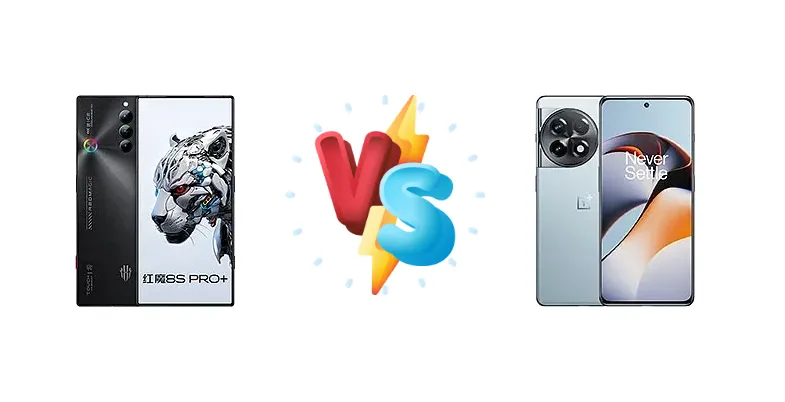
The ZTE nubia RedMagic 8S Pro+ and OnePlus 11R represent distinct approaches to the flagship smartphone experience. The RedMagic prioritizes raw gaming performance with cutting-edge hardware, while the OnePlus 11R aims for a more balanced blend of power, features, and value. This comparison dissects their key differences to help you determine which device best suits your needs.
🏆 Quick Verdict
For dedicated mobile gamers, the ZTE nubia RedMagic 8S Pro+ is the clear winner. Its Snapdragon 8 Gen 2 chipset and advanced cooling system deliver sustained peak performance. However, the OnePlus 11R offers excellent value for users prioritizing a well-rounded experience and faster charging at a lower price point.
| Network |
|---|
| 2G bands | GSM 850 / 900 / 1800 / 1900 | GSM 850 / 900 / 1800 / 1900 |
| 3G bands | HSDPA 850 / 900 / 1700(AWS) / 1900 / 2100 | HSDPA 850 / 900 / 1700(AWS) / 2100 |
| 4G bands | LTE | 1, 3, 4, 5, 8, 28, 34, 38, 39, 40, 41 |
| 5G bands | SA/NSA | 1, 3, 5, 8, 28, 40, 41, 77, 78 SA/NSA |
| Speed | HSPA, LTE, 5G | HSPA, LTE (3CA), 5G |
| Technology | GSM / CDMA / HSPA / EVDO / LTE / 5G | GSM / CDMA / HSPA / LTE / 5G |
| | - | CDMA 800 |
| Launch |
|---|
| Announced | 2023, June 05 | 2023, February 07 |
| Status | Available. Released 2023, July 11 | Available. Released 2023, February 21 |
| Body |
|---|
| Build | Glass front (Gorilla Glass 5), glass back, aluminum frame | Glass front, glass back (Gorilla Glass 5), plastic frame |
| Dimensions | 164 x 76.4 x 8.9 mm (6.46 x 3.01 x 0.35 in) | 163.4 x 74.3 x 8.7 mm (6.43 x 2.93 x 0.34 in) |
| SIM | Nano-SIM + Nano-SIM | Nano-SIM + Nano-SIM |
| Weight | 230 g (8.11 oz) | 204 g (7.20 oz) |
| Display |
|---|
| Protection | Corning Gorilla Glass 5 | - |
| Resolution | 1116 x 2480 pixels, 20:9 ratio (~400 ppi density) | 1240 x 2772 pixels, 20:9 ratio (~451 ppi density) |
| Size | 6.8 inches, 111.6 cm2 (~89.1% screen-to-body ratio) | 6.74 inches, 109.2 cm2 (~90.0% screen-to-body ratio) |
| Type | AMOLED, 1B colors (China only), 120Hz, 1300 nits (peak) | Fluid AMOLED, 1B colors, 120Hz, HDR10+, 1450 nits (peak) |
| Platform |
|---|
| CPU | Octa-core (1x3.36 GHz Cortex-X3 & 2x2.8 GHz Cortex-A715 & 2x2.8 GHz Cortex-A710 & 3x2.0 GHz Cortex-A510) | Octa-core (1x3.0 GHz Cortex-X2 & 3x2.5 GHz Cortex-A710 & 4x1.80 GHz Cortex-A510) |
| Chipset | Qualcomm SM8550-AC Snapdragon 8 Gen 2 (4 nm) | Qualcomm SM8475 Snapdragon 8+ Gen 1 (4 nm) |
| GPU | Adreno 740 (719 MHz) | Adreno 730 |
| OS | Android 13, Redmagic OS 8 | Android 13, upgradable to Android 15, OxygenOS 15 |
| Memory |
|---|
| Card slot | No | No |
| Internal | 256GB 16GB RAM, 512GB 16GB RAM, 1TB 16GB RAM, 1TB 24GB RAM | 128GB 8GB RAM, 256GB 16GB RAM, 512GB 18GB RAM |
| | - | UFS 3.1 |
| Main Camera |
|---|
| Features | LED flash, HDR, panorama | Color spectrum sensor, LED flash, HDR, panorama |
| Single | - | 16 MP, f/2.4, 24mm (wide), 1/3.09", 1.0µm |
| Triple | 50 MP, f/1.9, 25mm (wide), 1/1.57", 1.0µm, PDAF
8 MP, f/2.2, 120˚, 13mm (ultrawide), 1/4.0", 1.12µm
2 MP (macro) | 50 MP, f/1.8, 24mm (wide), 1/1.56", 1.0µm, multi-directional PDAF, OIS
8 MP, f/2.2, 120˚ (ultrawide), 1/4.0", 1.12µm
2 MP (macro) |
| Video | 8K@30fps, 4K@30/60fps, 1080p@30/60/120/240fps | 4K@30/60fps, 1080p@30/60/240fps, gyro-EIS |
| Selfie camera |
|---|
| Features | HDR | HDR |
| Single | 16 MP, f/2.0, (wide), 1.12µm, under display | 16 MP, f/2.4, 24mm (wide), 1/3.09", 1.0µm |
| Video | 1080p@30/60fps | 1080p@30fps |
| Sound |
|---|
| 3.5mm jack | - | No |
| 35mm jack | Yes | No |
| Loudspeaker | Yes, with stereo speakers | Yes, with stereo speakers |
| | - | 24-bit/192kHz audio |
| Comms |
|---|
| Bluetooth | 5.3, A2DP, LE, aptX HD, aptX Adaptive, aptX Lossless | 5.3, A2DP, LE, aptX HD |
| Infrared port | - | Yes |
| NFC | Yes (market/region dependent) | Yes |
| Positioning | GPS (L1+L5), GLONASS, BDS, GALILEO | GPS (L1+L5), GLONASS (G1), BDS (B1I+B1c+B2a), GALILEO (E1+E5a), QZSS (L1+L5) |
| Radio | No | No |
| USB | USB Type-C 3.2 (China), 3.1 (International), OTG, accessory connector, DisplayPort | USB Type-C 2.0 |
| WLAN | Wi-Fi 802.11 a/b/g/n/ac/6e/7, tri-band, Wi-Fi Direct | Wi-Fi 802.11 a/b/g/n/ac/6, dual-band |
| Features |
|---|
| Sensors | Fingerprint (under display, optical), accelerometer, gyro, proximity, compass | Fingerprint (under display, optical), accelerometer, gyro, proximity, compass |
| Battery |
|---|
| Charging | 165W wired, PD3.0, 100% in 14 min | 100W wired |
| Type | Li-Po 5000 mAh | Li-Po 5000 mAh |
| Misc |
|---|
| Colors | Midnight, Platinum, Aurora | Galactic Silver, Sonic Black, Solar Red |
| Models | - | CPH2487 |
| Price | About 700 EUR | About 600 EUR |
| SAR | - | 1.16 W/kg (head) 0.61 W/kg (body) |
ZTE nubia RedMagic 8S Pro+
- Unmatched gaming performance with Snapdragon 8 Gen 2
- Superior thermal management with active cooling
- Blazing-fast 165W charging
- Likely higher touch sampling rate for gaming
- Potentially less refined camera system
- Gaming-focused design may not appeal to everyone
OnePlus 11R
- Excellent value for money
- Fast 100W charging
- Well-rounded software experience
- Likely superior camera quality
- Snapdragon 8+ Gen 1 may throttle under sustained load
- Less focused on extreme gaming performance
Display Comparison
While both devices likely feature high refresh rate AMOLED panels, the specifics are crucial. The RedMagic 8S Pro+’s display is geared towards gaming, potentially offering a higher touch sampling rate and lower latency. The OnePlus 11R, while excellent, will likely prioritize color accuracy and viewing angles for general use. The absence of LTPO information for the 11R suggests it may not dynamically adjust refresh rates as efficiently as some competitors, impacting battery life during less demanding tasks. Bezels are expected to be minimal on both, but the RedMagic’s design may prioritize screen real estate over a sleek aesthetic.
Camera Comparison
Without detailed camera specs, a direct comparison is limited. However, given the RedMagic’s gaming focus, the camera system is likely optimized for social media sharing rather than professional photography. The OnePlus 11R, inheriting OnePlus’s camera tradition, likely prioritizes image quality and versatility. The 8+ Gen 1’s ISP is capable of excellent image processing, and the 11R likely features a more sophisticated camera array with larger sensors and optical image stabilization (OIS). The RedMagic may rely more on software enhancements to compensate for potentially less advanced hardware.
Performance
The core difference lies in the chipsets. The RedMagic 8S Pro+ boasts the Qualcomm SM8550-AC Snapdragon 8 Gen 2 (4nm), featuring a Cortex-X3 prime core clocked at 3.36 GHz. This architecture provides a significant performance uplift over the OnePlus 11R’s Snapdragon 8+ Gen 1 (4nm) with its Cortex-X2 prime core at 3.0 GHz. The 8 Gen 2’s improved efficiency also translates to better thermal management. The RedMagic’s active cooling system further enhances sustained performance, mitigating throttling during extended gaming sessions – a potential issue for the 11R under heavy load. The RedMagic also benefits from faster LPDDR5x RAM, contributing to quicker app loading and multitasking.
Battery Life
The OnePlus 11R’s 100W wired charging is incredibly fast, achieving a full charge in a reasonable timeframe. However, the RedMagic 8S Pro+’s 165W charging is in a different league, promising a 100% charge in just 14 minutes. While battery capacity isn’t specified, the RedMagic’s more efficient chipset and potentially larger battery could offset the 11R’s faster charging in real-world usage. The Snapdragon 8 Gen 2’s 4nm process contributes to lower power consumption, extending battery life during gaming and everyday tasks.
Buying Guide
Buy the ZTE nubia RedMagic 8S Pro+ if you demand the absolute best mobile gaming performance, require sustained high frame rates, and appreciate features like active cooling. Buy the OnePlus 11R if you prefer a more versatile smartphone with a focus on fast charging, a refined software experience, and a lower overall cost, even if it means sacrificing some gaming headroom.
Frequently Asked Questions
❓ Will the OnePlus 11R experience significant thermal throttling during prolonged gaming sessions?
The Snapdragon 8+ Gen 1 is a capable chipset, but it's known to generate more heat than the Snapdragon 8 Gen 2. While the OnePlus 11R likely has thermal management features, it may experience throttling during extended, graphically demanding games, leading to reduced frame rates and performance.
❓ How effective is the RedMagic 8S Pro+'s active cooling system in real-world gaming?
The RedMagic 8S Pro+'s active cooling system, typically a fan and vapor chamber, significantly improves sustained performance. It allows the Snapdragon 8 Gen 2 to maintain higher clock speeds for longer periods, preventing throttling and delivering consistently high frame rates in demanding games. This is a key advantage for serious mobile gamers.
❓ Does the RedMagic 8S Pro+ support high frame rate gaming (90fps or 120fps) in popular titles like PUBG Mobile?
Given the Snapdragon 8 Gen 2's power and the RedMagic's gaming focus, it's highly likely to support 90fps or even 120fps in PUBG Mobile, assuming the game itself offers those settings. The phone's optimized software and cooling system will contribute to a smooth and stable gaming experience at these higher frame rates.
❓ Is the 100W charging on the OnePlus 11R enough for a typical user, or is the 165W on the RedMagic significantly better?
100W charging is exceptionally fast and will fully charge the OnePlus 11R in a short amount of time. However, the RedMagic 8S Pro+'s 165W charging is substantially faster, reducing charging time by approximately 40%. For users who frequently need to top up their battery quickly, the RedMagic's charging speed is a significant advantage.