
ZTE nubia RedMagic 8S Pro vs. OnePlus 11R: A Deep Dive into Gaming and Everyday Performance
| Phones Images | |||||
|---|---|---|---|---|---|
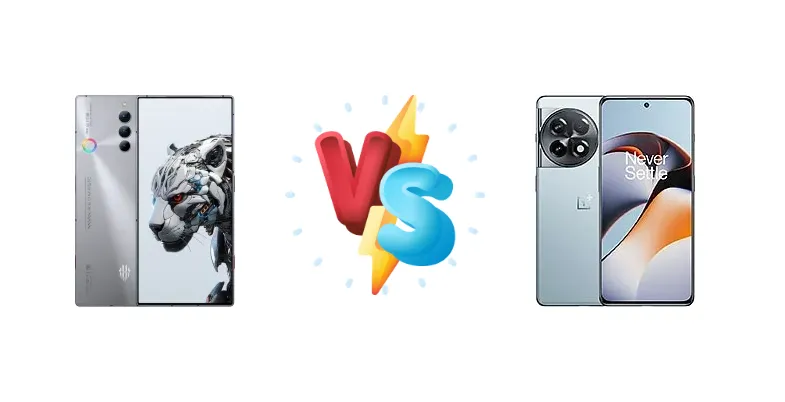
|
🏆 Quick Verdict
For dedicated mobile gamers, the ZTE nubia RedMagic 8S Pro is the clear winner. Its Snapdragon 8 Gen 2 chipset delivers superior performance and thermal management. However, the OnePlus 11R provides excellent value for users prioritizing fast 100W charging and a more versatile everyday experience.
| PHONES | ||
|---|---|---|
| Phone Names | ZTE nubia RedMagic 8S Pro | OnePlus 11R |
| Network | ||
|---|---|---|
| 2G bands | GSM 850 / 900 / 1800 / 1900 | GSM 850 / 900 / 1800 / 1900 |
| 3G bands | HSDPA 850 / 900 / 1700(AWS) / 1900 / 2100 | HSDPA 850 / 900 / 1700(AWS) / 2100 |
| 4G bands | 1, 2, 3, 4, 5, 7, 8, 12, 17, 18, 19, 20, 26, 28, 34, 38, 39, 40, 41, 66 | 1, 3, 4, 5, 8, 28, 34, 38, 39, 40, 41 |
| 5G bands | 1, 3, 5, 7, 8, 20, 28, 38, 41, 66, 77, 78 SA/NSA - International | 1, 3, 5, 8, 28, 40, 41, 77, 78 SA/NSA |
| Speed | HSPA, LTE, 5G | HSPA, LTE (3CA), 5G |
| Technology | GSM / CDMA / HSPA / EVDO / LTE / 5G | GSM / CDMA / HSPA / LTE / 5G |
| - | CDMA 800 | |
| Launch | ||
|---|---|---|
| Announced | 2023, June 05 | 2023, February 07 |
| Status | Available. Released 2023, July 11 | Available. Released 2023, February 21 |
| Body | ||
|---|---|---|
| Build | Glass front (Gorilla Glass 5), glass back, aluminum frame | Glass front, glass back (Gorilla Glass 5), plastic frame |
| Dimensions | 164 x 76.4 x 9.5 mm (6.46 x 3.01 x 0.37 in) | 163.4 x 74.3 x 8.7 mm (6.43 x 2.93 x 0.34 in) |
| SIM | Nano-SIM + Nano-SIM | Nano-SIM + Nano-SIM |
| Weight | 228 g (8.04 oz) | 204 g (7.20 oz) |
| Display | ||
|---|---|---|
| Protection | Corning Gorilla Glass 5 | - |
| Resolution | 1116 x 2480 pixels, 20:9 ratio (~400 ppi density) | 1240 x 2772 pixels, 20:9 ratio (~451 ppi density) |
| Size | 6.8 inches, 111.6 cm2 (~89.1% screen-to-body ratio) | 6.74 inches, 109.2 cm2 (~90.0% screen-to-body ratio) |
| Type | AMOLED, 1B colors (China only), 120Hz, 1300 nits (peak) | Fluid AMOLED, 1B colors, 120Hz, HDR10+, 1450 nits (peak) |
| Platform | ||
|---|---|---|
| CPU | Octa-core (1x3.36 GHz Cortex-X3 & 2x2.8 GHz Cortex-A715 & 2x2.8 GHz Cortex-A710 & 3x2.0 GHz Cortex-A510) | Octa-core (1x3.0 GHz Cortex-X2 & 3x2.5 GHz Cortex-A710 & 4x1.80 GHz Cortex-A510) |
| Chipset | Qualcomm SM8550-AC Snapdragon 8 Gen 2 (4 nm) | Qualcomm SM8475 Snapdragon 8+ Gen 1 (4 nm) |
| GPU | Adreno 740 (719 MHz) | Adreno 730 |
| OS | Android 13, Redmagic OS 8 | Android 13, upgradable to Android 15, OxygenOS 15 |
| Memory | ||
|---|---|---|
| Card slot | No | No |
| Internal | 128GB 8GB RAM, 256GB 8GB RAM, 256GB 12GB RAM, 512GB 12GB RAM, 512GB 16GB RAM | 128GB 8GB RAM, 256GB 16GB RAM, 512GB 18GB RAM |
| - | UFS 3.1 | |
| Main Camera | ||
|---|---|---|
| Features | LED flash, HDR, panorama | Color spectrum sensor, LED flash, HDR, panorama |
| Single | - | 16 MP, f/2.4, 24mm (wide), 1/3.09", 1.0µm |
| Triple | 50 MP, f/1.9, 25mm (wide), 1/1.57", 1.0µm, PDAF 8 MP, f/2.2, 120˚, 13mm (ultrawide), 1/4.0", 1.12µm 2 MP (macro) | 50 MP, f/1.8, 24mm (wide), 1/1.56", 1.0µm, multi-directional PDAF, OIS 8 MP, f/2.2, 120˚ (ultrawide), 1/4.0", 1.12µm 2 MP (macro) |
| Video | 8K@30fps, 4K@30/60fps, 1080p@30/60/120/240fps | 4K@30/60fps, 1080p@30/60/240fps, gyro-EIS |
| Selfie camera | ||
|---|---|---|
| Features | HDR | HDR |
| Single | 16 MP, f/2.0, (wide), 1.12µm, under display | 16 MP, f/2.4, 24mm (wide), 1/3.09", 1.0µm |
| Video | 1080p@30/60fps | 1080p@30fps |
| Sound | ||
|---|---|---|
| 3.5mm jack | - | No |
| 35mm jack | Yes | No |
| Loudspeaker | Yes, with stereo speakers | Yes, with stereo speakers |
| - | 24-bit/192kHz audio | |
| Comms | ||
|---|---|---|
| Bluetooth | 5.3, A2DP, LE, aptX HD, aptX Adaptive, aptX Lossless | 5.3, A2DP, LE, aptX HD |
| Infrared port | - | Yes |
| NFC | Yes (market/region dependent) | Yes |
| Positioning | GPS (L1+L5), GLONASS, BDS, GALILEO | GPS (L1+L5), GLONASS (G1), BDS (B1I+B1c+B2a), GALILEO (E1+E5a), QZSS (L1+L5) |
| Radio | No | No |
| USB | USB Type-C 3.2 (China), 3.1 (Global), OTG, accessory connector, DisplayPort | USB Type-C 2.0 |
| WLAN | Wi-Fi 802.11 a/b/g/n/ac/6e/7, tri-band, Wi-Fi Direct | Wi-Fi 802.11 a/b/g/n/ac/6, dual-band |
| Features | ||
|---|---|---|
| Sensors | Fingerprint (under display, optical), accelerometer, gyro, proximity, compass | Fingerprint (under display, optical), accelerometer, gyro, proximity, compass |
| Battery | ||
|---|---|---|
| Charging | 80W wired, PD3.0, 100% in 35 min (China) 65W wired, PD3.0, 100% in 40 min (International) | 100W wired |
| Type | Li-Po 6000 mAh | Li-Po 5000 mAh |
| Misc | ||
|---|---|---|
| Colors | Midnight, Platinum, Aurora | Galactic Silver, Sonic Black, Solar Red |
| Models | - | CPH2487 |
| Price | About 650 EUR | About 600 EUR |
| SAR | - | 1.16 W/kg (head) 0.61 W/kg (body) |
ZTE nubia RedMagic 8S Pro
- Superior gaming performance with Snapdragon 8 Gen 2
- Advanced cooling system for sustained performance
- Potentially higher refresh rate display with LTPO
- Charging speed slower than OnePlus 11R
- Camera system may not be as refined as competitors
OnePlus 11R
- Incredibly fast 100W charging
- Balanced performance for everyday tasks and gaming
- Sleek and mainstream design
- Snapdragon 8+ Gen 1 is less powerful than Snapdragon 8 Gen 2
- May experience more thermal throttling during prolonged gaming
Display Comparison
The RedMagic 8S Pro boasts a 784 nits max brightness, providing a reasonably vivid viewing experience, though not class-leading. While the OnePlus 11R’s display specs aren’t provided, OnePlus typically utilizes AMOLED panels with excellent color accuracy. The RedMagic’s focus on gaming suggests a higher refresh rate, potentially with LTPO technology for adaptive refresh rate control, conserving battery life during static content. The RedMagic’s under-display camera design also contributes to a more immersive, bezel-less experience, a key advantage for gaming.
Camera Comparison
Both phones feature capable camera systems, but details are limited. The RedMagic 8S Pro’s camera is listed as 'Photo / Video' without specifics, suggesting a focus on general usability rather than groundbreaking innovation. The OnePlus 11R, based on OnePlus’s recent history, likely features a more refined camera system with a larger main sensor and advanced image processing algorithms. Without sensor size or aperture information for the RedMagic, it’s difficult to assess its low-light performance. The OnePlus 11R’s camera is likely to offer more consistent results across various lighting conditions, though the RedMagic may excel in specific gaming-related video capture scenarios.
Performance
The core difference lies in the chipsets: the RedMagic 8S Pro utilizes the Qualcomm SM8550-AC Snapdragon 8 Gen 2 (4nm), while the OnePlus 11R features the older, but still potent, Snapdragon 8+ Gen 1 (4nm). The Snapdragon 8 Gen 2’s Cortex-X3 prime core, clocked at 3.36 GHz, offers a significant performance uplift over the 11R’s Cortex-X2 core at 3.0 GHz. The 8 Gen 2’s improved architecture and 4nm process node also translate to better thermal efficiency, reducing throttling during extended gaming sessions. While the 11R’s Snapdragon 8+ Gen 1 is no slouch, the RedMagic 8S Pro will consistently deliver higher and more stable frame rates in demanding titles. The RedMagic’s likely inclusion of faster LPDDR5x RAM further enhances its performance advantage.
Battery Life
The RedMagic 8S Pro has an endurance rating of 132 hours, indicating solid battery life. It supports 80W wired charging (China) or 65W (International), reaching 100% in 35 or 40 minutes respectively. The OnePlus 11R, however, boasts a significantly faster 100W charging capability, allowing for a full charge in a shorter timeframe. While the RedMagic’s battery endurance is commendable, the OnePlus 11R’s faster charging is a major convenience factor, especially for users who frequently top up their devices. The actual battery capacity of both devices isn't specified, but the RedMagic's endurance suggests a reasonably sized battery optimized for gaming.
Buying Guide
Buy the ZTE nubia RedMagic 8S Pro if you demand the highest possible frame rates in demanding games, require active cooling for sustained performance, and appreciate gaming-centric features like shoulder triggers. Buy the OnePlus 11R if you prioritize a sleek design, incredibly fast 100W charging, and a more balanced experience for everyday tasks and casual gaming, all at a potentially lower price point.