
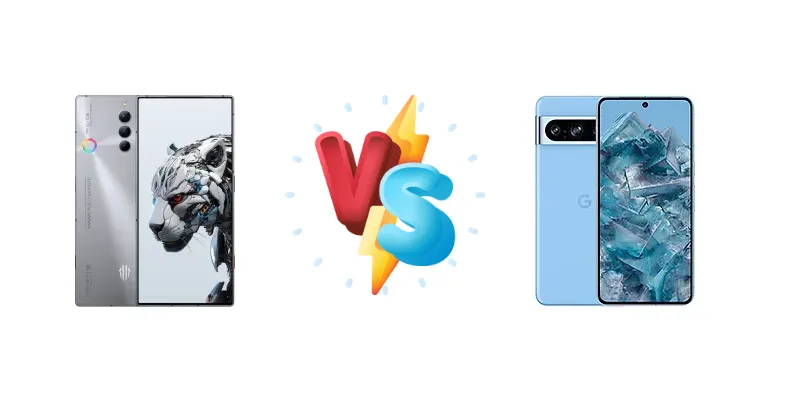
ZTE nubia RedMagic 8S Pro vs. Google Pixel 8 Pro: A Deep Dive into Gaming and AI
| Phones Images | |||||
|---|---|---|---|---|---|
|
🏆 Quick Verdict
For the average user prioritizing a versatile, intelligent smartphone experience, the Google Pixel 8 Pro emerges as the winner. Its superior display, advanced camera system, and long-term software support outweigh the RedMagic 8S Pro’s gaming focus. However, dedicated mobile gamers will find the RedMagic 8S Pro’s performance and cooling capabilities unmatched.
| PHONES | ||
|---|---|---|
| Phone Names | ZTE nubia RedMagic 8S Pro | Google Pixel 8 Pro |
| Network | ||
|---|---|---|
| 2G bands | GSM 850 / 900 / 1800 / 1900 | GSM 850 / 900 / 1800 / 1900 |
| 3G bands | HSDPA 850 / 900 / 1700(AWS) / 1900 / 2100 | HSDPA 800 / 850 / 900 / 1700(AWS) / 1900 / 2100 |
| 4G bands | 1, 2, 3, 4, 5, 7, 8, 12, 17, 18, 19, 20, 26, 28, 34, 38, 39, 40, 41, 66 | 1, 2, 3, 4, 5, 7, 8, 12, 13, 14, 17, 18, 19, 20, 25, 26, 28, 29, 30, 38, 39, 40, 41, 46, 48, 66, 71 - G1MNW |
| 5G bands | 1, 3, 5, 7, 8, 20, 28, 38, 41, 66, 77, 78 SA/NSA - International | 1, 2, 3, 5, 7, 8, 12, 20, 25, 26, 28, 29, 30, 38, 40, 41, 48, 66, 70, 71, 77, 78, 257, 258, 260, 261 SA/NSA/Sub6/mmWave - G1MNW |
| Speed | HSPA, LTE, 5G | HSPA, LTE, 5G |
| Technology | GSM / CDMA / HSPA / EVDO / LTE / 5G | GSM / HSPA / LTE / 5G |
| Launch | ||
|---|---|---|
| Announced | 2023, June 05 | 2023, October 04 |
| Status | Available. Released 2023, July 11 | Available. Released 2023, October 12 |
| Body | ||
|---|---|---|
| Build | Glass front (Gorilla Glass 5), glass back, aluminum frame | Glass front (Gorilla Glass Victus 2), glass back (Gorilla Glass Victus 2), aluminum frame |
| Dimensions | 164 x 76.4 x 9.5 mm (6.46 x 3.01 x 0.37 in) | 162.6 x 76.5 x 8.8 mm (6.40 x 3.01 x 0.35 in) |
| SIM | Nano-SIM + Nano-SIM | Nano-SIM + eSIM |
| Weight | 228 g (8.04 oz) | 213 g (7.51 oz) |
| Display | ||
|---|---|---|
| Protection | Corning Gorilla Glass 5 | Corning Gorilla Glass Victus 2 |
| Resolution | 1116 x 2480 pixels, 20:9 ratio (~400 ppi density) | 1344 x 2992 pixels, 20:9 ratio (~489 ppi density) |
| Size | 6.8 inches, 111.6 cm2 (~89.1% screen-to-body ratio) | 6.7 inches, 108.7 cm2 (~87.4% screen-to-body ratio) |
| Type | AMOLED, 1B colors (China only), 120Hz, 1300 nits (peak) | LTPO OLED, 120Hz, HDR10+, 1600 nits (HBM), 2400 nits (peak) |
| Platform | ||
|---|---|---|
| CPU | Octa-core (1x3.36 GHz Cortex-X3 & 2x2.8 GHz Cortex-A715 & 2x2.8 GHz Cortex-A710 & 3x2.0 GHz Cortex-A510) | Nona-core (1x3.0 GHz Cortex-X3 & 4x2.45 GHz Cortex-A715 & 4x2.15 GHz Cortex-A510) |
| Chipset | Qualcomm SM8550-AC Snapdragon 8 Gen 2 (4 nm) | Google Tensor G3 (4 nm) |
| GPU | Adreno 740 (719 MHz) | Immortalis-G715s MC10 |
| OS | Android 13, Redmagic OS 8 | Android 14, upgradable to Android 16, up to 7 major Android upgrades |
| Memory | ||
|---|---|---|
| Card slot | No | No |
| Internal | 128GB 8GB RAM, 256GB 8GB RAM, 256GB 12GB RAM, 512GB 12GB RAM, 512GB 16GB RAM | 128GB 12GB RAM, 256GB 12GB RAM, 512GB 12GB RAM, 1TB 12GB RAM |
| Main Camera | ||
|---|---|---|
| Features | LED flash, HDR, panorama | Multi-zone Laser AF, Dual-LED flash, Pixel Shift, Ultra-HDR, panorama, Best Take, Zoom Enhance |
| Triple | 50 MP, f/1.9, 25mm (wide), 1/1.57", 1.0µm, PDAF 8 MP, f/2.2, 120˚, 13mm (ultrawide), 1/4.0", 1.12µm 2 MP (macro) | 50 MP, f/1.7, 25mm (wide), 1/1.31", 1.2µm, dual pixel PDAF, OIS 48 MP, f/2.8, 113mm (periscope telephoto), 1/2.55", 0.7µm, dual pixel PDAF, OIS, 5x optical zoom 48 MP, f/2.0, 126˚ (ultrawide), 1/2.0", 0.8µm, dual pixel PDAF |
| Video | 8K@30fps, 4K@30/60fps, 1080p@30/60/120/240fps | 4K@30/60fps, 1080p@24/30/60/120/240fps; gyro-EIS, OIS, 10-bit HDR |
| Selfie camera | ||
|---|---|---|
| Features | HDR | HDR, panorama |
| Single | 16 MP, f/2.0, (wide), 1.12µm, under display | 10.5 MP, f/2.2, 20mm (ultrawide), 1/3.1", 1.22µm, PDAF |
| Video | 1080p@30/60fps | 4K@24/30/60fps, 1080p@30/60fps |
| Sound | ||
|---|---|---|
| 35mm jack | Yes | No |
| Loudspeaker | Yes, with stereo speakers | Yes, with stereo speakers |
| Comms | ||
|---|---|---|
| Bluetooth | 5.3, A2DP, LE, aptX HD, aptX Adaptive, aptX Lossless | 5.3, A2DP, LE, aptX HD |
| NFC | Yes (market/region dependent) | Yes |
| Positioning | GPS (L1+L5), GLONASS, BDS, GALILEO | GPS (L1+L5), GLONASS (G1), GALILEO (E1+E5a), QZSS (L1+L5) |
| Radio | No | No |
| USB | USB Type-C 3.2 (China), 3.1 (Global), OTG, accessory connector, DisplayPort | USB Type-C 3.2 |
| WLAN | Wi-Fi 802.11 a/b/g/n/ac/6e/7, tri-band, Wi-Fi Direct | Wi-Fi 802.11 a/b/g/n/ac/6e/7, tri-band, Wi-Fi Direct |
| Features | ||
|---|---|---|
| Sensors | Fingerprint (under display, optical), accelerometer, gyro, proximity, compass | Fingerprint (under display, optical), accelerometer, gyro, proximity, compass, barometer, thermometer (skin temperature) |
| Battery | ||
|---|---|---|
| Charging | 80W wired, PD3.0, 100% in 35 min (China) 65W wired, PD3.0, 100% in 40 min (International) | 30W wired, PD3.0, PPS, 50% in 30 min 23W wireless Reverse wireless Bypass charging |
| Type | Li-Po 6000 mAh | Li-Ion 5050 mAh |
| Misc | ||
|---|---|---|
| Colors | Midnight, Platinum, Aurora | Obsidian, Porcelain, Bay, Mint |
| Models | - | GC3VE, G1MNW |
| Price | About 650 EUR | € 362.00 / $ 289.97 / £ 329.95 / ₹ 54,999 |
ZTE nubia RedMagic 8S Pro
- Superior gaming performance with Snapdragon 8 Gen 2
- Faster wired charging (65W/80W)
- Aggressive cooling system prevents throttling
- Lower display brightness
- Less refined camera experience
- Gaming-focused design may not appeal to all
Google Pixel 8 Pro
- Brighter, more vibrant display
- Exceptional camera with AI-powered features
- Long-term software support and updates
- Slower wired charging (30W)
- Less powerful GPU for demanding games
- Tensor G3 chip may not match Snapdragon 8 Gen 2 in raw power
Display Comparison
The Pixel 8 Pro boasts a significantly brighter display, reaching 1600 nits compared to the RedMagic 8S Pro’s 784 nits. This translates to vastly improved visibility in direct sunlight. While both utilize a 4nm chipset, the Pixel 8 Pro’s display technology likely benefits from more sophisticated power management, contributing to its overall efficiency. The RedMagic 8S Pro, while lacking the peak brightness, likely targets a higher PWM dimming rate, potentially making it more comfortable for users sensitive to screen flicker, a detail not specified in the data but common in gaming phones. The Pixel 8 Pro’s higher brightness is a clear advantage for outdoor use and HDR content consumption.
Camera Comparison
Both devices offer photo and video capabilities, but their approaches diverge. The Pixel 8 Pro leverages Google’s computational photography expertise, utilizing AI to enhance image quality and provide features like Magic Eraser and Best Take. While sensor sizes and apertures aren’t specified, the Pixel 8 Pro’s image processing pipeline is a significant advantage. The RedMagic 8S Pro, geared towards gaming, likely prioritizes camera functionality less, focusing on delivering acceptable image quality without significant processing overhead. The Pixel 8 Pro’s AI-powered features and superior image processing will appeal to users who prioritize camera quality and ease of use.
Performance
Both phones employ a 4nm process, but the chipsets differ significantly. The RedMagic 8S Pro features the Qualcomm Snapdragon 8 Gen 2, known for its raw CPU and GPU power. Its octa-core configuration, with the Cortex-X3 prime core clocked at 3.36 GHz, is geared towards sustained performance. The Pixel 8 Pro utilizes Google’s Tensor G3, a nona-core chip prioritizing AI and machine learning tasks. While the Tensor G3’s Cortex-X3 is clocked slightly lower at 3.0 GHz, its strength lies in its dedicated AI cores. For gaming, the Snapdragon 8 Gen 2 in the RedMagic 8S Pro will deliver higher frame rates and smoother gameplay. The Pixel 8 Pro’s Tensor G3 excels in tasks like image processing, voice recognition, and real-time translation. The RedMagic’s focus on thermal management, a key aspect of its design, will allow it to sustain peak performance for longer periods.
Battery Life
The RedMagic 8S Pro boasts an endurance rating of 132 hours, while the Pixel 8 Pro achieves 90 hours. However, endurance ratings don’t tell the whole story. The Pixel 8 Pro’s active use score of 11:14h provides a more realistic measure of real-world battery life. The RedMagic 8S Pro’s 80W (China) or 65W (International) wired charging is significantly faster than the Pixel 8 Pro’s 30W charging, allowing for a full charge in approximately 35-40 minutes. The Pixel 8 Pro compensates with 23W wireless charging and reverse wireless charging, features absent on the RedMagic 8S Pro. The RedMagic 8S Pro prioritizes quick top-ups, while the Pixel 8 Pro offers more versatile charging options.
Buying Guide
Buy the ZTE nubia RedMagic 8S Pro if you demand the highest possible frame rates in demanding mobile games, prioritize cooling to avoid throttling, and appreciate a dedicated gaming aesthetic. Buy the Google Pixel 8 Pro if you value a best-in-class camera experience, seamless integration with Google’s AI services, and a refined, user-friendly software experience with guaranteed updates.