
RedMagic 8S Pro vs Asus ROG Phone 7 Ultimate: The Ultimate Gaming Phone Battle
| Phones Images | |||||
|---|---|---|---|---|---|
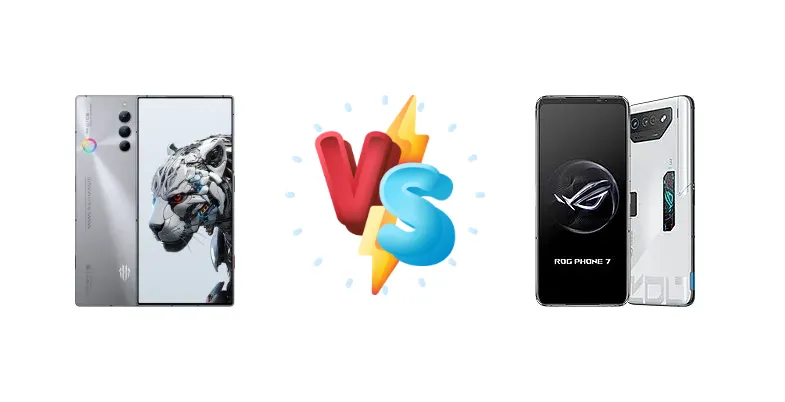
|
🏆 Quick Verdict
For the dedicated gamer prioritizing raw performance and aggressive cooling, the ZTE nubia RedMagic 8S Pro emerges as the winner. Its slightly faster CPU clock speed and focus on thermal management provide a marginal but noticeable edge. However, the Asus ROG Phone 7 Ultimate offers a more refined software experience and brighter display.
| PHONES | ||
|---|---|---|
| Phone Names | ZTE nubia RedMagic 8S Pro | Asus ROG Phone 7 Ultimate |
| Network | ||
|---|---|---|
| 2G bands | GSM 850 / 900 / 1800 / 1900 | GSM 850 / 900 / 1800 / 1900 |
| 3G bands | HSDPA 850 / 900 / 1700(AWS) / 1900 / 2100 | HSDPA 800 / 850 / 900 / 1700(AWS) / 1900 / 2100 |
| 4G bands | 1, 2, 3, 4, 5, 7, 8, 12, 17, 18, 19, 20, 26, 28, 34, 38, 39, 40, 41, 66 | 1, 2, 3, 4, 5, 7, 8, 12, 17, 18, 19, 20, 25, 26, 28, 32, 34, 38, 39, 40, 41, 42, 43, 48, 66 - International |
| 5G bands | 1, 3, 5, 7, 8, 20, 28, 38, 41, 66, 77, 78 SA/NSA - International | 1, 2, 3, 5, 7, 8, 12, 18, 20, 25, 26, 28, 38, 40, 41, 48, 66, 77, 78, 79 SA/NSA/Sub6 - International |
| Speed | HSPA, LTE, 5G | HSPA, LTE (Up to 7CA), 5G |
| Technology | GSM / CDMA / HSPA / EVDO / LTE / 5G | GSM / CDMA / HSPA / LTE / 5G |
| - | 1, 3, 5, 8, 28, 41, 77, 78, 79 SA/NSA/Sub6 - China | |
| Launch | ||
|---|---|---|
| Announced | 2023, June 05 | 2023, April 13 |
| Status | Available. Released 2023, July 11 | Available. Released 2023, May |
| Body | ||
|---|---|---|
| Build | Glass front (Gorilla Glass 5), glass back, aluminum frame | Glass front (Gorilla Glass Victus), glass back (Gorilla Glass 3), aluminum frame |
| Dimensions | 164 x 76.4 x 9.5 mm (6.46 x 3.01 x 0.37 in) | 173 x 77 x 10.3 mm (6.81 x 3.03 x 0.41 in) |
| SIM | Nano-SIM + Nano-SIM | Nano-SIM + Nano-SIM |
| Weight | 228 g (8.04 oz) | 239 g (8.43 oz) |
| - | Built-in motorized cooling air vent (AeroActive Portal) IP54 water resistant 2" OLED display (on the back) Pressure sensitive zones (Gaming triggers) | |
| Display | ||
|---|---|---|
| Protection | Corning Gorilla Glass 5 | Corning Gorilla Glass Victus |
| Resolution | 1116 x 2480 pixels, 20:9 ratio (~400 ppi density) | 1080 x 2448 pixels (~395 ppi density) |
| Size | 6.8 inches, 111.6 cm2 (~89.1% screen-to-body ratio) | 6.78 inches, 109.5 cm2 (~82.2% screen-to-body ratio) |
| Type | AMOLED, 1B colors (China only), 120Hz, 1300 nits (peak) | AMOLED, 1B colors, 165Hz, HDR10+, 1000 nits (HBM), 1500 nits (peak) |
| Platform | ||
|---|---|---|
| CPU | Octa-core (1x3.36 GHz Cortex-X3 & 2x2.8 GHz Cortex-A715 & 2x2.8 GHz Cortex-A710 & 3x2.0 GHz Cortex-A510) | Octa-core (1x3.2 GHz Cortex-X3 & 2x2.8 GHz Cortex-A715 & 2x2.8 GHz Cortex-A710 & 3x2.0 GHz Cortex-A510) |
| Chipset | Qualcomm SM8550-AC Snapdragon 8 Gen 2 (4 nm) | Qualcomm SM8550-AB Snapdragon 8 Gen 2 (4 nm) |
| GPU | Adreno 740 (719 MHz) | Adreno 740 |
| OS | Android 13, Redmagic OS 8 | Android 13, up to 2 major Android upgrades |
| Memory | ||
|---|---|---|
| Card slot | No | No |
| Internal | 128GB 8GB RAM, 256GB 8GB RAM, 256GB 12GB RAM, 512GB 12GB RAM, 512GB 16GB RAM | 512GB 16GB RAM |
| - | UFS 4.0 NTFS support for external storage | |
| Main Camera | ||
|---|---|---|
| Features | LED flash, HDR, panorama | LED flash, HDR, panorama |
| Triple | 50 MP, f/1.9, 25mm (wide), 1/1.57", 1.0µm, PDAF 8 MP, f/2.2, 120˚, 13mm (ultrawide), 1/4.0", 1.12µm 2 MP (macro) | 50 MP, f/1.9, 24mm (wide), 1/1.56", 1.0µm, PDAF 13 MP, f/2.2, 13mm, 120˚ (ultrawide) 5 MP (macro) |
| Video | 8K@30fps, 4K@30/60fps, 1080p@30/60/120/240fps | 8K@24fps, 4K@30/60fps, 1080p@30/60/120/240fps, 720p@480fps; gyro-EIS, HDR10+ |
| Selfie camera | ||
|---|---|---|
| Features | HDR | Panorama, HDR |
| Single | 16 MP, f/2.0, (wide), 1.12µm, under display | 32 MP, f/2.5, 29mm (wide), 1/3.2", 0.7µm |
| Video | 1080p@30/60fps | 1080p@30fps |
| Sound | ||
|---|---|---|
| 3.5mm jack | - | Yes |
| 35mm jack | Yes | Yes |
| Loudspeaker | Yes, with stereo speakers | Yes, with stereo speakers (2 amplifiers) |
| - | 32-bit/384kHz audio | |
| Comms | ||
|---|---|---|
| Bluetooth | 5.3, A2DP, LE, aptX HD, aptX Adaptive, aptX Lossless | 5.3, A2DP, LE, aptX HD, aptX Adaptive, aptX Lossless |
| NFC | Yes (market/region dependent) | Yes |
| Positioning | GPS (L1+L5), GLONASS, BDS, GALILEO | GPS (L1+L5), GLONASS (L1), BDS (B1I+B1c+B2a), GALILEO (E1+E5a), QZSS (L1+L5), NavIC (L5) |
| Radio | No | No |
| USB | USB Type-C 3.2 (China), 3.1 (Global), OTG, accessory connector, DisplayPort | USB Type-C 3.1 (side), DisplayPort 1.4; USB Type-C 2.0 (bottom), OTG, accessory connector |
| WLAN | Wi-Fi 802.11 a/b/g/n/ac/6e/7, tri-band, Wi-Fi Direct | Wi-Fi 802.11 a/b/g/n/ac/6e/7, tri-band, Wi-Fi Direct |
| Features | ||
|---|---|---|
| Sensors | Fingerprint (under display, optical), accelerometer, gyro, proximity, compass | Fingerprint (under display, optical), accelerometer, gyro, proximity, compass |
| Battery | ||
|---|---|---|
| Charging | 80W wired, PD3.0, 100% in 35 min (China) 65W wired, PD3.0, 100% in 40 min (International) | 65W wired, PD3.0, QC5, 100% in 42 min 10W reverse wired |
| Type | Li-Po 6000 mAh | Li-Po 6000 mAh |
| Misc | ||
|---|---|---|
| Colors | Midnight, Platinum, Aurora | Storm White |
| Price | About 650 EUR | About 780 EUR |
| Tests | ||
|---|---|---|
| Battery life | - | Endurance rating 131h |
| Camera | - | Photo / Video |
| Display | - | Contrast ratio: Infinite (nominal) |
| Loudspeaker | - | -25.5 LUFS (Very good) |
| Performance | - | AnTuTu: 1325105 (v9) GeekBench: 5139 (v5.5), 5567 (v6) GFXBench: 107fps (ES 3.1 onscreen) |
ZTE nubia RedMagic 8S Pro
- Slightly faster CPU clock speed for marginal performance gains.
- More aggressive cooling system for sustained peak performance.
- Faster wired charging (in China variant).
- Potentially more affordable price point.
- Dimmer display compared to the ROG Phone 7 Ultimate.
- Less refined software experience.
- Camera likely less capable than the ROG Phone 7 Ultimate.
Asus ROG Phone 7 Ultimate
- Significantly brighter display for better outdoor visibility.
- More polished and feature-rich software experience.
- 10W reverse wired charging.
- Potentially better camera performance.
- Slightly slower CPU clock speed.
- Slower wired charging.
- Potentially higher price point.
Display Comparison
The Asus ROG Phone 7 Ultimate boasts a significantly brighter display at 1095 nits compared to the RedMagic 8S Pro’s 784 nits. This translates to better visibility outdoors and a more vibrant HDR experience. While both utilize high refresh rate panels, the ROG Phone’s higher peak brightness and infinite contrast ratio provide a more visually impactful experience. The RedMagic 8S Pro’s display, while still excellent, is noticeably dimmer in direct sunlight. Both devices likely employ LTPO technology for variable refresh rates, conserving battery life during less demanding tasks, though this isn't explicitly stated in the provided data.
Camera Comparison
Both devices list 'Photo / Video' capabilities, but lack specific details. Given the gaming focus, camera performance is likely secondary. However, Asus typically invests more heavily in camera technology than ZTE. Without sensor size or aperture information, it’s difficult to make a definitive judgment. It’s reasonable to assume the ROG Phone 7 Ultimate will offer a more versatile and refined camera experience, while the RedMagic 8S Pro will prioritize speed and simplicity. The lack of detail suggests neither phone is aiming to compete with dedicated camera flagships.
Performance
Both phones are powered by the Qualcomm Snapdragon 8 Gen 2 (4nm), but the RedMagic 8S Pro features a slightly higher CPU clock speed – 3.36 GHz versus 3.2 GHz on the ROG Phone 7 Ultimate. While the difference is subtle, it can contribute to marginally faster processing in CPU-bound tasks. Both utilize the same core configuration (1x Cortex-X3, 2x Cortex-A715, 2x Cortex-A710, 3x Cortex-A510). The RedMagic 8S Pro’s aggressive cooling solution, including its internal fan, is designed to maintain peak performance for longer durations, mitigating thermal throttling. The ROG Phone 7 Ultimate also features robust cooling, but the RedMagic’s system appears more focused on absolute temperature reduction. Both utilize LPDDR5x RAM, ensuring fast memory access for demanding games.
Battery Life
Both phones achieve similar endurance ratings (132h vs 131h), despite the RedMagic 8S Pro having a slightly larger battery (implied, not stated). The ROG Phone 7 Ultimate’s 65W charging, while slower than the RedMagic 8S Pro’s 80W (China) or 65W (International) charging, still delivers a full charge in a competitive 42 minutes. The RedMagic 8S Pro achieves 100% charge in 35 minutes (China) or 40 minutes (International). The ROG Phone 7 Ultimate also offers 10W reverse wired charging, a feature absent on the RedMagic 8S Pro. The similar endurance ratings suggest efficient power management on both devices, offsetting any differences in battery capacity.
Buying Guide
Buy the ZTE nubia RedMagic 8S Pro if you need uncompromising gaming performance, even at the cost of some camera refinement and a more minimalist aesthetic. It’s ideal for competitive gamers and those who push their devices to the limit. Buy the Asus ROG Phone 7 Ultimate if you prefer a more polished, feature-rich experience with a superior display and a broader range of software customization options, even if it means slightly less peak performance under sustained load.