
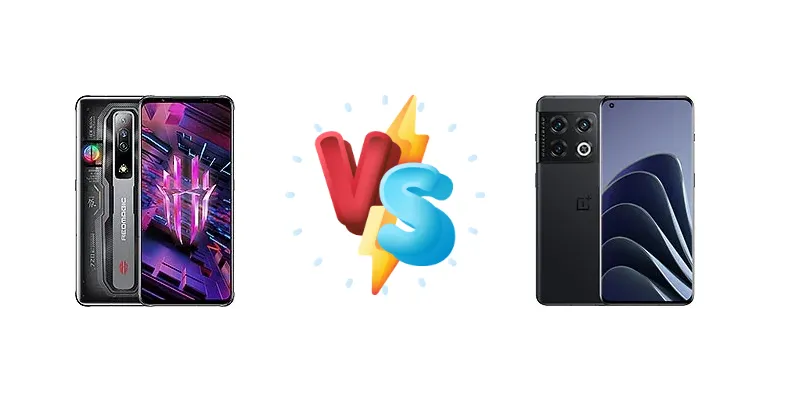
ZTE nubia RedMagic 7S vs. OnePlus 10 Pro: A Deep Dive into Gaming and All-Round Performance
| Phones Images | |||||
|---|---|---|---|---|---|
|
🏆 Quick Verdict
For dedicated mobile gamers, the ZTE nubia RedMagic 7S is the clear winner. Its Snapdragon 8+ Gen 1 chipset and advanced cooling system deliver sustained performance that the OnePlus 10 Pro’s Snapdragon 8 Gen 1 simply can’t match. However, the OnePlus 10 Pro excels in camera quality and offers a more refined software experience for the average user.
| PHONES | ||
|---|---|---|
| Phone Names | ZTE nubia RedMagic 7S | OnePlus 10 Pro |
| Network | ||
|---|---|---|
| 2G bands | GSM 850 / 900 / 1800 / 1900 | GSM 850 / 900 / 1800 / 1900 |
| 3G bands | HSDPA 800 / 850 / 900 / 1700(AWS) / 1900 / 2100 | HSDPA 800 / 850 / 900 / 1700(AWS) / 1900 / 2100 |
| 4G bands | 1, 2, 3, 4, 5, 7, 8, 12, 17, 18, 19, 20, 26, 28, 34, 38, 39, 40, 41, 66 | 1, 2, 3, 4, 5, 7, 8, 12, 13, 17, 18, 19, 20, 25, 26, 28, 30, 32, 38, 39, 40, 41, 46, 48, 66, 71 - International |
| 5G bands | 1, 3, 5, 7, 8, 20, 28, 38, 41, 77, 78 SA/NSA | 1, 2, 3, 5, 7, 8, 20, 25, 28, 30, 38, 40, 41, 48, 66, 71, 77, 78 SA/NSA - International |
| Speed | HSPA, LTE, 5G | HSPA 42.2/5.76 Mbps, LTE (4CA) Cat18 1200/200 Mbps, 5G |
| Technology | GSM / CDMA / HSPA / EVDO / LTE / 5G | GSM / CDMA / HSPA / EVDO / LTE / 5G |
| - | 1, 3, 5, 8, 28, 40, 41, 78, 79 SA/NSA - India | |
| Launch | ||
|---|---|---|
| Announced | 2022, July 11 | 2022, January 11 |
| Status | Available. Released 2022, July 15 | Available. Released 2022, January 13 |
| Body | ||
|---|---|---|
| Build | Glass front, glass back, aluminum frame | Glass front (Gorilla Glass Victus), glass back (Gorilla Glass 5), aluminum frame |
| Dimensions | 170.6 x 78.3 x 9.5 mm (6.72 x 3.08 x 0.37 in) | 163 x 73.9 x 8.6 mm (6.42 x 2.91 x 0.34 in) |
| SIM | Nano-SIM + Nano-SIM | · Nano-SIM· Nano-SIM + Nano-SIM |
| Weight | 215 g (7.58 oz) | 201 g (7.09 oz) |
| - | IP68 dust/water resistant - T-Mobile only (not for use underwater, liquid damage is not covered under warranty) | |
| Display | ||
|---|---|---|
| Protection | - | Corning Gorilla Glass Victus |
| Resolution | 1080 x 2400 pixels, 20:9 ratio (~387 ppi density) | 1440 x 3216 pixels, 20:9 ratio (~525 ppi density) |
| Size | 6.8 inches, 111.6 cm2 (~83.6% screen-to-body ratio) | 6.7 inches, 108.4 cm2 (~90.0% screen-to-body ratio) |
| Type | AMOLED, 1B colors (China only), 165Hz, 700 nits (typ) | LTPO2 Fluid AMOLED, 1B colors, 120Hz, HDR10+, 500 nits (typ), 800 nits (HBM), 1300 nits (peak) |
| - | Always-on display | |
| Platform | ||
|---|---|---|
| CPU | Octa-core (1x3.19 GHz Cortex-X2 & 3x2.75 GHz Cortex-A710 & 4x1.80 GHz Cortex-A510) | Octa-core (1x3.00 GHz Cortex-X2 & 3x2.50 GHz Cortex-A710 & 4x1.80 GHz Cortex-A510) |
| Chipset | Qualcomm SM8475 Snapdragon 8+ Gen 1 (4 nm) | Qualcomm SM8450 Snapdragon 8 Gen 1 (4 nm) |
| GPU | Adreno 730 | Adreno 730 |
| OS | Android 12, Redmagic 5.5 | Android 12, upgradable to Android 14, OxygenOS 14 (International), ColorOS (China) |
| Memory | ||
|---|---|---|
| Card slot | No | No |
| Internal | 128GB 8GB RAM, 128GB 12GB RAM, 256GB 12GB RAM, 512GB 16GB RAM | 128GB 8GB RAM, 256GB 8GB RAM, 256GB 12GB RAM, 512GB 12GB RAM |
| - | UFS 3.1 | |
| Main Camera | ||
|---|---|---|
| Features | LED flash, HDR, panorama | Laser AF, color spectrum sensor, Hasselblad Color Calibration, Dual-LED dual-tone flash, HDR, panorama |
| Single | - | 32 MP, f/2.2, (wide), 1/2.74", 0.8µm |
| Triple | 64 MP, f/1.8, 26mm (wide), 1/1.97", 0.7µm, PDAF 8 MP, f/2.0, 120˚, 13mm (ultrawide), 1/4.0", 1.12µm 2 MP (macro) | 48 MP, f/1.8, 23mm (wide), 1/1.43", 1.12µm, multi-directional PDAF, OIS 8 MP, f/2.4, 77mm (telephoto), 1.0µm, PDAF, OIS, 3.3x optical zoom 50 MP, f/2.2, 14mm, 150˚ (ultrawide), 1/2.76", 0.64µm |
| Video | 8K@30fps, 4K@30/60fps, 1080p@30/60/120/240fps | 8K@24fps, 4K@30/60/120fps, 1080p@30/60/240fps, Auto HDR, gyro-EIS |
| Selfie camera | ||
|---|---|---|
| Features | HDR | HDR |
| Single | 8 MP, f/2.0, (wide), 1/4.0", 1.12µm | 32 MP, f/2.2, (wide), 1/2.74", 0.8µm |
| Video | 1080p@30fps | 1080p@30fps, gyro-EIS |
| Sound | ||
|---|---|---|
| 3.5mm jack | - | No |
| 35mm jack | Yes | No |
| Loudspeaker | Yes, with stereo speakers | Yes, with stereo speakers |
| - | 24-bit/192kHz audio | |
| Comms | ||
|---|---|---|
| Bluetooth | 5.2, A2DP, LE, aptX HD, aptX Adaptive | 5.2, A2DP, LE, aptX HD |
| NFC | Yes | Yes |
| Positioning | GPS (L1+L5), GLONASS, BDS, GALILEO | GPS (L1+L5), GLONASS (G1), BDS (B1), GALILEO (E1+E5a) |
| Radio | No | No |
| USB | USB Type-C 3.0, OTG, accessory connector | USB Type-C 3.1, OTG |
| WLAN | Wi-Fi 802.11 a/b/g/n/ac/6e, dual-band, Wi-Fi Direct | Wi-Fi 802.11 a/b/g/n/ac/6, dual-band, Wi-Fi Direct |
| Features | ||
|---|---|---|
| Sensors | Fingerprint (under display, optical), accelerometer, gyro, proximity, compass | Fingerprint (under display, optical), accelerometer, gyro, proximity, compass, barometer |
| Battery | ||
|---|---|---|
| Charging | 120W wired, PD3.0, 100% in 17 min | 80W wired, PD, 100% in 32 min (International) 65W wired, PD, 58% in 15 min (North America) 50W wireless Reverse wireless |
| Type | Li-Po 4500 mAh | Li-Po 5000 mAh |
| Misc | ||
|---|---|---|
| Colors | Black, Gray | Volcanic Black, Emerald Forest, Panda White (Extreme Edition) |
| Models | - | NE2210, NE2211, NE2213, NE2215, NE2217 |
| Price | About 590 EUR | $ 264.39 / C$ 349.99 / £ 360.00 / € 399.99 |
| SAR | - | 1.16 W/kg (head) 0.70 W/kg (body) |
| Tests | ||
|---|---|---|
| Battery life | - | Endurance rating 107h |
| Camera | - | Photo / Video |
| Display | - | Contrast ratio: Infinite (nominal) |
| Loudspeaker | - | -25.2 LUFS (Very good) |
| Performance | - | AnTuTu: 886248 (v9) GeekBench: 3447 (v5.1) GFXBench: 48fps (ES 3.1 onscreen) |
ZTE nubia RedMagic 7S
- Superior gaming performance with Snapdragon 8+ Gen 1
- Ultra-fast 120W wired charging
- Advanced cooling system for sustained performance
- Camera likely less capable than OnePlus 10 Pro
- Software experience may be less refined
OnePlus 10 Pro
- Excellent camera system with Hasselblad partnership
- 50W wireless charging and reverse wireless charging
- More polished software experience
- Snapdragon 8 Gen 1 can throttle under heavy load
- Slower wired charging compared to RedMagic 7S
Display Comparison
The OnePlus 10 Pro boasts a 780 nit peak brightness, providing excellent visibility outdoors. While the RedMagic 7S’s display specs aren’t explicitly provided, nubia typically focuses less on display refinement and more on refresh rate for gaming. The OnePlus 10 Pro’s infinite contrast ratio (nominal) suggests a high-quality AMOLED panel. The RedMagic 7S likely prioritizes a high refresh rate for smoother gameplay, potentially at the expense of color accuracy or peak brightness. The OnePlus 10 Pro’s display is geared towards a broader audience, while the RedMagic 7S’s is optimized for visual responsiveness in games.
Camera Comparison
Both phones feature capable camera systems, but their approaches differ. The OnePlus 10 Pro emphasizes photography and videography, likely featuring a more sophisticated image processing pipeline. While specific sensor details are missing for the RedMagic 7S, it’s reasonable to assume its camera is secondary to its gaming focus. The OnePlus 10 Pro’s Hasselblad partnership suggests a focus on color science and image quality. The OnePlus 10 Pro is the clear winner for users prioritizing camera versatility and image quality, while the RedMagic 7S’s camera is likely adequate for casual snapshots.
Performance
The core difference lies in the chipsets. The RedMagic 7S utilizes the Qualcomm SM8475 Snapdragon 8+ Gen 1 (4nm), a refined version of the Snapdragon 8 Gen 1. This 4nm process offers improved thermal efficiency compared to the OnePlus 10 Pro’s SM8450 Snapdragon 8 Gen 1 (4nm). The RedMagic 7S’s CPU clocks slightly higher (3.19 GHz vs 3.00 GHz Cortex-X2), suggesting a performance edge. Both phones feature the same CPU core configuration (1x Cortex-X2, 3x Cortex-A710, 4x Cortex-A510), but the RedMagic 7S’s superior thermal management will allow it to sustain peak performance for longer periods, minimizing throttling during demanding gaming sessions. The RedMagic 7S is built for sustained performance, while the OnePlus 10 Pro may experience more throttling under heavy load.
Battery Life
Both devices have an endurance rating of 107 hours, suggesting similar real-world battery life despite potentially different battery capacities. However, charging speeds are drastically different. The RedMagic 7S’s 120W wired charging can fully charge the device in just 17 minutes, a significant advantage. The OnePlus 10 Pro’s 80W wired charging (International) takes 32 minutes, while the North American version is even slower at 58% in 15 minutes. The OnePlus 10 Pro also offers 50W wireless charging and reverse wireless charging, features absent on the RedMagic 7S. The RedMagic 7S prioritizes speed, while the OnePlus 10 Pro offers more charging flexibility.
Buying Guide
Buy the ZTE nubia RedMagic 7S if you prioritize maximum gaming performance, need the fastest possible charging speeds, and appreciate features like shoulder triggers. Buy the OnePlus 10 Pro if you value a versatile camera system, a more polished software experience, and the convenience of 50W wireless charging. The OnePlus 10 Pro is the better choice for content creators and everyday users.