
ZTE nubia RedMagic 7S vs. Google Pixel 6 Pro: A Deep Dive into Gaming and AI
| Phones Images | |||||
|---|---|---|---|---|---|
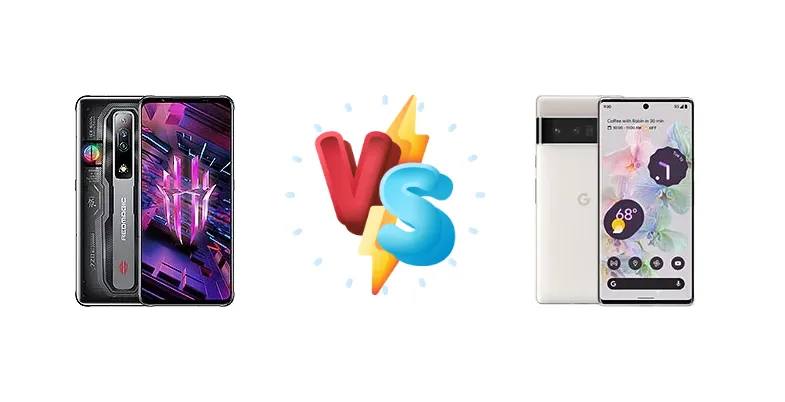
|
🏆 Quick Verdict
For the average user prioritizing a balanced experience with excellent camera capabilities and smart features, the Google Pixel 6 Pro is the better choice. However, gamers and power users demanding sustained peak performance will find the RedMagic 7S’s Snapdragon 8+ Gen 1 and advanced cooling system far more compelling.
| PHONES | ||
|---|---|---|
| Phone Names | ZTE nubia RedMagic 7S | Google Pixel 6 Pro |
| Network | ||
|---|---|---|
| 2G bands | GSM 850 / 900 / 1800 / 1900 | GSM 850 / 900 / 1800 / 1900 |
| 3G bands | HSDPA 800 / 850 / 900 / 1700(AWS) / 1900 / 2100 | HSDPA 800 / 850 / 900 / 1700(AWS) / 1900 / 2100 |
| 4G bands | 1, 2, 3, 4, 5, 7, 8, 12, 17, 18, 19, 20, 26, 28, 34, 38, 39, 40, 41, 66 | 1, 2, 3, 4, 5, 7, 8, 12, 13, 14, 17, 18, 19, 20, 25, 26, 28, 29, 30, 32, 38, 39, 40, 41, 42, 46, 48, 66, 71 - GLUOG, G8VOU |
| 5G bands | 1, 3, 5, 7, 8, 20, 28, 38, 41, 77, 78 SA/NSA | 1, 2, 3, 5, 7, 8, 12, 14, 20, 25, 28, 30, 38, 40, 41, 48, 66, 71, 77, 78, 257, 258, 260, 261 SA/NSA/Sub6/mmWave - G8VOU |
| Speed | HSPA, LTE, 5G | HSPA, LTE, 5G |
| Technology | GSM / CDMA / HSPA / EVDO / LTE / 5G | GSM / CDMA / HSPA / EVDO / LTE / 5G |
| - | 1, 2, 3, 5, 7, 8, 12, 14, 20, 25, 28, 30, 38, 40, 41, 48, 66, 71, 77, 78 SA/NSA/Sub6 - GLUOG | |
| Launch | ||
|---|---|---|
| Announced | 2022, July 11 | 2021, October 19 |
| Status | Available. Released 2022, July 15 | Available. Released 2021, October 28 |
| Body | ||
|---|---|---|
| Build | Glass front, glass back, aluminum frame | Glass front (Gorilla Glass Victus), glass back (Gorilla Glass Victus), aluminum frame |
| Dimensions | 170.6 x 78.3 x 9.5 mm (6.72 x 3.08 x 0.37 in) | 163.9 x 75.9 x 8.9 mm (6.45 x 2.99 x 0.35 in) |
| SIM | Nano-SIM + Nano-SIM | Nano-SIM + eSIM |
| Weight | 215 g (7.58 oz) | 210 g (7.41 oz) |
| - | IP68 dust/water resistant (up to 1.5m for 30 min) | |
| Display | ||
|---|---|---|
| Protection | - | Corning Gorilla Glass Victus |
| Resolution | 1080 x 2400 pixels, 20:9 ratio (~387 ppi density) | 1440 x 3120 pixels, 19.5:9 ratio (~512 ppi density) |
| Size | 6.8 inches, 111.6 cm2 (~83.6% screen-to-body ratio) | 6.7 inches, 110.6 cm2 (~88.9% screen-to-body ratio) |
| Type | AMOLED, 1B colors (China only), 165Hz, 700 nits (typ) | LTPO AMOLED, 120Hz, HDR10+ |
| - | Always-on display | |
| Platform | ||
|---|---|---|
| CPU | Octa-core (1x3.19 GHz Cortex-X2 & 3x2.75 GHz Cortex-A710 & 4x1.80 GHz Cortex-A510) | Octa-core (2x2.80 GHz Cortex-X1 & 2x2.25 GHz Cortex-A76 & 4x1.80 GHz Cortex-A55) |
| Chipset | Qualcomm SM8475 Snapdragon 8+ Gen 1 (4 nm) | Google Tensor (5 nm) |
| GPU | Adreno 730 | Mali-G78 MP20 |
| OS | Android 12, Redmagic 5.5 | Android 12, upgradable to Android 15, up to 5 major Android upgrades |
| Memory | ||
|---|---|---|
| Card slot | No | No |
| Internal | 128GB 8GB RAM, 128GB 12GB RAM, 256GB 12GB RAM, 512GB 16GB RAM | 128GB 12GB RAM, 256GB 12GB RAM, 512GB 12GB RAM |
| - | UFS 3.1 | |
| Main Camera | ||
|---|---|---|
| Features | LED flash, HDR, panorama | Laser AF, Dual-LED flash, Pixel Shift, Auto-HDR, panorama |
| Single | - | 11.1 MP, f/2.2, 20mm (ultrawide), 1.22µm |
| Triple | 64 MP, f/1.8, 26mm (wide), 1/1.97", 0.7µm, PDAF 8 MP, f/2.0, 120˚, 13mm (ultrawide), 1/4.0", 1.12µm 2 MP (macro) | 50 MP, f/1.9, 25mm (wide), 1/1.31", 1.2µm, dual pixel PDAF, OIS 48 MP, f/3.5, 104mm (periscope telephoto), 1/2.0", 0.8µm, PDAF, OIS, 4x optical zoom 12 MP, f/2.2, 17mm, 114˚ (ultrawide), 1.25µm |
| Video | 8K@30fps, 4K@30/60fps, 1080p@30/60/120/240fps | 4K@30/60fps, 1080p@30/60/120/240fps; gyro-EIS, OIS |
| Selfie camera | ||
|---|---|---|
| Features | HDR | HDR, panorama |
| Single | 8 MP, f/2.0, (wide), 1/4.0", 1.12µm | 11.1 MP, f/2.2, 20mm (ultrawide), 1.22µm |
| Video | 1080p@30fps | 4K@30fps, 1080p@30/60fps |
| Sound | ||
|---|---|---|
| 3.5mm jack | - | No |
| 35mm jack | Yes | No |
| Loudspeaker | Yes, with stereo speakers | Yes, with stereo speakers |
| Comms | ||
|---|---|---|
| Bluetooth | 5.2, A2DP, LE, aptX HD, aptX Adaptive | 5.2, A2DP, LE, aptX HD |
| NFC | Yes | Yes |
| Positioning | GPS (L1+L5), GLONASS, BDS, GALILEO | GPS (L1+L5), GLONASS (G1), BDS (B1I+B1c+B2a), GALILEO (E1+E5a), QZSS (L1+L5) |
| Radio | No | No |
| USB | USB Type-C 3.0, OTG, accessory connector | USB Type-C 3.1 |
| WLAN | Wi-Fi 802.11 a/b/g/n/ac/6e, dual-band, Wi-Fi Direct | Wi-Fi 802.11 a/b/g/n/ac/6e, dual-band, Wi-Fi Direct |
| Features | ||
|---|---|---|
| Sensors | Fingerprint (under display, optical), accelerometer, gyro, proximity, compass | Fingerprint (under display, optical), accelerometer, gyro, proximity, compass, barometer |
| - | Ultra Wideband (UWB) support | |
| Battery | ||
|---|---|---|
| Charging | 120W wired, PD3.0, 100% in 17 min | 23W wired, PD3.0, 50% in 30 min 23W wireless Reverse wireless |
| Type | Li-Po 4500 mAh | Li-Ion 5003 mAh |
| Misc | ||
|---|---|---|
| Colors | Black, Gray | Cloudy White, Sorta Sunny, Stormy Black |
| Models | - | GLUOG, G8VOU, GF5KQ |
| Price | About 590 EUR | € 199.99 / $ 204.99 / £ 275.00 / ₹ 29,699 |
| Tests | ||
|---|---|---|
| Battery life | - | Endurance rating 84h |
| Display | - | Contrast ratio: Infinite (nominal) |
| Performance | - | AnTuTu: 585485 (v8), 719815 (v9) GeekBench: 2831 (v5.1) GFXBench: 39 fps (ES 3.1 onscreen) |
ZTE nubia RedMagic 7S
- Unmatched gaming performance with Snapdragon 8+ Gen 1
- Ultra-fast 120W charging
- Advanced cooling system prevents throttling
- Camera quality likely inferior to Pixel 6 Pro
- Software experience may be less refined
Google Pixel 6 Pro
- Exceptional camera with Google’s computational photography
- Smooth and intuitive software experience
- Wireless and reverse wireless charging
- Slower charging speeds
- Can experience thermal throttling during prolonged gaming
Display Comparison
The Pixel 6 Pro boasts a bright display, reaching 846 nits measured, and an infinite contrast ratio, providing vibrant visuals. However, the RedMagic 7S, while lacking specific brightness data, is geared towards high refresh rates for smoother gaming. The Pixel 6 Pro’s larger display size and curved edges offer a more immersive viewing experience, while the RedMagic 7S likely prioritizes responsiveness over absolute visual fidelity. The absence of LTPO technology in the RedMagic 7S suggests it may not dynamically adjust refresh rates as efficiently as some competitors, potentially impacting battery life during less demanding tasks.
Camera Comparison
The Pixel 6 Pro excels in computational photography, leveraging Google’s Tensor chip for advanced image processing. While specific sensor details are missing for the RedMagic 7S, it’s unlikely to match the Pixel 6 Pro’s capabilities in dynamic range, detail, and low-light performance. The Pixel 6 Pro’s image processing algorithms are renowned for their realistic color reproduction and excellent portrait mode. The RedMagic 7S likely focuses on providing a functional camera system for casual use, rather than competing with the Pixel 6 Pro’s flagship-level imaging.
Performance
The core difference lies in the chipsets. The RedMagic 7S’s Snapdragon 8+ Gen 1 (4nm) is a powerhouse, featuring a Cortex-X2 prime core clocked at 3.19 GHz, designed for peak performance. This contrasts with the Pixel 6 Pro’s Google Tensor (5nm), which prioritizes AI and machine learning tasks. While the Tensor’s Cortex-X1 cores reach 2.80 GHz, the Snapdragon 8+ Gen 1’s architecture and smaller node size offer superior sustained performance and thermal efficiency. The RedMagic 7S’s focus on gaming is further reinforced by its likely use of faster LPDDR5X RAM, while the Pixel 6 Pro’s RAM configuration isn’t specified. The RedMagic 7S’s active cooling system is a critical advantage, mitigating thermal throttling during extended gaming sessions, a weakness often observed in the Pixel 6 Pro under heavy load.
Battery Life
Both phones achieve an endurance rating of 84 hours, suggesting comparable overall battery life despite differing capacities. However, the charging speeds are drastically different. The RedMagic 7S’s 120W wired charging can fully charge the device in just 17 minutes, a significant advantage over the Pixel 6 Pro’s 23W wired charging, which takes 30 minutes to reach 50%. The Pixel 6 Pro also offers 23W wireless charging and reverse wireless charging, features absent on the RedMagic 7S. The faster charging on the RedMagic 7S is crucial for gamers who need to quickly top up their battery between sessions.
Buying Guide
Buy the ZTE nubia RedMagic 7S if you need a dedicated gaming phone with maximum sustained performance, rapid 120W charging, and don't prioritize camera versatility or a polished software experience. Buy the Google Pixel 6 Pro if you prefer a premium smartphone experience with a class-leading camera, innovative AI features, and a clean, intuitive software interface, even if it means sacrificing some raw gaming power.