
ZTE nubia RedMagic 7S Pro vs. Xiaomi 12 Pro (Dimensity): A Deep Dive Comparison
| Phones Images | |||||
|---|---|---|---|---|---|
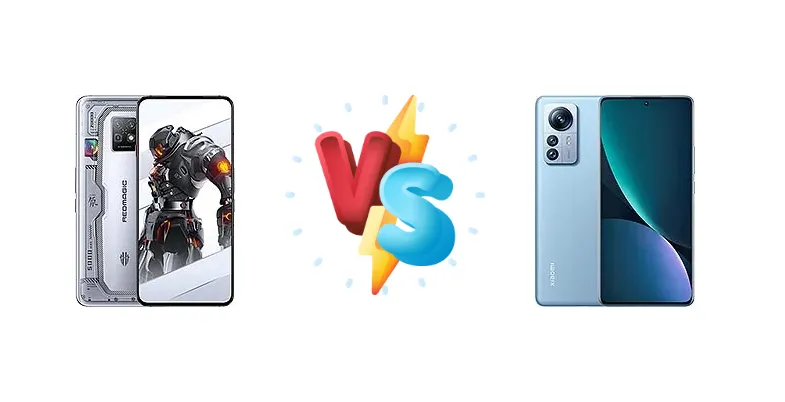
|
🏆 Quick Verdict
For dedicated mobile gamers, the ZTE nubia RedMagic 7S Pro is the clear winner, offering superior cooling and a chipset optimized for sustained performance. However, the Xiaomi 12 Pro (Dimensity) provides a more refined all-around experience with a better camera and more versatile software, making it ideal for everyday users.
| PHONES | ||
|---|---|---|
| Phone Names | ZTE nubia RedMagic 7S Pro | Xiaomi 12 Pro (Dimensity) |
| Network | ||
|---|---|---|
| 2G bands | GSM 850 / 900 / 1800 / 1900 | GSM 850 / 900 / 1800 / 1900 |
| 3G bands | HSDPA 850 / 900 / 1700(AWS) / 1900 / 2100 | HSDPA 800 / 850 / 900 / 1700(AWS) / 1900 / 2100 |
| 4G bands | 1, 2, 3, 4, 5, 7, 8, 12, 17, 18, 19, 20, 26, 28, 34, 38, 40, 41, 66 - International | 1, 2, 3, 4, 5, 7, 8, 18, 19, 26, 34, 38, 39, 40, 41, 42 |
| 5G bands | 1, 3, 5, 7, 8, 20, 28, 38, 41, 77, 78 SA/NSA - International, China | 1, 3, 5, 8, 28, 38, 40, 41, 77, 78 SA/NSA |
| Speed | HSPA, LTE, 5G | HSPA, LTE, 5G |
| Technology | GSM / CDMA / HSPA / EVDO / LTE / 5G | GSM / CDMA / HSPA / EVDO / LTE / 5G |
| - | CDMA2000 1xEV-DO | |
| Launch | ||
|---|---|---|
| Announced | 2022, July 11 | 2022, July 04 |
| Status | Available. Released 2022, July 15 | Available. Released 2022, July 13 |
| Body | ||
|---|---|---|
| Build | Glass front, glass back, aluminum frame | - |
| Dimensions | 166.3 x 77.1 x 10 mm (6.55 x 3.04 x 0.39 in) | 163.6 x 74.6 x 8.2 mm (6.44 x 2.94 x 0.32 in) |
| SIM | Nano-SIM + Nano-SIM | Nano-SIM + Nano-SIM |
| Weight | 235 g (8.29 oz) | 201 g (7.09 oz) |
| Display | ||
|---|---|---|
| Protection | Corning Gorilla Glass 5 | Corning Gorilla Glass Victus |
| Resolution | 1080 x 2400 pixels, 20:9 ratio (~387 ppi density) | 1440 x 3200 pixels, 20:9 ratio (~521 ppi density) |
| Size | 6.8 inches, 111.6 cm2 (~87.1% screen-to-body ratio) | 6.73 inches, 109.4 cm2 (~89.6% screen-to-body ratio) |
| Type | AMOLED, 1B colors (China only), 120Hz, 600 nits | LTPO2 AMOLED, 1B colors, 120Hz, Dolby Vision, HDR10+, 1000 nits (HBM), 1500 nits (peak) |
| Platform | ||
|---|---|---|
| CPU | Octa-core (1x3.19 GHz Cortex-X2 & 3x2.75 GHz Cortex-A710 & 4x1.80 GHz Cortex-A510) | Octa-core (1x3.20 GHz Cortex-X2 & 3x2.85 GHz Cortex-A710 & 4x1.80 GHz Cortex-A510) |
| Chipset | Qualcomm SM8475 Snapdragon 8+ Gen 1 (4 nm) | Mediatek Dimensity 9000+ (4 nm) |
| GPU | Adreno 730 | Mali-G710 MC10 |
| OS | Android 12, Redmagic 5.5 | Android 12, MIUI 13 |
| Memory | ||
|---|---|---|
| Card slot | No | No |
| Internal | 256GB 12GB RAM, 512GB 16GB RAM, 512GB 18GB RAM, 1TB 18GB RAM | 128GB 8GB RAM, 256GB 12GB RAM |
| - | UFS 3.1 | |
| Main Camera | ||
|---|---|---|
| Features | LED flash, HDR, panorama | Color spectrum sensor, Dual-LED dual-tone flash, HDR, panorama |
| Single | - | 32 MP, f/2.5, 26mm (wide), 0.7µm |
| Triple | 64 MP, f/1.8, 26mm (wide), 1/1.97", 0.7µm, PDAF 8 MP, f/2.2, 120˚, 13mm (ultrawide), 1/4.0", 1.12µm 2 MP (macro) | 50 MP, f/1.9, 24mm (wide), 1/1.28", 1.22µm, dual pixel PDAF, OIS 13 MP, f/2.4, 15mm, 123˚ (ultrawide), 1/3.06", 1.12µm 5 MP, f/2.4, 50mm (telephoto macro), AF |
| Video | 8K@30fps, 4K@30/60fps, 1080p@30/60/120/240fps | 4K@30/60fps, 1080p@30/60/120fps, gyro-EIS |
| Selfie camera | ||
|---|---|---|
| Features | HDR | HDR, panorama |
| Single | 16 MP, (wide), under display | 32 MP, f/2.5, 26mm (wide), 0.7µm |
| Video | 1080p@30/60fps | 1080p@30/60fps, 720p@120fps |
| Sound | ||
|---|---|---|
| 3.5mm jack | - | No |
| 35mm jack | Yes | No |
| Loudspeaker | Yes, with stereo speakers | Yes, with stereo speakers |
| - | 24-bit/192kHz audio Tuned by Harman Kardon | |
| Comms | ||
|---|---|---|
| Bluetooth | 5.2, A2DP, LE, aptX HD, aptX Adaptive | 5.3, A2DP, LE |
| Infrared port | - | Yes |
| NFC | Yes | Yes |
| Positioning | GPS (L1+L5), GLONASS, BDS, GALILEO | GPS (L1+L5), GLONASS (L1), BDS (B1I+B1c+B2a), GALILEO (E1+E5a), QZSS (L1+L5), NavIC (L5) |
| Radio | No | No |
| USB | USB Type-C 3.0, OTG, accessory connector | USB Type-C 2.0, OTG |
| WLAN | Wi-Fi 802.11 a/b/g/n/ac/6e, dual-band, Wi-Fi Direct | Wi-Fi 802.11 a/b/g/n/ac/6, dual-band, Wi-Fi Direct |
| Features | ||
|---|---|---|
| Sensors | Fingerprint (under display, optical), accelerometer, gyro, proximity, compass | Fingerprint (under display, optical), accelerometer, gyro, proximity, compass |
| Battery | ||
|---|---|---|
| Charging | 135W wired, PD3.0, 50% in 5 min, 100% in 15 min (China) 65W wired, PD3.0 (International) | 67W wired, PD3.0, QC4 |
| Type | Li-Po 5000 mAh | Li-Po 5160 mAh |
| Misc | ||
|---|---|---|
| Colors | Obsidian, Supernova, Mercury, Yellow | Gray, Blue |
| Models | NX709S | 2207122MC |
| Price | About 780 EUR | About 570 EUR |
ZTE nubia RedMagic 7S Pro
- Unmatched charging speed (135W in China)
- Superior sustained gaming performance due to cooling
- Snapdragon 8+ Gen 1 chipset optimized for gaming
- Potentially less refined camera system
- Design prioritizes cooling over aesthetics for some
Xiaomi 12 Pro (Dimensity)
- Premium build quality and design
- More versatile and capable camera system
- Balanced performance for everyday tasks
- Slower charging speed compared to RedMagic
- May experience more thermal throttling during extended gaming
Display Comparison
The Xiaomi 12 Pro doesn't disclose its peak brightness, but the RedMagic 7S Pro achieves 449 nits, suggesting the Xiaomi likely surpasses this. Both utilize 4nm chipsets, but the RedMagic's focus is on maximizing sustained performance, potentially at the expense of display calibration. While both likely offer excellent color accuracy, the RedMagic's display is geared towards responsiveness for gaming, while the Xiaomi's is likely tuned for more natural color reproduction. Bezels are expected to be minimal on both, but the RedMagic's design prioritizes cooling vents, potentially impacting the screen-to-body ratio.
Camera Comparison
The context data lacks detailed camera specifications for both devices. However, given Xiaomi's history, the 12 Pro likely features a more sophisticated camera system with a larger main sensor and advanced image processing algorithms. The RedMagic 7S Pro, while capable, likely prioritizes camera functionality as a secondary feature. Expect the Xiaomi 12 Pro to excel in low-light photography and offer more versatile shooting modes. The inclusion of OIS (Optical Image Stabilization) is probable on the Xiaomi, further enhancing image quality.
Performance
Both devices employ 4nm chipsets, but the Qualcomm Snapdragon 8+ Gen 1 in the RedMagic 7S Pro and the MediaTek Dimensity 9000+ in the Xiaomi 12 Pro differ in architecture. The Dimensity 9000+ boasts a slightly higher peak CPU clock speed (3.20 GHz vs 3.19 GHz), but the Snapdragon 8+ Gen 1 is known for its improved thermal efficiency. This means the RedMagic 7S Pro is likely to sustain peak performance for longer periods during demanding tasks like gaming, minimizing throttling. Both utilize octa-core configurations with the same Cortex-A510 cores, but the A710 cores differ slightly in clock speed. The RedMagic's active cooling system further enhances its sustained performance capabilities.
Battery Life
The RedMagic 7S Pro boasts incredibly fast charging – 135W wired (China) and 65W internationally – capable of reaching 100% in just 15 minutes (China) or a still-impressive time internationally. The Xiaomi 12 Pro offers 67W wired charging, which is respectable but significantly slower. While battery capacity isn't specified, the RedMagic's charging speed effectively mitigates any potential capacity disadvantage. The Xiaomi 12 Pro supports PD3.0 and QC4, while the RedMagic supports PD3.0, offering broad compatibility.
Buying Guide
Buy the ZTE nubia RedMagic 7S Pro if you prioritize maximum gaming performance, require the fastest possible charging speeds (especially the Chinese variant), and appreciate a design focused on cooling and ergonomics for extended play sessions. Buy the Xiaomi 12 Pro (Dimensity) if you value a premium build quality, a more capable camera system, and a balanced user experience that doesn't solely revolve around gaming.