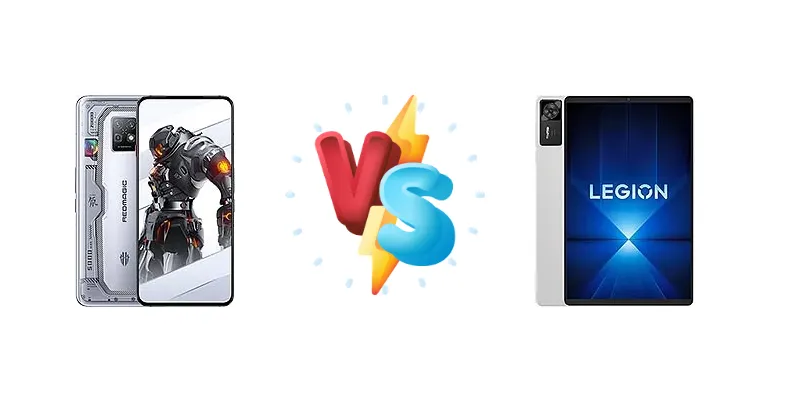
The gaming phone market is heating up, with the ZTE nubia RedMagic 7S Pro and Lenovo Legion Y700 (Gen 4) representing distinct approaches to mobile gaming dominance. The RedMagic 7S Pro, leveraging the Snapdragon 8+ Gen 1, focuses on aggressive cooling and a feature-rich gaming experience. The Legion Y700 (Gen 4), powered by the newer Snapdragon 8 Elite, aims for peak performance with a more streamlined design. This comparison dissects their key differences to determine which phone reigns supreme.
🏆 Quick Verdict
For most gamers, the Lenovo Legion Y700 (Gen 4) emerges as the superior choice. Its Snapdragon 8 Elite chipset, built on a 3nm process, delivers demonstrably better performance and efficiency than the RedMagic 7S Pro’s 4nm Snapdragon 8+ Gen 1. While the RedMagic boasts faster wired charging, the Legion’s overall package offers a more future-proof and refined gaming experience.
| Network |
|---|
| 2G bands | GSM 850 / 900 / 1800 / 1900 | N/A |
| 3G bands | HSDPA 850 / 900 / 1700(AWS) / 1900 / 2100 | N/A |
| 4G bands | 1, 2, 3, 4, 5, 7, 8, 12, 17, 18, 19, 20, 26, 28, 34, 38, 40, 41, 66 - International | N/A |
| 5G bands | 1, 3, 5, 7, 8, 20, 28, 38, 41, 77, 78 SA/NSA - International, China | - |
| EDGE | - | No |
| GPRS | - | No |
| Speed | HSPA, LTE, 5G | - |
| Technology | GSM / CDMA / HSPA / EVDO / LTE / 5G | No cellular connectivity |
| Launch |
|---|
| Announced | 2022, July 11 | 2025, May 08 |
| Status | Available. Released 2022, July 15 | Available. Released 2025, May |
| Body |
|---|
| Build | Glass front, glass back, aluminum frame | Glass front, aluminum frame, aluminum back |
| Dimensions | 166.3 x 77.1 x 10 mm (6.55 x 3.04 x 0.39 in) | 7 mm thickness |
| SIM | Nano-SIM + Nano-SIM | No |
| Weight | 235 g (8.29 oz) | 340 g (11.99 oz) |
| Display |
|---|
| Protection | Corning Gorilla Glass 5 | - |
| Resolution | 1080 x 2400 pixels, 20:9 ratio (~387 ppi density) | 1904 x 3040 pixels, 16:10 ratio (~408 ppi density) |
| Size | 6.8 inches, 111.6 cm2 (~87.1% screen-to-body ratio) | 8.8 inches, 224.8 cm2 |
| Type | AMOLED, 1B colors (China only), 120Hz, 600 nits | IPS LCD, 68B colors, 165Hz, HDR, 600 nits (typ) |
| Platform |
|---|
| CPU | Octa-core (1x3.19 GHz Cortex-X2 & 3x2.75 GHz Cortex-A710 & 4x1.80 GHz Cortex-A510) | Octa-core (2x4.32 GHz Oryon V2 Phoenix L + 6x3.53 GHz Oryon V2 Phoenix M) |
| Chipset | Qualcomm SM8475 Snapdragon 8+ Gen 1 (4 nm) | Qualcomm SM8750-AB Snapdragon 8 Elite (3 nm) |
| GPU | Adreno 730 | Adreno 830 |
| OS | Android 12, Redmagic 5.5 | Android 15 |
| Memory |
|---|
| Card slot | No | microSDXC |
| Internal | 256GB 12GB RAM, 512GB 16GB RAM, 512GB 18GB RAM, 1TB 18GB RAM | 256GB 12GB RAM, 512GB 16GB RAM, 1TB 16GB RAM |
| Main Camera |
|---|
| Features | LED flash, HDR, panorama | LED flash |
| Single | - | 50 MP, (wide), PDAF |
| Triple | 64 MP, f/1.8, 26mm (wide), 1/1.97", 0.7µm, PDAF
8 MP, f/2.2, 120˚, 13mm (ultrawide), 1/4.0", 1.12µm
2 MP (macro) | - |
| Video | 8K@30fps, 4K@30/60fps, 1080p@30/60/120/240fps | Yes |
| Selfie camera |
|---|
| Features | HDR | - |
| Single | 16 MP, (wide), under display | 8 MP |
| Video | 1080p@30/60fps | 1080p@30fps |
| Sound |
|---|
| 35mm jack | Yes | No |
| Loudspeaker | Yes, with stereo speakers | Yes, with stereo speakers |
| Comms |
|---|
| Bluetooth | 5.2, A2DP, LE, aptX HD, aptX Adaptive | Yes |
| NFC | Yes | No |
| Positioning | GPS (L1+L5), GLONASS, BDS, GALILEO | No |
| Radio | No | Unspecified |
| USB | USB Type-C 3.0, OTG, accessory connector | 1x USB Type-C 2.0 & 1x USB Type-C 3.2 Gen2, DisplayPort 1.4 |
| WLAN | Wi-Fi 802.11 a/b/g/n/ac/6e, dual-band, Wi-Fi Direct | Yes |
| Features |
|---|
| Sensors | Fingerprint (under display, optical), accelerometer, gyro, proximity, compass | Unspecified |
| Battery |
|---|
| Charging | 135W wired, PD3.0, 50% in 5 min, 100% in 15 min (China)
65W wired, PD3.0 (International) | 68W wired
Bypass charging |
| Type | Li-Po 5000 mAh | Li-Po 7600 mAh |
| Misc |
|---|
| Colors | Obsidian, Supernova, Mercury, Yellow | Black, White |
| Models | NX709S | TB322FC, ZAG40002CN |
| Price | About 780 EUR | About 400 EUR |
ZTE nubia RedMagic 7S Pro
- Extremely fast wired charging (135W in China)
- Aggressive cooling system for sustained performance
- Gaming-focused features like shoulder triggers
- Older Snapdragon 8+ Gen 1 chipset
- Potentially less efficient power consumption
- Bulky design geared towards gamers
Lenovo Legion Y700 (Gen 4)
- Cutting-edge Snapdragon 8 Elite chipset (3nm)
- Superior thermal efficiency and sustained performance
- Bypass charging for gaming without battery drain
- Slower wired charging compared to RedMagic 7S Pro (China)
- Less overtly 'gamer' aesthetic
- Limited details on display specifications
Display Comparison
The RedMagic 7S Pro features a display capable of 449 nits of peak brightness, which is adequate but not exceptional. The Legion Y700’s display specifications are not provided, but given Lenovo’s focus on premium features, it’s reasonable to expect comparable or superior brightness. Both devices likely employ high refresh rate panels for smooth gaming, but the RedMagic’s emphasis on gaming suggests a potentially higher PWM dimming rate, which could benefit users sensitive to flicker. Without specific Legion Y700 display specs, a direct comparison is limited, but the RedMagic’s measured brightness provides a concrete benchmark.
Camera Comparison
Both devices offer photo and video capabilities, but neither is positioned as a camera-centric phone. The RedMagic 7S Pro’s camera specs are not detailed, suggesting a focus on functionality rather than flagship-level imaging. Similarly, the Legion Y700’s camera details are absent. Given the gaming focus, expect competent but not groundbreaking camera performance from both, prioritizing speed and reliability over advanced features. The absence of detailed specs suggests that camera quality isn’t a primary differentiator.
Performance
The core difference lies in the chipsets. The RedMagic 7S Pro utilizes the Qualcomm SM8475 Snapdragon 8+ Gen 1 (4nm), featuring an octa-core CPU with a Cortex-X2 prime core clocked at 3.19 GHz. The Legion Y700 (Gen 4) leaps ahead with the Qualcomm SM8750-AB Snapdragon 8 Elite (3nm), employing Oryon V2 Phoenix cores clocked up to 4.32 GHz. The 3nm process node of the Snapdragon 8 Elite offers significantly improved thermal efficiency compared to the 4nm Snapdragon 8+ Gen 1, translating to sustained performance and reduced throttling during extended gaming sessions. The Legion’s Oryon cores are also architecturally more advanced, promising better IPC (Instructions Per Clock) and overall responsiveness.
Battery Life
The RedMagic 7S Pro boasts impressive charging speeds – 135W wired (China) and 65W (International) – capable of reaching 100% in just 15 minutes (China) or a still-fast time internationally. The Legion Y700 (Gen 4) is limited to 68W wired charging. However, the Legion features 'bypass charging,' allowing the phone to be powered directly from the charger while gaming, reducing battery strain and heat generation. While the RedMagic charges faster overall, the Legion’s bypass charging offers a unique advantage for hardcore gamers who prioritize sustained performance over quick top-ups.
Buying Guide
Buy the ZTE nubia RedMagic 7S Pro if you prioritize extremely fast charging (135W in China, 65W internationally) and a more aggressively cooled design, even if it means slightly older processing power. Buy the Lenovo Legion Y700 (Gen 4) if you demand the highest possible performance from a mobile chipset, benefit from the efficiency of the 3nm Snapdragon 8 Elite, and appreciate a more balanced design that doesn’t scream ‘gaming phone’ quite as loudly.
Frequently Asked Questions
❓ Does the Snapdragon 8 Elite in the Legion Y700 (Gen 4) actually run cooler than the Snapdragon 8+ Gen 1 in the RedMagic 7S Pro during prolonged gaming?
Yes, the Snapdragon 8 Elite’s 3nm process node is significantly more power-efficient than the 4nm process used in the Snapdragon 8+ Gen 1. This translates directly to lower heat generation under load, allowing the Legion Y700 to maintain higher clock speeds for longer periods without thermal throttling. While the RedMagic 7S Pro has a robust cooling system, it’s fighting a losing battle against the inherent efficiency advantage of the newer chipset.
❓ What are the real-world benefits of 'bypass charging' on the Lenovo Legion Y700 (Gen 4) for gamers?
Bypass charging allows the Legion Y700 to be powered directly from the charger while gaming, effectively bypassing the battery. This prevents the battery from heating up during intense gaming sessions, which can degrade its lifespan and contribute to thermal throttling. It also ensures consistent power delivery, minimizing performance dips that can occur when relying solely on battery power.
❓ Is the 135W charging on the RedMagic 7S Pro (China version) significantly faster than the 65W charging on the international version?
Yes, the difference is substantial. 135W charging can fully charge the RedMagic 7S Pro in approximately 15 minutes, while the 65W version takes considerably longer. However, even 65W is still faster than the Legion Y700’s 68W charging.