
RedMagic 7S Pro vs. Pixel 6 Pro: A Deep Dive into Gaming and AI
| Phones Images | |||||
|---|---|---|---|---|---|
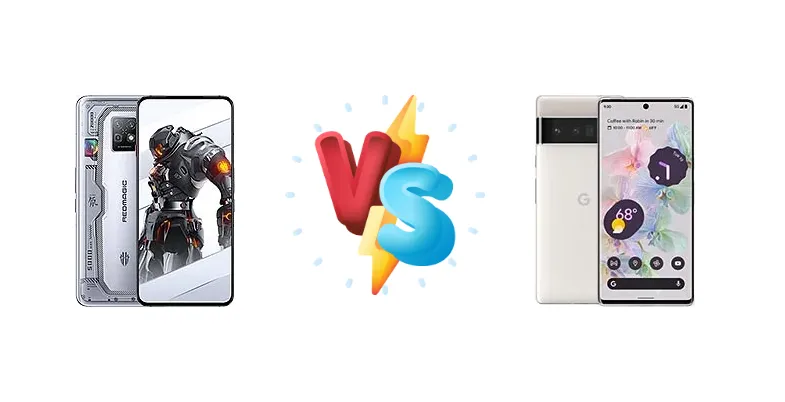
|
🏆 Quick Verdict
For the average user prioritizing a well-rounded experience with exceptional camera capabilities and software support, the Google Pixel 6 Pro is the better choice. However, gamers and power users demanding maximum performance and rapid charging will find the RedMagic 7S Pro a compelling alternative.
| PHONES | ||
|---|---|---|
| Phone Names | ZTE nubia RedMagic 7S Pro | Google Pixel 6 Pro |
| Network | ||
|---|---|---|
| 2G bands | GSM 850 / 900 / 1800 / 1900 | GSM 850 / 900 / 1800 / 1900 |
| 3G bands | HSDPA 850 / 900 / 1700(AWS) / 1900 / 2100 | HSDPA 800 / 850 / 900 / 1700(AWS) / 1900 / 2100 |
| 4G bands | 1, 2, 3, 4, 5, 7, 8, 12, 17, 18, 19, 20, 26, 28, 34, 38, 40, 41, 66 - International | 1, 2, 3, 4, 5, 7, 8, 12, 13, 14, 17, 18, 19, 20, 25, 26, 28, 29, 30, 32, 38, 39, 40, 41, 42, 46, 48, 66, 71 - GLUOG, G8VOU |
| 5G bands | 1, 3, 5, 7, 8, 20, 28, 38, 41, 77, 78 SA/NSA - International, China | 1, 2, 3, 5, 7, 8, 12, 14, 20, 25, 28, 30, 38, 40, 41, 48, 66, 71, 77, 78, 257, 258, 260, 261 SA/NSA/Sub6/mmWave - G8VOU |
| Speed | HSPA, LTE, 5G | HSPA, LTE, 5G |
| Technology | GSM / CDMA / HSPA / EVDO / LTE / 5G | GSM / CDMA / HSPA / EVDO / LTE / 5G |
| - | 1, 2, 3, 5, 7, 8, 12, 14, 20, 25, 28, 30, 38, 40, 41, 48, 66, 71, 77, 78 SA/NSA/Sub6 - GLUOG | |
| Launch | ||
|---|---|---|
| Announced | 2022, July 11 | 2021, October 19 |
| Status | Available. Released 2022, July 15 | Available. Released 2021, October 28 |
| Body | ||
|---|---|---|
| Build | Glass front, glass back, aluminum frame | Glass front (Gorilla Glass Victus), glass back (Gorilla Glass Victus), aluminum frame |
| Dimensions | 166.3 x 77.1 x 10 mm (6.55 x 3.04 x 0.39 in) | 163.9 x 75.9 x 8.9 mm (6.45 x 2.99 x 0.35 in) |
| SIM | Nano-SIM + Nano-SIM | Nano-SIM + eSIM |
| Weight | 235 g (8.29 oz) | 210 g (7.41 oz) |
| - | IP68 dust/water resistant (up to 1.5m for 30 min) | |
| Display | ||
|---|---|---|
| Protection | Corning Gorilla Glass 5 | Corning Gorilla Glass Victus |
| Resolution | 1080 x 2400 pixels, 20:9 ratio (~387 ppi density) | 1440 x 3120 pixels, 19.5:9 ratio (~512 ppi density) |
| Size | 6.8 inches, 111.6 cm2 (~87.1% screen-to-body ratio) | 6.7 inches, 110.6 cm2 (~88.9% screen-to-body ratio) |
| Type | AMOLED, 1B colors (China only), 120Hz, 600 nits | LTPO AMOLED, 120Hz, HDR10+ |
| - | Always-on display | |
| Platform | ||
|---|---|---|
| CPU | Octa-core (1x3.19 GHz Cortex-X2 & 3x2.75 GHz Cortex-A710 & 4x1.80 GHz Cortex-A510) | Octa-core (2x2.80 GHz Cortex-X1 & 2x2.25 GHz Cortex-A76 & 4x1.80 GHz Cortex-A55) |
| Chipset | Qualcomm SM8475 Snapdragon 8+ Gen 1 (4 nm) | Google Tensor (5 nm) |
| GPU | Adreno 730 | Mali-G78 MP20 |
| OS | Android 12, Redmagic 5.5 | Android 12, upgradable to Android 15, up to 5 major Android upgrades |
| Memory | ||
|---|---|---|
| Card slot | No | No |
| Internal | 256GB 12GB RAM, 512GB 16GB RAM, 512GB 18GB RAM, 1TB 18GB RAM | 128GB 12GB RAM, 256GB 12GB RAM, 512GB 12GB RAM |
| - | UFS 3.1 | |
| Main Camera | ||
|---|---|---|
| Features | LED flash, HDR, panorama | Laser AF, Dual-LED flash, Pixel Shift, Auto-HDR, panorama |
| Single | - | 11.1 MP, f/2.2, 20mm (ultrawide), 1.22µm |
| Triple | 64 MP, f/1.8, 26mm (wide), 1/1.97", 0.7µm, PDAF 8 MP, f/2.2, 120˚, 13mm (ultrawide), 1/4.0", 1.12µm 2 MP (macro) | 50 MP, f/1.9, 25mm (wide), 1/1.31", 1.2µm, dual pixel PDAF, OIS 48 MP, f/3.5, 104mm (periscope telephoto), 1/2.0", 0.8µm, PDAF, OIS, 4x optical zoom 12 MP, f/2.2, 17mm, 114˚ (ultrawide), 1.25µm |
| Video | 8K@30fps, 4K@30/60fps, 1080p@30/60/120/240fps | 4K@30/60fps, 1080p@30/60/120/240fps; gyro-EIS, OIS |
| Selfie camera | ||
|---|---|---|
| Features | HDR | HDR, panorama |
| Single | 16 MP, (wide), under display | 11.1 MP, f/2.2, 20mm (ultrawide), 1.22µm |
| Video | 1080p@30/60fps | 4K@30fps, 1080p@30/60fps |
| Sound | ||
|---|---|---|
| 3.5mm jack | - | No |
| 35mm jack | Yes | No |
| Loudspeaker | Yes, with stereo speakers | Yes, with stereo speakers |
| Comms | ||
|---|---|---|
| Bluetooth | 5.2, A2DP, LE, aptX HD, aptX Adaptive | 5.2, A2DP, LE, aptX HD |
| NFC | Yes | Yes |
| Positioning | GPS (L1+L5), GLONASS, BDS, GALILEO | GPS (L1+L5), GLONASS (G1), BDS (B1I+B1c+B2a), GALILEO (E1+E5a), QZSS (L1+L5) |
| Radio | No | No |
| USB | USB Type-C 3.0, OTG, accessory connector | USB Type-C 3.1 |
| WLAN | Wi-Fi 802.11 a/b/g/n/ac/6e, dual-band, Wi-Fi Direct | Wi-Fi 802.11 a/b/g/n/ac/6e, dual-band, Wi-Fi Direct |
| Features | ||
|---|---|---|
| Sensors | Fingerprint (under display, optical), accelerometer, gyro, proximity, compass | Fingerprint (under display, optical), accelerometer, gyro, proximity, compass, barometer |
| - | Ultra Wideband (UWB) support | |
| Battery | ||
|---|---|---|
| Charging | 135W wired, PD3.0, 50% in 5 min, 100% in 15 min (China) 65W wired, PD3.0 (International) | 23W wired, PD3.0, 50% in 30 min 23W wireless Reverse wireless |
| Type | Li-Po 5000 mAh | Li-Ion 5003 mAh |
| Misc | ||
|---|---|---|
| Colors | Obsidian, Supernova, Mercury, Yellow | Cloudy White, Sorta Sunny, Stormy Black |
| Models | NX709S | GLUOG, G8VOU, GF5KQ |
| Price | About 780 EUR | € 199.99 / $ 204.99 / £ 275.00 / ₹ 29,699 |
| Tests | ||
|---|---|---|
| Battery life | - | Endurance rating 84h |
| Display | - | Contrast ratio: Infinite (nominal) |
| Performance | - | AnTuTu: 585485 (v8), 719815 (v9) GeekBench: 2831 (v5.1) GFXBench: 39 fps (ES 3.1 onscreen) |
ZTE nubia RedMagic 7S Pro
- Blazing-fast 135W charging (China)
- Superior gaming performance with Snapdragon 8+ Gen 1
- Likely higher refresh rate display for smoother gaming
- Lower display brightness compared to Pixel 6 Pro
- Camera likely inferior to Pixel 6 Pro
- Software experience may lack polish
Google Pixel 6 Pro
- Exceptional camera quality and computational photography
- Smooth and intuitive software experience with guaranteed updates
- Brighter and more vibrant display
- Slower charging speed compared to RedMagic 7S Pro
- Less powerful processor for demanding games
- Tensor chip can run hotter under sustained load
Display Comparison
The Pixel 6 Pro boasts a significantly brighter display at 846 nits measured, compared to the RedMagic 7S Pro’s 449 nits. This translates to superior visibility under direct sunlight for the Pixel. While both offer smooth experiences, the Pixel’s contrast ratio is described as infinite (nominal), suggesting deeper blacks. The RedMagic 7S Pro, however, is geared towards gaming, and while brightness is lower, it likely features a higher refresh rate and potentially lower response times, though these specs aren't provided. The Pixel's larger display size and higher resolution also contribute to a more immersive viewing experience for media consumption.
Camera Comparison
The Pixel 6 Pro is the clear winner in the camera department, leveraging Google’s renowned computational photography. While the RedMagic 7S Pro offers photo and video capabilities, details regarding its sensor size and image processing are absent. The Pixel 6 Pro’s image processing excels in dynamic range, detail, and low-light performance. The Tensor chip’s dedicated image signal processor (ISP) plays a crucial role in these capabilities. The RedMagic 7S Pro likely prioritizes speed and efficiency over image quality, making it less suitable for serious photography enthusiasts. The absence of detailed camera specs for the RedMagic suggests it's not a primary focus.
Performance
The RedMagic 7S Pro leverages the Qualcomm Snapdragon 8+ Gen 1 (4nm), a chip designed for peak performance and efficiency. Its octa-core configuration, featuring a Cortex-X2 prime core clocked at 3.19 GHz, promises superior CPU performance compared to the Pixel 6 Pro’s Google Tensor (5nm). The Tensor, while optimized for AI tasks like image processing and voice recognition, utilizes older Cortex-A76 cores. The 4nm process node of the Snapdragon 8+ Gen 1 offers better thermal efficiency, potentially leading to less throttling during extended gaming sessions. The RedMagic’s likely inclusion of LPDDR5X RAM further enhances memory bandwidth, benefiting demanding games. The Pixel 6 Pro’s Tensor chip excels in machine learning tasks, but falls behind in raw processing power.
Battery Life
Both phones have an endurance rating of 84h, but achieve this differently. The Pixel 6 Pro’s battery life is sustained by the efficiency of the Tensor chip and software optimizations. The RedMagic 7S Pro, despite potentially having a smaller battery, compensates with incredibly fast charging – 135W wired (in China, 65W internationally) can deliver a 50% charge in just 5 minutes and a full charge in 15 minutes. The Pixel 6 Pro’s 23W wired charging takes 30 minutes for a 50% charge. The Pixel 6 Pro also offers 23W wireless charging and reverse wireless charging, features absent on the RedMagic 7S Pro. The RedMagic’s charging speed is a significant advantage for users who prioritize minimizing downtime.
Buying Guide
Buy the ZTE nubia RedMagic 7S Pro if you need a dedicated gaming phone with top-tier performance, incredibly fast charging, and are willing to compromise on camera quality and software polish. Buy the Google Pixel 6 Pro if you prefer a balanced smartphone experience with a class-leading camera, innovative software features, and long-term software support, even if it means sacrificing some raw gaming power.