
ZTE nubia RedMagic 7S Pro vs Asus ROG Phone 6 Pro: The Ultimate Gaming Phone Showdown
| Phones Images | |||||
|---|---|---|---|---|---|
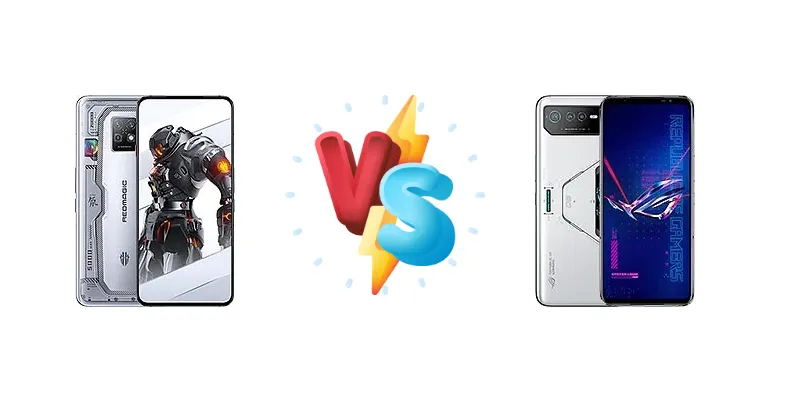
|
🏆 Quick Verdict
For the average gamer prioritizing sustained performance and a brighter display, the Asus ROG Phone 6 Pro emerges as the winner. Its superior brightness and potentially more refined thermal management (based on endurance rating) provide a more consistent experience. However, the RedMagic 7S Pro’s blistering 135W charging is a compelling advantage for those who value minimal downtime.
| PHONES | ||
|---|---|---|
| Phone Names | ZTE nubia RedMagic 7S Pro | Asus ROG Phone 6 Pro |
| Network | ||
|---|---|---|
| 2G bands | GSM 850 / 900 / 1800 / 1900 | GSM 850 / 900 / 1800 / 1900 |
| 3G bands | HSDPA 850 / 900 / 1700(AWS) / 1900 / 2100 | HSDPA 800 / 850 / 900 / 1700(AWS) / 1900 / 2100 |
| 4G bands | 1, 2, 3, 4, 5, 7, 8, 12, 17, 18, 19, 20, 26, 28, 34, 38, 40, 41, 66 - International | 1, 2, 3, 4, 5, 7, 8, 12, 13, 17, 18, 19, 20, 25, 26, 28, 29, 30, 32, 34, 38, 39, 40, 41, 42, 43, 48, 66, 71 - Version A |
| 5G bands | 1, 3, 5, 7, 8, 20, 28, 38, 41, 77, 78 SA/NSA - International, China | 1, 2, 3, 5, 7, 8, 12, 13, 18, 20, 25, 26, 28, 38, 40, 41, 48, 66, 71, 77, 78, 79 SA/NSA/Sub6 - Version A |
| Speed | HSPA, LTE, 5G | HSPA 42.2/5.76 Mbps, LTE (6CA) Cat20 2024/210 Mbps, 5G |
| Technology | GSM / CDMA / HSPA / EVDO / LTE / 5G | GSM / CDMA / HSPA / LTE / 5G |
| - | 1, 3, 5, 8, 28, 41, 77, 78, 79 - Version B | |
| Launch | ||
|---|---|---|
| Announced | 2022, July 11 | 2022, July 05 |
| Status | Available. Released 2022, July 15 | Available. Released 2022, July 13 |
| Body | ||
|---|---|---|
| Build | Glass front, glass back, aluminum frame | Glass front (Gorilla Glass Victus), glass back (Gorilla Glass 3), aluminum frame |
| Dimensions | 166.3 x 77.1 x 10 mm (6.55 x 3.04 x 0.39 in) | 173 x 77 x 10.3 mm (6.81 x 3.03 x 0.41 in) |
| SIM | Nano-SIM + Nano-SIM | Nano-SIM + Nano-SIM |
| Weight | 235 g (8.29 oz) | 239 g (8.43 oz) |
| - | IPX4 water resistant 2" OLED display (on the back) Pressure sensitive zones (Gaming triggers) | |
| Display | ||
|---|---|---|
| Protection | Corning Gorilla Glass 5 | Corning Gorilla Glass Victus |
| Resolution | 1080 x 2400 pixels, 20:9 ratio (~387 ppi density) | 1080 x 2448 pixels (~395 ppi density) |
| Size | 6.8 inches, 111.6 cm2 (~87.1% screen-to-body ratio) | 6.78 inches, 109.5 cm2 (~82.2% screen-to-body ratio) |
| Type | AMOLED, 1B colors (China only), 120Hz, 600 nits | AMOLED, 1B colors, 165Hz, HDR10+, 800 nits (typ), 1200 nits (peak) |
| Platform | ||
|---|---|---|
| CPU | Octa-core (1x3.19 GHz Cortex-X2 & 3x2.75 GHz Cortex-A710 & 4x1.80 GHz Cortex-A510) | Octa-core (1x3.19 GHz Cortex-X2 & 3x2.75 GHz Cortex-A710 & 4x1.80 GHz Cortex-A510) |
| Chipset | Qualcomm SM8475 Snapdragon 8+ Gen 1 (4 nm) | Qualcomm SM8475 Snapdragon 8+ Gen 1 (4 nm) |
| GPU | Adreno 730 | Adreno 730 |
| OS | Android 12, Redmagic 5.5 | Android 12, upgradable to Android 13 |
| Memory | ||
|---|---|---|
| Card slot | No | No |
| Internal | 256GB 12GB RAM, 512GB 16GB RAM, 512GB 18GB RAM, 1TB 18GB RAM | 512GB 18GB RAM |
| - | UFS 3.1 NTFS support for external storage | |
| Main Camera | ||
|---|---|---|
| Features | LED flash, HDR, panorama | LED flash, HDR, panorama |
| Triple | 64 MP, f/1.8, 26mm (wide), 1/1.97", 0.7µm, PDAF 8 MP, f/2.2, 120˚, 13mm (ultrawide), 1/4.0", 1.12µm 2 MP (macro) | 50 MP, f/1.9, (wide), 1/1.56", 1.0µm, PDAF 13 MP, f/2.2, (ultrawide) 5 MP (macro) |
| Video | 8K@30fps, 4K@30/60fps, 1080p@30/60/120/240fps | 8K@24fps, 4K@30/60/120fps, 1080p@30/60/120/240fps, 720p@480fps; gyro-EIS |
| Selfie camera | ||
|---|---|---|
| Features | HDR | Panorama, HDR |
| Single | 16 MP, (wide), under display | 12 MP, 28mm (wide) |
| Video | 1080p@30/60fps | 1080p@30fps |
| Sound | ||
|---|---|---|
| 3.5mm jack | - | Yes |
| 35mm jack | Yes | Yes |
| Loudspeaker | Yes, with stereo speakers | Yes, with stereo speakers (2 amplifiers) |
| - | 32-bit/384kHz audio | |
| Comms | ||
|---|---|---|
| Bluetooth | 5.2, A2DP, LE, aptX HD, aptX Adaptive | 5.2, A2DP, LE, aptX HD, aptX Adaptive, aptX Lossless |
| NFC | Yes | Yes |
| Positioning | GPS (L1+L5), GLONASS, BDS, GALILEO | GPS (L1+L5), GLONASS (L1), BDS (B1I+B1c+B2a), GALILEO (E1+E5a), QZSS (L1+L5), NavIC (L5) |
| Radio | No | No |
| USB | USB Type-C 3.0, OTG, accessory connector | USB Type-C 3.1 (side), USB Type-C 2.0 (bottom), OTG, accessory connector |
| WLAN | Wi-Fi 802.11 a/b/g/n/ac/6e, dual-band, Wi-Fi Direct | Wi-Fi 802.11 a/b/g/n/ac/6e, tri-band, Wi-Fi Direct |
| Features | ||
|---|---|---|
| Sensors | Fingerprint (under display, optical), accelerometer, gyro, proximity, compass | Fingerprint (under display, optical), accelerometer, gyro, proximity, compass |
| Battery | ||
|---|---|---|
| Charging | 135W wired, PD3.0, 50% in 5 min, 100% in 15 min (China) 65W wired, PD3.0 (International) | 65W wired, PD3.0, QC5, 100% in 42 min 10W reverse wired |
| Type | Li-Po 5000 mAh | Li-Po 6000 mAh |
| Misc | ||
|---|---|---|
| Colors | Obsidian, Supernova, Mercury, Yellow | Storm White |
| Models | NX709S | AI2201_D |
| Price | About 780 EUR | About 800 EUR |
| Tests | ||
|---|---|---|
| Battery life | - | Endurance rating 119h |
| Camera | - | Photo / Video |
| Display | - | Contrast ratio: Infinite (nominal) |
| Loudspeaker | - | -24.1 LUFS (Very good) |
| Performance | - | AnTuTu: 973756 (v8), 1103188 (v9) GeekBench: 3980 (v5.1) GFXBench: 79fps (ES 3.1 onscreen) |
ZTE nubia RedMagic 7S Pro
- Blazing-fast 135W charging (China)
- Aggressive gaming design and features
- Potentially lower price point
- Significantly dimmer display
- Uncertain long-term thermal performance
Asus ROG Phone 6 Pro
- Much brighter and more vibrant display
- Potentially better thermal management (based on endurance)
- More refined software experience
- Slower charging speed
- Higher price point
Display Comparison
The Asus ROG Phone 6 Pro boasts a significantly brighter display, reaching 829 nits measured, compared to the RedMagic 7S Pro’s 449 nits. This difference is crucial for outdoor visibility and HDR content consumption. While both utilize high refresh rate panels, the ROG Phone’s higher peak brightness and infinite contrast ratio contribute to a more vibrant and immersive visual experience. The RedMagic 7S Pro’s display, while still capable, will appear washed out in direct sunlight. Neither specification details PWM dimming rates, a critical factor for users sensitive to flicker, requiring further investigation.
Camera Comparison
Both devices feature 'Photo / Video' capabilities, but the provided data offers no specifics on sensor size, aperture, or image processing. Given the gaming focus, camera quality is likely secondary. It’s reasonable to assume both phones offer competent cameras for casual use, but neither is likely to compete with dedicated camera flagships. The absence of detail makes a meaningful comparison impossible; market analysis suggests Asus typically invests more in camera hardware than ZTE’s nubia sub-brand.
Performance
Both phones are powered by the Qualcomm SM8475 Snapdragon 8+ Gen 1 (4 nm) chipset, featuring the same CPU configuration: Octa-core (1x3.19 GHz Cortex-X2 & 3x2.75 GHz Cortex-A710 & 4x1.80 GHz Cortex-A510). Performance will be largely identical in short bursts. However, the ROG Phone 6 Pro’s endurance rating of 119 hours suggests potentially more efficient power management and, consequently, less thermal throttling during extended gaming sessions. The RedMagic 7S Pro’s active cooling system (not detailed in the provided data) is a key differentiator, but its effectiveness relative to the ROG Phone’s thermal design remains unknown without further testing. Both utilize LPDDR5x RAM, ensuring ample memory bandwidth.
Battery Life
The Asus ROG Phone 6 Pro’s endurance rating of 119 hours indicates strong battery life, despite lacking detailed mAh information. The RedMagic 7S Pro’s charging speed is its standout feature: 135W wired (China) and 65W (International) versus the ROG Phone’s 65W. This translates to a 50% charge in just 5 minutes (China) and 100% in 15 minutes (China), a significant advantage for gamers who need to quickly top up their battery. The ROG Phone 6 Pro takes 42 minutes to reach 100%. The RedMagic 7S Pro also supports reverse wired charging, a feature absent on the ROG Phone 6 Pro.
Buying Guide
Buy the ZTE nubia RedMagic 7S Pro if you absolutely need the fastest charging available on a smartphone and prioritize a more aggressive, value-focused gaming experience. Buy the Asus ROG Phone 6 Pro if you prefer a brighter, more color-accurate display, potentially better long-term thermal stability, and a more polished software experience with broader ecosystem support.