
ZTE nubia RedMagic 7 vs Xiaomi Black Shark 5 Pro: The Ultimate Gaming Phone Battle
| Phones Images | |||||
|---|---|---|---|---|---|
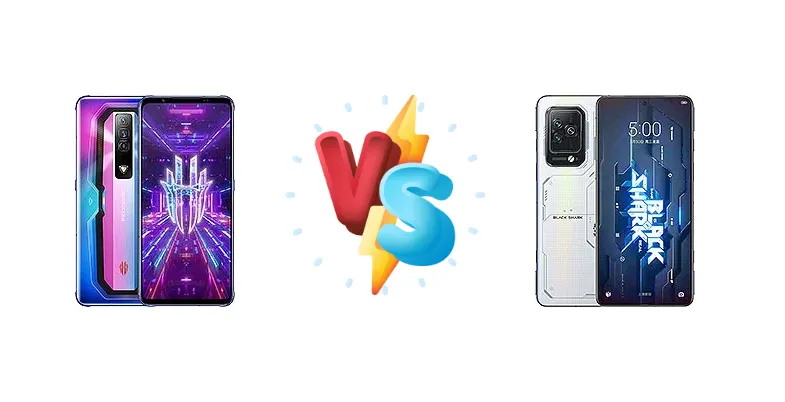
|
🏆 Quick Verdict
For most gamers, the Xiaomi Black Shark 5 Pro edges out the RedMagic 7. Its significantly brighter 682-nit display provides superior visibility in bright environments, and the 15-minute full charge is a tangible advantage. While the RedMagic 7 boasts excellent endurance, the Black Shark 5 Pro’s overall package is more refined.
| PHONES | ||
|---|---|---|
| Phone Names | ZTE nubia RedMagic 7 | Xiaomi Black Shark 5 Pro |
| Network | ||
|---|---|---|
| 2G bands | GSM 850 / 900 / 1800 / 1900 | GSM 850 / 900 / 1800 / 1900 |
| 3G bands | HSDPA 800 / 850 / 900 / 1700(AWS) / 1900 / 2100 | HSDPA 800 / 850 / 900 / 1700(AWS) / 1900 / 2100 |
| 4G bands | 1, 2, 3, 4, 5, 7, 8, 12, 17, 18, 19, 20, 26, 28, 34, 38, 39, 40, 41, 66 | 1, 2, 3, 4, 5, 7, 8, 12, 17, 18, 19, 26, 28, 34, 38, 39, 40, 41 |
| 5G bands | 1, 3, 5, 7, 8, 20, 28, 38, 41, 77, 78 SA/NSA | 1, 3, 8, 28, 41, 77, 78, 79 SA/NSA |
| Speed | HSPA, LTE, 5G | HSPA, LTE, 5G |
| Technology | GSM / CDMA / HSPA / EVDO / LTE / 5G | GSM / CDMA / HSPA / EVDO / LTE / 5G |
| Launch | ||
|---|---|---|
| Announced | 2022, February 17 | 2022, March 30 |
| Status | Available. Released 2022, February 21 | Available. Released 2022, April 04 |
| Body | ||
|---|---|---|
| Build | Glass front, glass back, aluminum frame | - |
| Dimensions | 170.6 x 78.3 x 9.5 mm (6.72 x 3.08 x 0.37 in) | 163.9 x 76.5 x 9.5 mm (6.45 x 3.01 x 0.37 in) |
| SIM | Nano-SIM + Nano-SIM | Nano-SIM + Nano-SIM |
| Weight | 215 g (7.58 oz) | 220 g (7.76 oz) |
| Display | ||
|---|---|---|
| Protection | Corning Gorilla Glass 5 | - |
| Resolution | 1080 x 2400 pixels, 20:9 ratio (~387 ppi density) | 1080 x 2400 pixels, 20:9 ratio (~395 ppi density) |
| Size | 6.8 inches, 111.6 cm2 (~83.6% screen-to-body ratio) | 6.67 inches, 107.4 cm2 (~85.7% screen-to-body ratio) |
| Type | AMOLED, 1B colors (China only), 165Hz, 700 nits (typ) | OLED, 1B colors, 144Hz, HDR10+ |
| Platform | ||
|---|---|---|
| CPU | Octa-core (1x3.00 GHz Cortex-X2 & 3x2.50 GHz Cortex-A710 & 4x1.80 GHz Cortex-A510) | Octa-core (1x3.00 GHz Cortex-X2 & 3x2.50 GHz Cortex-A710 & 4x1.80 GHz Cortex-A510) |
| Chipset | Qualcomm SM8450 Snapdragon 8 Gen 1 (4 nm) | Qualcomm SM8450 Snapdragon 8 Gen 1 (4 nm) |
| GPU | Adreno 730 | Adreno 730 |
| OS | Android 12, Redmagic 5.0 | Android 12, Joy UI 13 |
| Memory | ||
|---|---|---|
| Card slot | No | No |
| Internal | 128GB 8GB RAM, 128GB 12GB RAM, 256GB 12GB RAM, 256GB 16GB RAM, 256GB 18GB RAM, 512GB 16GB RAM | 128GB 8GB RAM, 256GB 8GB RAM, 256GB 12GB RAM, 512GB 16GB RAM |
| Main Camera | ||
|---|---|---|
| Features | LED flash, HDR, panorama | LED flash, HDR, panorama |
| Single | - | 16 MP, (wide), 1/3.06", 1.0µm |
| Triple | 64 MP, f/1.8, 26mm (wide), 1/1.97", 0.7µm, PDAF 8 MP, f/2.0, 120˚, 13mm (ultrawide), 1/4.0", 1.12µm 2 MP (macro) | 108 MP, f/1.8, (wide), 1/1.52", 0.7µm, PDAF 13 MP, f/2.4, 120˚ (ultrawide), 1/3.06", 1.12µm 5 MP, f/2.4, (telephoto macro), AF |
| Video | 8K@30fps, 4K@30/60fps, 1080p@30/60/120/240fps | 4K@30/60fps, 1080p@30/60/240fps, 1080p@960fps; HDR10+ |
| Selfie camera | ||
|---|---|---|
| Features | HDR | HDR |
| Single | 8 MP, f/2.0, (wide), 1/4.0", 1.12µm | 16 MP, (wide), 1/3.06", 1.0µm |
| Video | 1080p@30fps | 1080p@30fps |
| Sound | ||
|---|---|---|
| 3.5mm jack | - | No |
| 35mm jack | Yes | No |
| Loudspeaker | Yes, with stereo speakers | Yes, with stereo speakers |
| Comms | ||
|---|---|---|
| Bluetooth | 5.2, A2DP, aptX, LE | 5.2, A2DP, LE, aptX HD, aptX Adaptive |
| NFC | Yes | Yes |
| Positioning | GPS (L1+L5), GLONASS, BDS, GALILEO | GPS, GLONASS, GALILEO, QZSS, BDS |
| Radio | No | No |
| USB | USB Type-C 3.0, OTG, accessory connector | USB Type-C 2.0, video output |
| WLAN | Wi-Fi 802.11 a/b/g/n/ac/6e, dual-band, Wi-Fi Direct | Wi-Fi 802.11 a/b/g/n/ac/6, dual-band, Wi-Fi Direct |
| Features | ||
|---|---|---|
| Sensors | Fingerprint (under display, optical), accelerometer, gyro, proximity, compass | Fingerprint (side-mounted), accelerometer, gyro, proximity, compass, barometer (China only) |
| Battery | ||
|---|---|---|
| Charging | 120W wired, PD3.0, 100% in 17 min (China) 65W wired, PD3.0 (International) | 120W wired, 100% in 15 min |
| Type | Li-Po 4500 mAh | Li-Po 4650 mAh |
| Misc | ||
|---|---|---|
| Colors | Obsidian, Pulsar, Supernova | Black, White |
| Models | NX679J | SHARK KTUS-H0 |
| Price | About 630 EUR | About 720 EUR |
| Tests | ||
|---|---|---|
| Battery life | - | Endurance rating 83h |
| Camera | - | Photo / Video |
| Display | - | Contrast ratio: Infinite (nominal) |
| Performance | - | AnTuTu: 876704 (v8), 1007133 (v9) GeekBench: 3665 (v5.1) GFXBench: 82fps (ES 3.1 onscreen) |
ZTE nubia RedMagic 7
- Superior battery endurance (89h)
- More robust cooling system for sustained performance
- Potentially less thermal throttling during long gaming sessions
- Dimmer display (527 nits)
- Slower charging speed (17 min China, 65W International)
Xiaomi Black Shark 5 Pro
- Brighter display (682 nits) for better visibility
- Faster charging (15 minutes)
- Infinite contrast ratio for deeper blacks
- Slightly lower battery endurance (83h)
- Cooling system less aggressive than RedMagic 7
Display Comparison
The Xiaomi Black Shark 5 Pro immediately distinguishes itself with a measured peak brightness of 682 nits, a substantial 30% increase over the RedMagic 7’s 527 nits. This difference is critical for outdoor visibility and HDR content. Both phones utilize a standard refresh rate, but the Black Shark 5 Pro’s infinite contrast ratio (nominal) suggests a superior OLED panel capable of deeper blacks. While both are excellent for gaming, the Black Shark 5 Pro’s display is demonstrably better for all-around use.
Camera Comparison
Both phones feature a 'Photo / Video' camera setup, but neither is a primary focus. Detailed camera specs are absent, so a direct comparison is limited. Given the gaming-centric nature of both devices, image processing likely prioritizes speed over detail. The absence of specific sensor information suggests both utilize mid-range sensors. Users shouldn't expect flagship-level photography from either device.
Performance
Both devices are powered by the Qualcomm SM8450 Snapdragon 8 Gen 1 (4nm), featuring the same CPU configuration: 1x3.00 GHz Cortex-X2, 3x2.50 GHz Cortex-A710, and 4x1.80 GHz Cortex-A510. Performance will be largely identical in synthetic benchmarks. However, the RedMagic 7’s aggressive cooling solution – including an internal fan – is designed to mitigate thermal throttling during prolonged gaming. While the Black Shark 5 Pro also features cooling, it’s less extensive. This means the RedMagic 7 is likely to maintain higher clock speeds for longer durations, potentially offering a slight edge in sustained performance.
Battery Life
The RedMagic 7 boasts an endurance rating of 89 hours, slightly exceeding the Black Shark 5 Pro’s 83 hours. However, the Black Shark 5 Pro compensates with significantly faster charging: 120W wired, achieving a full charge in just 15 minutes, compared to the RedMagic 7’s 17 minutes (China) or 65W (International). This 2-minute difference, while seemingly small, adds up over time. The Black Shark 5 Pro’s faster charging is a significant convenience factor, especially for gamers who need to quickly top up their battery between sessions.
Buying Guide
Buy the ZTE nubia RedMagic 7 if you prioritize sustained gaming performance over extended periods and value a slightly longer battery life. Its robust cooling system is ideal for marathon gaming sessions. Buy the Xiaomi Black Shark 5 Pro if you prefer a brighter, more vibrant display for gaming and everyday use, and if minimizing charging downtime is crucial. The Black Shark 5 Pro is also a better all-rounder for media consumption.