
ZTE nubia RedMagic 7 vs. Samsung Galaxy S22 Ultra: A Deep Dive into Gaming and Flagship Features
| Phones Images | |||||
|---|---|---|---|---|---|
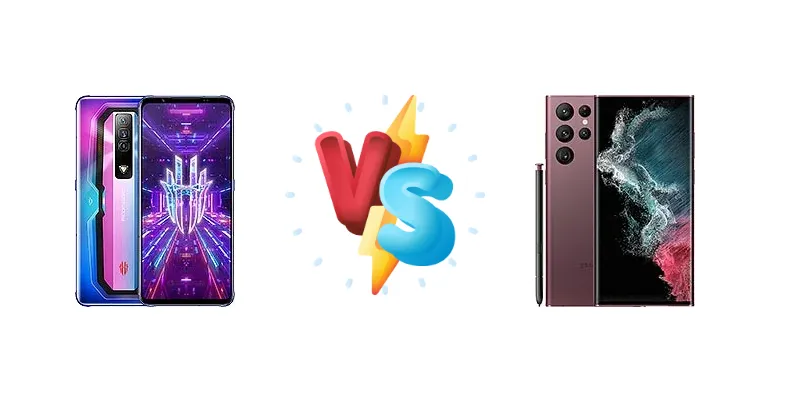
|
🏆 Quick Verdict
For dedicated mobile gamers, the ZTE nubia RedMagic 7 is the clear winner, offering superior cooling and faster charging. However, the Samsung Galaxy S22 Ultra 5G provides a more polished, versatile experience with a significantly better display and camera system, making it the better choice for the average user.
| PHONES | ||
|---|---|---|
| Phone Names | ZTE nubia RedMagic 7 | Samsung Galaxy S22 Ultra 5G |
| Network | ||
|---|---|---|
| 2G bands | GSM 850 / 900 / 1800 / 1900 | GSM 850 / 900 / 1800 / 1900 |
| 3G bands | HSDPA 800 / 850 / 900 / 1700(AWS) / 1900 / 2100 | HSDPA 850 / 900 / 1700(AWS) / 1900 / 2100 |
| 4G bands | 1, 2, 3, 4, 5, 7, 8, 12, 17, 18, 19, 20, 26, 28, 34, 38, 39, 40, 41, 66 | 1, 2, 3, 4, 5, 7, 8, 12, 13, 17, 18, 19, 20, 25, 26, 28, 32, 38, 39, 40, 41, 66 - International |
| 5G bands | 1, 3, 5, 7, 8, 20, 28, 38, 41, 77, 78 SA/NSA | 1, 2, 3, 5, 7, 8, 12, 20, 25, 28, 38, 40, 41, 66, 75, 77, 78 SA/NSA/Sub6 - International |
| Speed | HSPA, LTE, 5G | HSPA 42.2/5.76 Mbps, LTE (7CA) Cat20 2000/200 Mbps, 5G (5+ Gbps DL) |
| Technology | GSM / CDMA / HSPA / EVDO / LTE / 5G | GSM / CDMA / HSPA / EVDO / LTE / 5G |
| - | 1, 3, 5, 7, 8, 20, 28, 38, 41, 66, 71, 260, 261 SA/NSA/Sub6/mmWave - USA | |
| Launch | ||
|---|---|---|
| Announced | 2022, February 17 | 2022, February 09 |
| Status | Available. Released 2022, February 21 | Available. Released 2022, February 25 |
| Body | ||
|---|---|---|
| Build | Glass front, glass back, aluminum frame | Glass front (Gorilla Glass Victus+), glass back (Gorilla Glass Victus+), aluminum frame |
| Dimensions | 170.6 x 78.3 x 9.5 mm (6.72 x 3.08 x 0.37 in) | 163.3 x 77.9 x 8.9 mm (6.43 x 3.07 x 0.35 in) |
| SIM | Nano-SIM + Nano-SIM | · Nano-SIM + eSIM· Nano-SIM + Nano-SIM + eSIM (max 2 at a time) |
| Weight | 215 g (7.58 oz) | 228 g / 229 g (mmWave) (8.04 oz) |
| - | IP68 dust/water resistant (up to 1.5m for 30 min) Armor aluminum frame with tougher drop and scratch resistance (advertised) Stylus, 2.8ms latency (Bluetooth integration, accelerometer, gyro) | |
| Display | ||
|---|---|---|
| Protection | Corning Gorilla Glass 5 | Corning Gorilla Glass Victus+ |
| Resolution | 1080 x 2400 pixels, 20:9 ratio (~387 ppi density) | 1440 x 3088 pixels, 19.3:9 ratio (~500 ppi density) |
| Size | 6.8 inches, 111.6 cm2 (~83.6% screen-to-body ratio) | 6.8 inches, 114.7 cm2 (~90.2% screen-to-body ratio) |
| Type | AMOLED, 1B colors (China only), 165Hz, 700 nits (typ) | Dynamic AMOLED 2X, 120Hz, HDR10+, 1750 nits (peak) |
| - | Always-on display | |
| Platform | ||
|---|---|---|
| CPU | Octa-core (1x3.00 GHz Cortex-X2 & 3x2.50 GHz Cortex-A710 & 4x1.80 GHz Cortex-A510) | Octa-core (1x2.8 GHz Cortex-X2 & 3x2.50 GHz Cortex-A710 & 4x1.8 GHz Cortex-A510) - EuropeOcta-core (1x3.00 GHz Cortex-X2 & 3x2.50 GHz Cortex-A710 & 4x1.80 GHz Cortex-A510) - ROW |
| Chipset | Qualcomm SM8450 Snapdragon 8 Gen 1 (4 nm) | Exynos 2200 (4 nm) - EuropeQualcomm SM8450 Snapdragon 8 Gen 1 (4 nm) - ROW |
| GPU | Adreno 730 | Xclipse 920 - EuropeAdreno 730 - ROW |
| OS | Android 12, Redmagic 5.0 | Android 12, up to 4 major Android upgrades, One UI 8 |
| Memory | ||
|---|---|---|
| Card slot | No | No |
| Internal | 128GB 8GB RAM, 128GB 12GB RAM, 256GB 12GB RAM, 256GB 16GB RAM, 256GB 18GB RAM, 512GB 16GB RAM | 128GB 8GB RAM, 256GB 12GB RAM, 512GB 12GB RAM, 1TB 12GB RAM |
| - | UFS 3.1 | |
| Main Camera | ||
|---|---|---|
| Features | LED flash, HDR, panorama | Laser AF, LED flash, auto-HDR, panorama |
| Quad | - | 108 MP, f/1.8, 23mm (wide), 1/1.33", 0.8µm, PDAF, OIS 10 MP, f/2.4, 70mm (telephoto), 1/3.52", 1.12µm, PDAF, OIS, 3x optical zoom 10 MP, f/4.9, 230mm (periscope telephoto), 1/3.52", 1.12µm, PDAF, OIS, 10x optical zoom 12 MP, f/2.2, 13mm, 120˚ (ultrawide), 1/2.55", 1.4µm, dual pixel PDAF, Super Steady video |
| Triple | 64 MP, f/1.8, 26mm (wide), 1/1.97", 0.7µm, PDAF 8 MP, f/2.0, 120˚, 13mm (ultrawide), 1/4.0", 1.12µm 2 MP (macro) | - |
| Video | 8K@30fps, 4K@30/60fps, 1080p@30/60/120/240fps | 8K@24fps, 4K@30/60fps, 1080p@30/60/120/240fps, HDR10+, stereo sound rec., gyro-EIS |
| Selfie camera | ||
|---|---|---|
| Features | HDR | HDR |
| Single | 8 MP, f/2.0, (wide), 1/4.0", 1.12µm | 40 MP, f/2.2, 26mm (wide), 1/2.82", 0.7µm, PDAF |
| Video | 1080p@30fps | 4K@30/60fps, 1080p@30fps |
| Sound | ||
|---|---|---|
| 3.5mm jack | - | No |
| 35mm jack | Yes | No |
| Loudspeaker | Yes, with stereo speakers | Yes, with stereo speakers |
| - | 32-bit/384kHz audio Tuned by AKG | |
| Comms | ||
|---|---|---|
| Bluetooth | 5.2, A2DP, aptX, LE | 5.2, A2DP, LE |
| NFC | Yes | Yes |
| Positioning | GPS (L1+L5), GLONASS, BDS, GALILEO | GPS, GLONASS, BDS, GALILEO |
| Radio | No | No |
| USB | USB Type-C 3.0, OTG, accessory connector | USB Type-C 3.2, OTG |
| WLAN | Wi-Fi 802.11 a/b/g/n/ac/6e, dual-band, Wi-Fi Direct | Wi-Fi 802.11 a/b/g/n/ac/6e, dual-band, Wi-Fi Direct |
| Features | ||
|---|---|---|
| Sensors | Fingerprint (under display, optical), accelerometer, gyro, proximity, compass | Fingerprint (under display, ultrasonic), accelerometer, gyro, proximity, compass, barometer |
| - | Samsung DeX, Samsung Wireless DeX (desktop experience support) Bixby natural language commands and dictation Samsung Pay (Visa, MasterCard certified) Ultra Wideband (UWB) support | |
| Battery | ||
|---|---|---|
| Charging | 120W wired, PD3.0, 100% in 17 min (China) 65W wired, PD3.0 (International) | 45W wired, PD3.0 15W wireless (Qi) 4.5W reverse wireless |
| Type | Li-Po 4500 mAh | Li-Ion 5000 mAh |
| Misc | ||
|---|---|---|
| Colors | Obsidian, Pulsar, Supernova | Phantom Black, White, Burgundy, Green, Graphite, Red, Sky Blue, Bora Purple |
| Models | NX679J | SM-S908B, SM-S908B/DS, SM-S908U, SM-S908U1, SM-S908W, SM-S908N, SM-S9080, SM-S908E, SM-S908E/DS |
| Price | About 630 EUR | € 397.07 / $ 269.98 / £ 304.99 / ₹ 63,899 |
| SAR | - | 1.18 W/kg (head) 0.98 W/kg (body) |
| SAR EU | - | 1.05 W/kg (head) 1.58 W/kg (body) |
| Tests | ||
|---|---|---|
| Battery life | - | Endurance rating 108h |
| Camera | - | Photo / Video |
| Display | - | Contrast ratio: Infinite (nominal) |
| Loudspeaker | - | -27.3 LUFS (Good) |
| Performance | - | AnTuTu: 968359 (v9) GeekBench: 3657 (v5.1) GFXBench: 37fps (ES 3.1 onscreen) |
ZTE nubia RedMagic 7
- Incredibly fast 65W/120W charging
- Active cooling system for sustained performance
- Built-in shoulder triggers for gaming
- More affordable price point
- Inferior display quality
- Less versatile camera system
- Bulkier design
- Software experience less refined
Samsung Galaxy S22 Ultra 5G
- Exceptional display brightness and quality
- Versatile and high-quality camera system
- S Pen functionality
- Premium build quality and design
- Slower charging speeds
- More prone to thermal throttling
- Higher price point
- Exynos variant (Europe) may have lower performance
Display Comparison
The Samsung Galaxy S22 Ultra boasts a significantly brighter display, reaching 1266 nits compared to the RedMagic 7’s 527 nits. This translates to vastly improved visibility outdoors. While both devices offer smooth scrolling, the S22 Ultra’s Dynamic AMOLED 2X panel with its infinite contrast ratio delivers richer colors and deeper blacks. The RedMagic 7’s display, while adequate, is clearly geared towards cost optimization, lacking the premium features found in Samsung’s flagship. The S22 Ultra’s LTPO technology also allows for a more dynamic refresh rate, potentially saving battery life.
Camera Comparison
The Samsung Galaxy S22 Ultra dominates in camera capabilities. While both phones offer photo and video recording, the S22 Ultra’s superior image processing, larger sensors, and advanced features like Space Zoom provide a far more versatile and high-quality photography experience. The RedMagic 7’s camera is functional but lacks the refinement and features of the S22 Ultra. Details regarding the RedMagic 7’s camera sensors are limited, but it’s safe to assume they don’t compete with the S22 Ultra’s sophisticated setup. The S22 Ultra’s 8K video recording and advanced stabilization are features absent on the RedMagic 7.
Performance
Both phones utilize the Qualcomm Snapdragon 8 Gen 1 (in ROW variants of the S22 Ultra), but the RedMagic 7’s design prioritizes thermal management. Its active cooling system, including a fan, allows it to sustain peak performance for longer periods. The S22 Ultra, while powerful, is more prone to thermal throttling under sustained load. The S22 Ultra’s European variant uses the Exynos 2200, which historically has shown slightly lower efficiency and performance compared to the Snapdragon variant. Both devices feature octa-core CPUs with a Cortex-X2 prime core, but the RedMagic 7’s focus on cooling gives it an edge in prolonged gaming sessions.
Battery Life
The Samsung Galaxy S22 Ultra offers a longer endurance rating of 108 hours compared to the RedMagic 7’s 89 hours, despite a similar battery capacity. This is likely due to the more efficient display and chipset optimization. However, the RedMagic 7 compensates with significantly faster charging. The Chinese model supports 120W wired charging, achieving a full charge in just 17 minutes, while the international model offers 65W. The S22 Ultra is limited to 45W wired charging, taking considerably longer to reach 100%. The S22 Ultra also offers 15W wireless charging and reverse wireless charging, features absent on the RedMagic 7.
Buying Guide
Buy the ZTE nubia RedMagic 7 if you prioritize sustained gaming performance, require the fastest possible charging speeds (especially the Chinese model with 120W), and appreciate gaming-centric features like shoulder triggers. Buy the Samsung Galaxy S22 Ultra 5G if you value a premium display, a versatile camera system, S Pen functionality, and a more refined software experience, even if it means sacrificing some raw gaming power.