
ZTE nubia RedMagic 7 vs. Google Pixel 6 Pro: A Deep Dive into Gaming and AI
| Phones Images | |||||
|---|---|---|---|---|---|
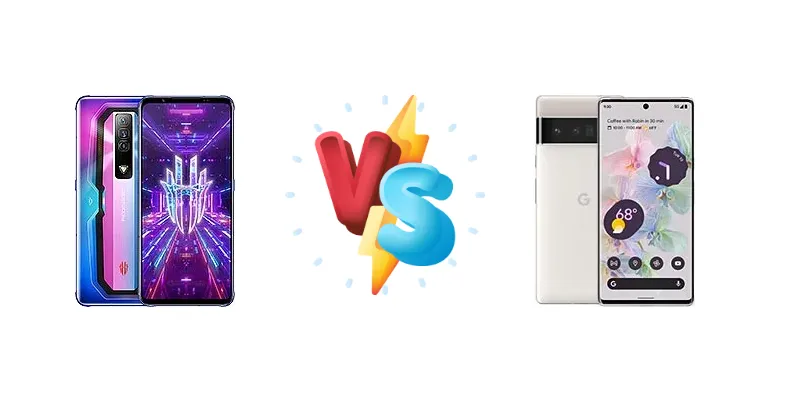
|
🏆 Quick Verdict
For the average user prioritizing a balanced experience with exceptional camera capabilities and smart features, the Google Pixel 6 Pro is the better choice. However, gamers and power users demanding maximum performance and rapid charging will find the RedMagic 7 a compelling alternative.
| PHONES | ||
|---|---|---|
| Phone Names | ZTE nubia RedMagic 7 | Google Pixel 6 Pro |
| Network | ||
|---|---|---|
| 2G bands | GSM 850 / 900 / 1800 / 1900 | GSM 850 / 900 / 1800 / 1900 |
| 3G bands | HSDPA 800 / 850 / 900 / 1700(AWS) / 1900 / 2100 | HSDPA 800 / 850 / 900 / 1700(AWS) / 1900 / 2100 |
| 4G bands | 1, 2, 3, 4, 5, 7, 8, 12, 17, 18, 19, 20, 26, 28, 34, 38, 39, 40, 41, 66 | 1, 2, 3, 4, 5, 7, 8, 12, 13, 14, 17, 18, 19, 20, 25, 26, 28, 29, 30, 32, 38, 39, 40, 41, 42, 46, 48, 66, 71 - GLUOG, G8VOU |
| 5G bands | 1, 3, 5, 7, 8, 20, 28, 38, 41, 77, 78 SA/NSA | 1, 2, 3, 5, 7, 8, 12, 14, 20, 25, 28, 30, 38, 40, 41, 48, 66, 71, 77, 78, 257, 258, 260, 261 SA/NSA/Sub6/mmWave - G8VOU |
| Speed | HSPA, LTE, 5G | HSPA, LTE, 5G |
| Technology | GSM / CDMA / HSPA / EVDO / LTE / 5G | GSM / CDMA / HSPA / EVDO / LTE / 5G |
| - | 1, 2, 3, 5, 7, 8, 12, 14, 20, 25, 28, 30, 38, 40, 41, 48, 66, 71, 77, 78 SA/NSA/Sub6 - GLUOG | |
| Launch | ||
|---|---|---|
| Announced | 2022, February 17 | 2021, October 19 |
| Status | Available. Released 2022, February 21 | Available. Released 2021, October 28 |
| Body | ||
|---|---|---|
| Build | Glass front, glass back, aluminum frame | Glass front (Gorilla Glass Victus), glass back (Gorilla Glass Victus), aluminum frame |
| Dimensions | 170.6 x 78.3 x 9.5 mm (6.72 x 3.08 x 0.37 in) | 163.9 x 75.9 x 8.9 mm (6.45 x 2.99 x 0.35 in) |
| SIM | Nano-SIM + Nano-SIM | Nano-SIM + eSIM |
| Weight | 215 g (7.58 oz) | 210 g (7.41 oz) |
| - | IP68 dust/water resistant (up to 1.5m for 30 min) | |
| Display | ||
|---|---|---|
| Protection | Corning Gorilla Glass 5 | Corning Gorilla Glass Victus |
| Resolution | 1080 x 2400 pixels, 20:9 ratio (~387 ppi density) | 1440 x 3120 pixels, 19.5:9 ratio (~512 ppi density) |
| Size | 6.8 inches, 111.6 cm2 (~83.6% screen-to-body ratio) | 6.7 inches, 110.6 cm2 (~88.9% screen-to-body ratio) |
| Type | AMOLED, 1B colors (China only), 165Hz, 700 nits (typ) | LTPO AMOLED, 120Hz, HDR10+ |
| - | Always-on display | |
| Platform | ||
|---|---|---|
| CPU | Octa-core (1x3.00 GHz Cortex-X2 & 3x2.50 GHz Cortex-A710 & 4x1.80 GHz Cortex-A510) | Octa-core (2x2.80 GHz Cortex-X1 & 2x2.25 GHz Cortex-A76 & 4x1.80 GHz Cortex-A55) |
| Chipset | Qualcomm SM8450 Snapdragon 8 Gen 1 (4 nm) | Google Tensor (5 nm) |
| GPU | Adreno 730 | Mali-G78 MP20 |
| OS | Android 12, Redmagic 5.0 | Android 12, upgradable to Android 15, up to 5 major Android upgrades |
| Memory | ||
|---|---|---|
| Card slot | No | No |
| Internal | 128GB 8GB RAM, 128GB 12GB RAM, 256GB 12GB RAM, 256GB 16GB RAM, 256GB 18GB RAM, 512GB 16GB RAM | 128GB 12GB RAM, 256GB 12GB RAM, 512GB 12GB RAM |
| - | UFS 3.1 | |
| Main Camera | ||
|---|---|---|
| Features | LED flash, HDR, panorama | Laser AF, Dual-LED flash, Pixel Shift, Auto-HDR, panorama |
| Single | - | 11.1 MP, f/2.2, 20mm (ultrawide), 1.22µm |
| Triple | 64 MP, f/1.8, 26mm (wide), 1/1.97", 0.7µm, PDAF 8 MP, f/2.0, 120˚, 13mm (ultrawide), 1/4.0", 1.12µm 2 MP (macro) | 50 MP, f/1.9, 25mm (wide), 1/1.31", 1.2µm, dual pixel PDAF, OIS 48 MP, f/3.5, 104mm (periscope telephoto), 1/2.0", 0.8µm, PDAF, OIS, 4x optical zoom 12 MP, f/2.2, 17mm, 114˚ (ultrawide), 1.25µm |
| Video | 8K@30fps, 4K@30/60fps, 1080p@30/60/120/240fps | 4K@30/60fps, 1080p@30/60/120/240fps; gyro-EIS, OIS |
| Selfie camera | ||
|---|---|---|
| Features | HDR | HDR, panorama |
| Single | 8 MP, f/2.0, (wide), 1/4.0", 1.12µm | 11.1 MP, f/2.2, 20mm (ultrawide), 1.22µm |
| Video | 1080p@30fps | 4K@30fps, 1080p@30/60fps |
| Sound | ||
|---|---|---|
| 3.5mm jack | - | No |
| 35mm jack | Yes | No |
| Loudspeaker | Yes, with stereo speakers | Yes, with stereo speakers |
| Comms | ||
|---|---|---|
| Bluetooth | 5.2, A2DP, aptX, LE | 5.2, A2DP, LE, aptX HD |
| NFC | Yes | Yes |
| Positioning | GPS (L1+L5), GLONASS, BDS, GALILEO | GPS (L1+L5), GLONASS (G1), BDS (B1I+B1c+B2a), GALILEO (E1+E5a), QZSS (L1+L5) |
| Radio | No | No |
| USB | USB Type-C 3.0, OTG, accessory connector | USB Type-C 3.1 |
| WLAN | Wi-Fi 802.11 a/b/g/n/ac/6e, dual-band, Wi-Fi Direct | Wi-Fi 802.11 a/b/g/n/ac/6e, dual-band, Wi-Fi Direct |
| Features | ||
|---|---|---|
| Sensors | Fingerprint (under display, optical), accelerometer, gyro, proximity, compass | Fingerprint (under display, optical), accelerometer, gyro, proximity, compass, barometer |
| - | Ultra Wideband (UWB) support | |
| Battery | ||
|---|---|---|
| Charging | 120W wired, PD3.0, 100% in 17 min (China) 65W wired, PD3.0 (International) | 23W wired, PD3.0, 50% in 30 min 23W wireless Reverse wireless |
| Type | Li-Po 4500 mAh | Li-Ion 5003 mAh |
| Misc | ||
|---|---|---|
| Colors | Obsidian, Pulsar, Supernova | Cloudy White, Sorta Sunny, Stormy Black |
| Models | NX679J | GLUOG, G8VOU, GF5KQ |
| Price | About 630 EUR | € 199.99 / $ 204.99 / £ 275.00 / ₹ 29,699 |
| Tests | ||
|---|---|---|
| Battery life | - | Endurance rating 84h |
| Display | - | Contrast ratio: Infinite (nominal) |
| Performance | - | AnTuTu: 585485 (v8), 719815 (v9) GeekBench: 2831 (v5.1) GFXBench: 39 fps (ES 3.1 onscreen) |
ZTE nubia RedMagic 7
- Blazing-fast 120W charging (China)
- Superior gaming performance
- Aggressive cooling system
- Inferior camera quality
- Less refined software experience
- Lower display brightness
Google Pixel 6 Pro
- Exceptional camera system
- Innovative AI features
- Bright and vibrant display
- Slower charging speed
- Less powerful gaming performance
- Potential for software bugs
Display Comparison
The Pixel 6 Pro boasts a significantly brighter display at 846 nits measured, compared to the RedMagic 7’s 527 nits. This translates to superior visibility under direct sunlight. While both offer smooth scrolling, the Pixel 6 Pro’s infinite contrast ratio (nominal) delivers deeper blacks and a more vibrant image. The RedMagic 7’s display is geared towards gaming, but the Pixel 6 Pro’s overall visual experience is more refined for general consumption. We lack PWM frequency data for both, but the Pixel 6 Pro’s LTPO panel allows for dynamic refresh rate scaling, potentially improving battery efficiency.
Camera Comparison
The Pixel 6 Pro unequivocally dominates in the camera department. While the RedMagic 7 offers photo and video capabilities, it lacks the sophisticated image processing and computational photography prowess of the Pixel 6 Pro. The Pixel 6 Pro’s larger sensor and Google’s software algorithms deliver exceptional dynamic range, detail, and low-light performance. The RedMagic 7’s camera is adequate for casual snapshots, but it cannot compete with the Pixel 6 Pro’s consistently high-quality results. The Pixel 6 Pro’s focus on AI-powered features like Magic Eraser and Face Unblur further enhances its photographic capabilities.
Performance
The RedMagic 7 leverages the Qualcomm Snapdragon 8 Gen 1 (4nm) chipset, while the Pixel 6 Pro utilizes Google’s in-house Tensor chip (5nm). The 4nm process of the Snapdragon 8 Gen 1 *should* offer better thermal efficiency than the 5nm Tensor, potentially leading to less throttling during sustained gaming sessions. However, the Tensor chip’s unique architecture excels in AI and machine learning tasks, powering features like Magic Eraser and Real Tone. The RedMagic 7’s CPU configuration, with its Cortex-X2 prime core clocked at 3.00 GHz, is geared towards peak performance, while the Pixel 6 Pro’s Cortex-X1 cores at 2.80 GHz prioritize a balance of performance and efficiency. Both phones utilize ample RAM, but the RedMagic 7 often ships with faster LPDDR5X configurations.
Battery Life
Both phones achieve similar endurance ratings (89h for RedMagic 7, 84h for Pixel 6 Pro), but achieve this through different means. The RedMagic 7’s 120W wired charging (65W internationally) is a game-changer, achieving a full charge in just 17 minutes (China) or a still-impressive time internationally. The Pixel 6 Pro’s 23W wired charging is significantly slower, taking around 30 minutes to reach 50%. The Pixel 6 Pro does offer 23W wireless charging and reverse wireless charging, features absent on the RedMagic 7. The RedMagic 7’s focus is on *speed* of charging, while the Pixel 6 Pro offers more versatility in charging options.
Buying Guide
Buy the ZTE nubia RedMagic 7 if you need a dedicated gaming phone with top-tier performance, incredibly fast charging (especially the Chinese variant), and are willing to compromise on camera quality and software polish. Buy the Google Pixel 6 Pro if you prefer a premium smartphone experience with a class-leading camera, innovative AI features, and a clean, intuitive software interface, even if it means sacrificing some raw gaming horsepower.