
ZTE nubia RedMagic 6s vs. Xiaomi Mi 11 Ultra: A Deep Dive into Gaming and Photography
| Phones Images | |||||
|---|---|---|---|---|---|
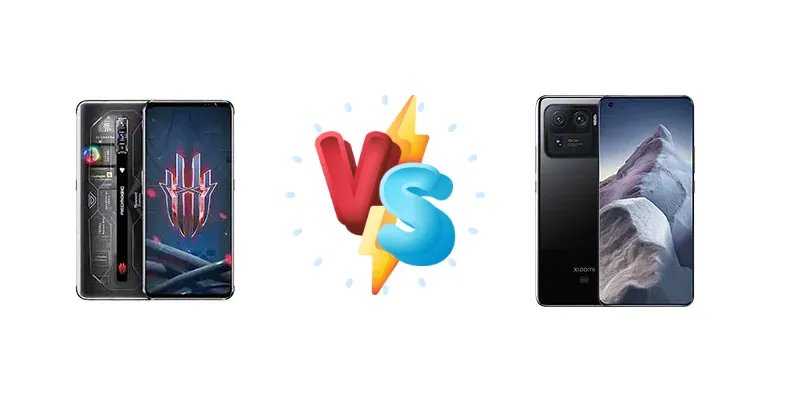
|
🏆 Quick Verdict
For the average user, the Xiaomi Mi 11 Ultra is the more well-rounded choice. Its exceptional camera system, brighter display, and faster charging capabilities offer a superior daily experience. However, serious mobile gamers will find the RedMagic 6s’s optimized performance and cooling to be invaluable.
| PHONES | ||
|---|---|---|
| Phone Names | ZTE nubia RedMagic 6s | Xiaomi Mi 11 Ultra |
| Network | ||
|---|---|---|
| 2G bands | GSM 850 / 900 / 1800 / 1900 | GSM 850 / 900 / 1800 / 1900 |
| 3G bands | HSDPA 850 / 900 / 1700(AWS) / 1900 / 2100 | HSDPA 850 / 900 / 1700(AWS) / 1900 / 2100 |
| 4G bands | LTE | 1, 2, 3, 4, 5, 7, 8, 12, 17, 20, 28, 32, 38, 40, 41, 42, 66 - International |
| 5G bands | SA/NSA | 1, 3, 5, 7, 8, 20, 28, 38, 40, 41, 77, 78, 79 SA/NSA - International |
| Speed | HSPA, LTE, 5G | HSPA, LTE, 5G |
| Technology | GSM / CDMA / HSPA / EVDO / LTE / 5G | GSM / CDMA / HSPA / EVDO / LTE / 5G |
| - | 1, 3, 28, 41, 77, 78, 79 SA/NSA - China | |
| Launch | ||
|---|---|---|
| Announced | 2021, September 06 | 2021, March 29 |
| Status | Available. Released 2021, September 27 | Available. Released 2021, April 02 |
| Body | ||
|---|---|---|
| Build | Glass front, glass back, aluminum frame | Glass front (Gorilla Glass Victus), ceramic back, aluminum frame |
| Dimensions | 169.9 x 77.2 x 9.5 mm (6.69 x 3.04 x 0.37 in) | 164.3 x 74.6 x 8.4 mm (6.47 x 2.94 x 0.33 in) |
| SIM | Nano-SIM + Nano-SIM | Nano-SIM + Nano-SIM |
| Weight | 215 g (7.58 oz) | 234 g (8.25 oz) |
| - | IP68 dust/water resistant (up to 1.5m for 30 min) | |
| Display | ||
|---|---|---|
| Protection | Corning Gorilla Glass | Corning Gorilla Glass Victus |
| Resolution | 1080 x 2400 pixels, 20:9 ratio (~387 ppi density) | 1440 x 3200 pixels, 20:9 ratio (~515 ppi density) |
| Size | 6.8 inches, 111.6 cm2 (~85.1% screen-to-body ratio) | 6.81 inches, 112.0 cm2 (~91.4% screen-to-body ratio) |
| Type | AMOLED, 165Hz, 700 nits (typ) | AMOLED, 1B colors, 120Hz, HDR10+, Dolby Vision, 900 nits (HBM), 1700 nits (peak) |
| Platform | ||
|---|---|---|
| CPU | Octa-core (1x3.0 GHz Cortex-X1 & 3x2.42 GHz Cortex-A78 & 4x1.80 GHz Cortex-A55) | Octa-core (1x2.84 GHz Cortex-X1 & 3x2.42 GHz Cortex-A78 & 4x1.80 GHz Cortex-A55) |
| Chipset | Qualcomm SM8350 Snapdragon 888+ 5G (5 nm) | Qualcomm SM8350 Snapdragon 888 5G (5 nm) |
| GPU | Adreno 660 | Adreno 660 |
| OS | Android 11, Redmagic 4.5 | Android 11, upgradable to Android 13, MIUI 14 |
| Memory | ||
|---|---|---|
| Card slot | No | No |
| Internal | 128GB 12GB RAM, 256GB 12GB RAM, 256GB 16GB RAM | 256GB 8GB RAM, 256GB 12GB RAM, 512GB 12GB RAM |
| - | UFS 3.1 | |
| Main Camera | ||
|---|---|---|
| Features | LED flash, HDR, panorama | Laser AF, color spectrum sensor, Dual-LED flash, HDR, panorama, 1.1” AMOLED selfie display |
| Single | - | 20 MP, f/2.2, 27mm (wide), 1/3.4", 0.8µm |
| Triple | 64 MP, f/1.8, 26mm (wide), 1/1.97", 0.7µm, PDAF 8 MP, f/2.0, 120˚, 13mm (ultrawide), 1/4.0", 1.12µm 2 MP (macro) | 50 MP, f/2.0, 24mm (wide), 1/1.12", 1.4µm, dual pixel PDAF, OIS 48 MP, f/4.1, 120mm (periscope telephoto), 1/2.0", 0.8µm, PDAF, OIS, 5x optical zoom 48 MP, f/2.2, 12mm, 128˚ (ultrawide), 1/2.0", 0.8µm, PDAF |
| Video | 8K@30fps, 4K@30/60fps, 1080p@30/60/120/240fps | 8K@24fps, 4K@30/60fps, 1080p@30/60/120/240/960/1920fps, gyro-EIS, HDR10+ rec. |
| Selfie camera | ||
|---|---|---|
| Features | HDR | HDR, panorama |
| Single | 8 MP, f/2.0, (wide), 1/4.0", 1.12µm | 20 MP, f/2.2, 27mm (wide), 1/3.4", 0.8µm |
| Video | 1080p@30fps | 1080p@30/60fps, 720p@120fps, gyro-EIS |
| Sound | ||
|---|---|---|
| 3.5mm jack | - | No |
| 35mm jack | Yes | No |
| Loudspeaker | Yes, with stereo speakers | Yes, with stereo speakers |
| - | 24-bit/192kHz audio Tuned by Harman Kardon | |
| Comms | ||
|---|---|---|
| Bluetooth | 5.1, A2DP, aptX, LE | 5.2, A2DP, LE, aptX HD, aptX Adaptive |
| Infrared port | - | Yes |
| NFC | Yes | Yes |
| Positioning | GPS (L1+L5), GLONASS, BDS, GALILEO | GPS (L1+L5), GLONASS (L1), BDS (B1I+B1c+B2a), GALILEO (E1+E5a), QZSS (L1+L5), NavIC (L5) |
| Radio | No | No |
| USB | USB Type-C 3.0, OTG, accessory connector | USB Type-C 2.0, OTG |
| WLAN | Wi-Fi 802.11 a/b/g/n/ac/6, dual-band, Wi-Fi Direct | Wi-Fi 802.11 a/b/g/n/ac/6e, dual-band, Wi-Fi Direct, DLNA |
| Features | ||
|---|---|---|
| Sensors | Fingerprint (under display, optical), accelerometer, gyro, proximity, compass, heart rate | Fingerprint (under display, optical), accelerometer, gyro, compass |
| - | Virtual proximity sensing | |
| Battery | ||
|---|---|---|
| Charging | 30W wired, PD3.0, QC5 | 67W wired, PD3.0, QC4, 100% in 36 min 67W wireless, 100% in 39 min 10W reverse wireless |
| Type | Li-Po 5050 mAh | Li-Po 5000 mAh |
| Misc | ||
|---|---|---|
| Colors | Eclipse Black, Transparent | Ceramic White (Cosmic White), Ceramic Black (Cosmic Black) |
| Models | - | M2102K1G, M2102K1C |
| Price | About 500 EUR | About 1500 EUR |
| SAR | - | 1.08 W/kg (head) 0.81 W/kg (body) |
| SAR EU | - | 0.55 W/kg (head) 0.99 W/kg (body) |
| Tests | ||
|---|---|---|
| Battery life | - | Endurance rating 95h |
| Camera | - | Photo / Video |
| Display | - | Contrast ratio: Infinite (nominal) |
| Loudspeaker | - | -24.3 LUFS (Very good) |
| Performance | - | AnTuTu: 688720 (v8) GeekBench: 3191 (v5.1) GFXBench: 33fps (ES 3.1 onscreen) |
ZTE nubia RedMagic 6s
- Superior gaming performance due to Snapdragon 888+ and cooling.
- Potentially higher refresh rate display for smoother gameplay.
- More affordable price point (likely).
- Inferior camera system compared to the Mi 11 Ultra.
- Slower charging speeds (30W vs 67W).
- Less refined overall user experience.
Xiaomi Mi 11 Ultra
- Exceptional camera system with high image quality.
- Faster wired and wireless charging speeds.
- Brighter and more versatile display.
- Potentially more thermal throttling during extended gaming.
- Higher price point.
- Less focused on gaming-specific features.
Display Comparison
The Xiaomi Mi 11 Ultra boasts a significantly brighter display, reaching a measured 943 nits, compared to an unspecified brightness for the RedMagic 6s. While both likely utilize AMOLED panels, the Mi 11 Ultra’s higher peak brightness translates to better visibility in direct sunlight. The Mi 11 Ultra’s ‘Infinite’ contrast ratio (nominal) suggests a superior black level performance. The RedMagic 6s, however, likely prioritizes a high refresh rate for smoother gaming, a feature not explicitly detailed for the Mi 11 Ultra, but common in the RedMagic line. The absence of LTPO information for either device means we can't assess dynamic refresh rate capabilities for power saving.
Camera Comparison
The Xiaomi Mi 11 Ultra is the clear winner in the camera department. While both phones are listed as having 'Photo / Video' capabilities, the Mi 11 Ultra is renowned for its exceptional camera system, featuring a large main sensor (specifications not provided in context data, but widely reviewed as a 50MP Samsung GN2). The Mi 11 Ultra’s image processing is geared towards natural-looking photos with excellent dynamic range. The RedMagic 6s, by contrast, prioritizes other features and likely has a more basic camera setup, sacrificing image quality for performance and cost. The absence of details regarding the RedMagic 6s’s camera sensors suggests it’s not a primary selling point.
Performance
Both devices are powered by the Qualcomm Snapdragon 888 series, but the RedMagic 6s features the Snapdragon 888+ 5G, clocked slightly higher at 3.0 GHz versus the Mi 11 Ultra’s 2.84 GHz. This clock speed difference, while not massive, provides a marginal performance advantage for the RedMagic 6s in sustained workloads. Crucially, the RedMagic 6s is designed with a more aggressive cooling system, essential for maintaining peak performance during extended gaming sessions, mitigating thermal throttling that the Mi 11 Ultra might experience. While both utilize an Octa-core CPU configuration with the same Cortex-A78 and A55 cores, the RedMagic’s focus on thermal management is a key differentiator.
Battery Life
Both phones achieve an endurance rating of 95 hours, indicating similar overall battery life despite differing charging capabilities. However, the Mi 11 Ultra offers significantly faster charging: 67W wired (100% in 36 minutes), 67W wireless (100% in 39 minutes), and 10W reverse wireless. The RedMagic 6s is limited to 30W wired charging, meaning a considerably longer charge time. While the Mi 11 Ultra doesn’t necessarily have a larger battery capacity, its faster charging speeds provide a more convenient user experience, especially for those who frequently need to top up their device.
Buying Guide
Buy the ZTE nubia RedMagic 6s if you need uncompromising gaming performance, a high refresh rate display for competitive play, and are willing to sacrifice camera quality and some everyday conveniences. Buy the Xiaomi Mi 11 Ultra if you prefer a top-tier camera system, a brighter and more versatile display, faster charging speeds (both wired and wireless), and a more polished overall smartphone experience.