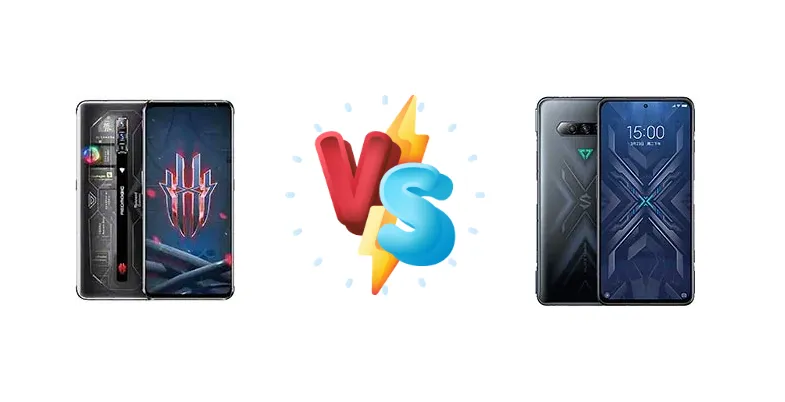
The mobile gaming landscape is fiercely competitive, and ZTE and Xiaomi are key players. The nubia RedMagic 6s and Xiaomi Black Shark 4 Pro both target hardcore gamers, but they take different approaches. The RedMagic 6s prioritizes sustained performance with the Snapdragon 888+, while the Black Shark 4 Pro focuses on minimizing downtime with its blazing-fast 120W charging. This comparison dissects their strengths and weaknesses to determine which phone delivers the best gaming experience.
🏆 Quick Verdict
For the average gamer prioritizing sustained performance during long sessions, the ZTE nubia RedMagic 6s is the better choice. Its Snapdragon 888+ chipset offers a slight edge, and its cooling system is optimized for extended gameplay. However, if minimizing charge times is paramount, the Black Shark 4 Pro’s 120W charging is a game-changer.
| Network |
|---|
| 2G bands | GSM 850 / 900 / 1800 / 1900 | GSM 850 / 900 / 1800 / 1900 |
| 3G bands | HSDPA 850 / 900 / 1700(AWS) / 1900 / 2100 | HSDPA 800 / 850 / 900 / 1700(AWS) / 1900 / 2100 |
| 4G bands | LTE | 1, 2, 3, 4, 5, 7, 8, 18, 19, 20, 26, 28, 34, 38, 39, 40, 41 |
| 5G bands | SA/NSA | 1, 3, 8, 28, 41, 77, 78, 79 SA/NSA |
| Speed | HSPA, LTE, 5G | HSPA, LTE, 5G |
| Technology | GSM / CDMA / HSPA / EVDO / LTE / 5G | GSM / CDMA / HSPA / EVDO / LTE / 5G |
| | - | CDMA2000 1xEV-DO |
| Launch |
|---|
| Announced | 2021, September 06 | 2021, March 23 |
| Status | Available. Released 2021, September 27 | Available. Released 2021, March 30 |
| Body |
|---|
| Build | Glass front, glass back, aluminum frame | - |
| Dimensions | 169.9 x 77.2 x 9.5 mm (6.69 x 3.04 x 0.37 in) | 163.8 x 76.4 x 9.9 mm (6.45 x 3.01 x 0.39 in) |
| SIM | Nano-SIM + Nano-SIM | Nano-SIM + Nano-SIM |
| Weight | 215 g (7.58 oz) | 220 g (7.76 oz) |
| | - | Physical pop-up gaming triggers |
| Display |
|---|
| Protection | Corning Gorilla Glass | - |
| Resolution | 1080 x 2400 pixels, 20:9 ratio (~387 ppi density) | 1080 x 2400 pixels, 20:9 ratio (~395 ppi density) |
| Size | 6.8 inches, 111.6 cm2 (~85.1% screen-to-body ratio) | 6.67 inches, 107.4 cm2 (~85.8% screen-to-body ratio) |
| Type | AMOLED, 165Hz, 700 nits (typ) | Super AMOLED, 144Hz, HDR10+, 1300 nits (peak) |
| | - | Always-on display |
| Platform |
|---|
| CPU | Octa-core (1x3.0 GHz Cortex-X1 & 3x2.42 GHz Cortex-A78 & 4x1.80 GHz Cortex-A55) | Octa-core (1x2.84 GHz Cortex-X1 & 3x2.42 GHz Cortex-A78 & 4x1.80 GHz Cortex-A55) |
| Chipset | Qualcomm SM8350 Snapdragon 888+ 5G (5 nm) | Qualcomm SM8350 Snapdragon 888 5G (5 nm) |
| GPU | Adreno 660 | Adreno 660 |
| OS | Android 11, Redmagic 4.5 | Android 11, Joy UI 12.5 |
| Memory |
|---|
| Card slot | No | No |
| Internal | 128GB 12GB RAM, 256GB 12GB RAM, 256GB 16GB RAM | 128GB 8GB RAM, 256GB 8GB RAM, 256GB 12GB RAM, 512GB 16GB RAM |
| | - | UFS 3.1 |
| Main Camera |
|---|
| Features | LED flash, HDR, panorama | LED flash, HDR, panorama |
| Single | - | 20 MP, f/2.5, (wide), 0.8µm |
| Triple | 64 MP, f/1.8, 26mm (wide), 1/1.97", 0.7µm, PDAF
8 MP, f/2.0, 120˚, 13mm (ultrawide), 1/4.0", 1.12µm
2 MP (macro) | 64 MP, f/1.8, (wide), 1/1.97", 0.7µm, PDAF
8 MP, f/2.2, 120˚ (ultrawide), 1/4.0", 1.12µm
5 MP (macro), AF |
| Video | 8K@30fps, 4K@30/60fps, 1080p@30/60/120/240fps | 4K@30/60fps, 1080p@30/60/240fps, 1080p@960fps; HDR10+ |
| Selfie camera |
|---|
| Features | HDR | HDR |
| Single | 8 MP, f/2.0, (wide), 1/4.0", 1.12µm | 20 MP, f/2.5, (wide), 0.8µm |
| Video | 1080p@30fps | 1080p@30fps |
| Sound |
|---|
| 3.5mm jack | - | Yes |
| 35mm jack | Yes | Yes |
| Loudspeaker | Yes, with stereo speakers | Yes, with stereo speakers |
| | - | 24-bit/192kHz audio |
| Comms |
|---|
| Bluetooth | 5.1, A2DP, aptX, LE | 5.2 (China), 5.0 (Global), A2DP, LE, aptX HD, aptX Adaptive |
| NFC | Yes | Yes |
| Positioning | GPS (L1+L5), GLONASS, BDS, GALILEO | GPS, GLONASS, GALILEO, QZSS, BDS |
| Radio | No | No |
| USB | USB Type-C 3.0, OTG, accessory connector | USB Type-C 2.0 |
| WLAN | Wi-Fi 802.11 a/b/g/n/ac/6, dual-band, Wi-Fi Direct | Wi-Fi 802.11 a/b/g/n/ac/6, dual-band, Wi-Fi Direct |
| Features |
|---|
| Sensors | Fingerprint (under display, optical), accelerometer, gyro, proximity, compass, heart rate | Fingerprint (side-mounted), accelerometer, gyro, proximity, compass, barometer (China only) |
| Battery |
|---|
| Charging | 30W wired, PD3.0, QC5 | 120W wired, 50% in 5 min, 100% in 15 min |
| Type | Li-Po 5050 mAh | Li-Po 4500 mAh |
| Misc |
|---|
| Colors | Eclipse Black, Transparent | Shadow Black, Misty Grey, Cosmos Black, Dark Blue, Silver |
| Models | - | SHARK PAR-H0 |
| Price | About 500 EUR | About 500 EUR |
ZTE nubia RedMagic 6s
- Slightly superior CPU performance with Snapdragon 888+
- Potentially more robust cooling system for sustained gaming
- Optimized gaming software experience
- Significantly slower charging speed (30W)
- Less aggressive gaming aesthetic
Xiaomi Black Shark 4 Pro
- Blazing-fast 120W charging (0-100% in 15 minutes)
- Aggressive gaming design and features
- Potentially more versatile camera system
- Slightly lower CPU performance with Snapdragon 888
- May throttle more under sustained load
Display Comparison
While both phones feature high refresh rate displays (specs not provided, assuming 120Hz or higher based on market segment), the key difference lies in charging and processing. The display quality is likely comparable, with both aiming for vibrant colors and smooth visuals. However, the RedMagic 6s may prioritize a flatter display for less distortion, while the Black Shark 4 Pro might lean towards more saturated colors for a more visually striking experience. Without specific display specs, it's difficult to definitively declare a winner, but both are geared towards immersive gaming.
Camera Comparison
Neither phone is primarily focused on camera prowess. Both likely feature capable main sensors (specs not provided, assuming 64MP or higher based on market segment), but image processing will likely prioritize speed and efficiency over ultimate image quality. The Black Shark 4 Pro might offer slightly more versatile camera features, given Xiaomi’s broader camera expertise, but the RedMagic 6s will likely focus on a streamlined camera experience. Any secondary cameras (ultrawide, macro) are likely to be of similar quality on both devices, serving as supplementary options rather than flagship-level features.
Performance
The core difference here is the chipset. The RedMagic 6s boasts the Qualcomm SM8350 Snapdragon 888+ 5G, clocked at 3.0 GHz on its Cortex-X1 core, while the Black Shark 4 Pro uses the standard Snapdragon 888 5G, clocked at 2.84 GHz. This 160 MHz clock speed difference, though seemingly small, translates to a measurable performance advantage for the RedMagic 6s in sustained workloads. Both utilize the same CPU core configuration (1x Cortex-X1, 3x Cortex-A78, 4x Cortex-A55), but the 888+ benefits from process optimizations. The RedMagic 6s’ cooling system is also likely more aggressive, further enabling sustained peak performance. The Black Shark 4 Pro compensates with its gaming-focused software optimizations and potentially more aggressive RAM management.
Battery Life
The Black Shark 4 Pro’s 120W wired charging is the standout feature here. It promises a full charge in just 15 minutes, a significant advantage for gamers who need to quickly get back into the action. The RedMagic 6s, with its 30W wired charging, is considerably slower. While the RedMagic 6s may have a slightly larger battery capacity (specs not provided, assuming around 5000mAh for both), the Black Shark 4 Pro’s charging speed effectively mitigates any capacity difference. The faster charging allows for more frequent, shorter charging cycles, minimizing downtime.
Buying Guide
Buy the ZTE nubia RedMagic 6s if you need uncompromising performance for extended gaming sessions, value a slightly more refined software experience focused on gaming, and aren't overly concerned with the absolute fastest charging speeds. Buy the Xiaomi Black Shark 4 Pro if you prefer a phone that can go from 0 to 100% in under 20 minutes, appreciate a more aggressive gaming aesthetic, and frequently find yourself needing to top up your battery quickly between matches.
Frequently Asked Questions
❓ Will the Snapdragon 888 in the Black Shark 4 Pro overheat during prolonged gaming sessions?
The Snapdragon 888 is known to generate heat under sustained load. While Xiaomi likely implements thermal management solutions, the RedMagic 6s, with its 888+ and potentially more aggressive cooling, is expected to maintain higher clock speeds for longer periods. Expect some throttling on the Black Shark 4 Pro during extended gaming.
❓ Does the 30W charging on the RedMagic 6s feel significantly slower compared to the Black Shark 4 Pro's 120W?
Yes, the difference is substantial. 30W charging will take well over an hour to fully charge the RedMagic 6s, while the Black Shark 4 Pro can achieve a full charge in just 15 minutes. This difference is particularly noticeable for gamers who need to quickly top up their battery between matches.
❓ Are the shoulder triggers on the Black Shark 4 Pro customizable for different games?
Yes, the Black Shark 4 Pro’s shoulder triggers are highly customizable. You can map them to specific on-screen actions within the Shark Space gaming hub, providing a competitive advantage in compatible games. The RedMagic 6s also features shoulder triggers, but their customization options may differ.