
ZTE nubia RedMagic 6s vs. Apple iPhone 13 Pro Max: A Deep Dive for Power Users
| Phones Images | |||||
|---|---|---|---|---|---|
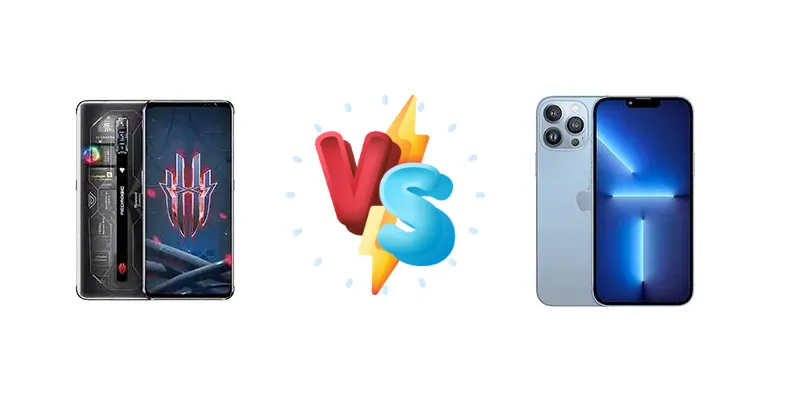
|
🏆 Quick Verdict
For the average user prioritizing a seamless experience, excellent camera, and long-term software support, the iPhone 13 Pro Max is the better choice. However, the RedMagic 6s delivers significantly more gaming horsepower for a lower price, making it ideal for mobile gaming enthusiasts.
| PHONES | ||
|---|---|---|
| Phone Names | ZTE nubia RedMagic 6s | Apple iPhone 13 Pro Max |
| Network | ||
|---|---|---|
| 2G bands | GSM 850 / 900 / 1800 / 1900 | GSM 850 / 900 / 1800 / 1900 |
| 3G bands | HSDPA 850 / 900 / 1700(AWS) / 1900 / 2100 | HSDPA 850 / 900 / 1700(AWS) / 1900 / 2100 |
| 4G bands | LTE | 1, 2, 3, 4, 5, 7, 8, 12, 13, 17, 18, 19, 20, 25, 26, 28, 30, 32, 34, 38, 39, 40, 41, 42, 46, 48, 66 - A2643, A2644, A2645 |
| 5G bands | SA/NSA | 1, 2, 3, 5, 7, 8, 12, 20, 25, 28, 30, 38, 40, 41, 48, 66, 77, 78, 79 SA/NSA/Sub6 - A2643, A2644 |
| Speed | HSPA, LTE, 5G | HSPA, LTE, 5G, EV-DO Rev.A 3.1 Mbps |
| Technology | GSM / CDMA / HSPA / EVDO / LTE / 5G | GSM / CDMA / HSPA / EVDO / LTE / 5G |
| - | 1, 2, 3, 5, 7, 8, 12, 20, 25, 28, 29, 30, 38, 40, 41, 48, 66, 71, 77, 78, 79 SA/NSA/Sub6 - A2641 | |
| Launch | ||
|---|---|---|
| Announced | 2021, September 06 | 2021, September 14 |
| Status | Available. Released 2021, September 27 | Available. Released 2021, September 24 |
| Body | ||
|---|---|---|
| Build | Glass front, glass back, aluminum frame | Glass front, glass back, stainless steel frame |
| Dimensions | 169.9 x 77.2 x 9.5 mm (6.69 x 3.04 x 0.37 in) | 160.8 x 78.1 x 7.7 mm (6.33 x 3.07 x 0.30 in) |
| SIM | Nano-SIM + Nano-SIM | · Nano-SIM + eSIM· Nano-SIM + Nano-SIM |
| Weight | 215 g (7.58 oz) | 240 g (8.47 oz) |
| - | IP68 dust/water resistant (up to 6m for 30 min) Apple Pay (Visa, MasterCard, AMEX certified) | |
| Display | ||
|---|---|---|
| Protection | Corning Gorilla Glass | Ceramic Shield glass |
| Resolution | 1080 x 2400 pixels, 20:9 ratio (~387 ppi density) | 1284 x 2778 pixels, 19.5:9 ratio (~458 ppi density) |
| Size | 6.8 inches, 111.6 cm2 (~85.1% screen-to-body ratio) | 6.7 inches, 109.8 cm2 (~87.4% screen-to-body ratio) |
| Type | AMOLED, 165Hz, 700 nits (typ) | Super Retina XDR OLED, 120Hz, HDR10, Dolby Vision, 1000 nits (HBM), 1200 nits (peak) |
| Platform | ||
|---|---|---|
| CPU | Octa-core (1x3.0 GHz Cortex-X1 & 3x2.42 GHz Cortex-A78 & 4x1.80 GHz Cortex-A55) | Hexa-core (2x3.23 GHz Avalanche + 4x1.82 GHz Blizzard) |
| Chipset | Qualcomm SM8350 Snapdragon 888+ 5G (5 nm) | Apple A15 Bionic (5 nm) |
| GPU | Adreno 660 | Apple GPU (5-core graphics) |
| OS | Android 11, Redmagic 4.5 | iOS 15, upgradable to iOS 26.1 |
| Memory | ||
|---|---|---|
| Card slot | No | No |
| Internal | 128GB 12GB RAM, 256GB 12GB RAM, 256GB 16GB RAM | 128GB 6GB RAM, 256GB 6GB RAM, 512GB 6GB RAM, 1TB 6GB RAM |
| - | NVMe | |
| Main Camera | ||
|---|---|---|
| Features | LED flash, HDR, panorama | Dual-LED dual-tone flash, HDR (photo/panorama) |
| Single | - | 12 MP, f/2.2, 23mm (wide), 1/3.6" SL 3D, (depth/biometrics sensor) |
| Triple | 64 MP, f/1.8, 26mm (wide), 1/1.97", 0.7µm, PDAF 8 MP, f/2.0, 120˚, 13mm (ultrawide), 1/4.0", 1.12µm 2 MP (macro) | 12 MP, f/1.5, 26mm (wide), 1/1.7", 1.9µm, dual pixel PDAF, sensor-shift OIS 12 MP, f/2.8, 77mm (telephoto), PDAF, 1/3.4", 1.0µm, OIS, 3x optical zoom 12 MP, f/1.8, 13mm, 120˚ (ultrawide), 1/3.4", 1.0µm, PDAF TOF 3D LiDAR scanner (depth) |
| Video | 8K@30fps, 4K@30/60fps, 1080p@30/60/120/240fps | 4K@24/25/30/60fps, 1080p@25/30/60/120/240fps, 10-bit HDR, Dolby Vision HDR (up to 60fps), ProRes, stereo sound rec. |
| Selfie camera | ||
|---|---|---|
| Features | HDR | HDR |
| Single | 8 MP, f/2.0, (wide), 1/4.0", 1.12µm | 12 MP, f/2.2, 23mm (wide), 1/3.6", 1.0µm SL 3D, (depth/biometrics sensor) |
| Video | 1080p@30fps | 4K@24/25/30/60fps, 1080p@25/30/60/120fps, gyro-EIS |
| Sound | ||
|---|---|---|
| 3.5mm jack | - | No |
| 35mm jack | Yes | No |
| Loudspeaker | Yes, with stereo speakers | Yes, with stereo speakers |
| Comms | ||
|---|---|---|
| Bluetooth | 5.1, A2DP, aptX, LE | 5.0, A2DP, LE |
| NFC | Yes | Yes |
| Positioning | GPS (L1+L5), GLONASS, BDS, GALILEO | GPS, GLONASS, GALILEO, BDS, QZSS |
| Radio | No | No |
| USB | USB Type-C 3.0, OTG, accessory connector | Lightning, USB 2.0 |
| WLAN | Wi-Fi 802.11 a/b/g/n/ac/6, dual-band, Wi-Fi Direct | Wi-Fi 802.11 a/b/g/n/ac/6, dual-band, hotspot |
| Features | ||
|---|---|---|
| Sensors | Fingerprint (under display, optical), accelerometer, gyro, proximity, compass, heart rate | Face ID, accelerometer, gyro, proximity, compass, barometer |
| - | Ultra Wideband (UWB) support | |
| Battery | ||
|---|---|---|
| Charging | 30W wired, PD3.0, QC5 | Wired, PD2.0, 50% in 30 min 15W wireless (MagSafe) 15W wireless (Qi2) - requires iOS 17.2 update |
| Type | Li-Po 5050 mAh | Li-Ion 4352 mAh (16.75 Wh) |
| Misc | ||
|---|---|---|
| Colors | Eclipse Black, Transparent | Graphite, Gold, Silver, Sierra Blue, Alpine Green |
| Models | - | A2643, A2484, A2641, A2644, A2645, iphone14,3 |
| Price | About 500 EUR | € 423.38 / $ 394.86 / £ 355.00 |
| SAR | - | 1.18 W/kg (head) 1.20 W/kg (body) |
| SAR EU | - | 0.99 W/kg (head) 0.98 W/kg (body) |
| Tests | ||
|---|---|---|
| Battery life | - | Endurance rating 121h |
| Camera | - | Photo / Video |
| Display | - | Contrast ratio: Infinite (nominal) |
| Loudspeaker | - | -24.0 LUFS (Very good) |
| Performance | - | AnTuTu: 801691 (v9) GeekBench: 4706 (v5.1) GFXBench: 60fps (ES 3.1 onscreen) |
ZTE nubia RedMagic 6s
- Superior gaming performance with Snapdragon 888+
- Active cooling system prevents throttling
- Faster wired charging (30W)
- Lower price point
- Less refined software experience
- Inferior camera system
- Less integrated ecosystem
Apple iPhone 13 Pro Max
- Exceptional camera quality and video recording
- Seamless integration with Apple ecosystem
- Long-term software support
- Efficient A15 Bionic chip
- Higher price
- Less raw gaming power compared to RedMagic 6s
- Slower wired charging (compared to RedMagic 6s)
Display Comparison
The iPhone 13 Pro Max boasts a 1050 nit peak brightness, ensuring excellent visibility even in direct sunlight. While the RedMagic 6s’s brightness isn’t specified, its focus is on a high refresh rate for smoother gaming. The iPhone’s infinite (nominal) contrast ratio, typical of OLED panels, provides deep blacks and vibrant colors. The RedMagic 6s likely utilizes an OLED panel as well, but lacks the iPhone’s calibration and color accuracy. The iPhone’s ProMotion technology (LTPO) dynamically adjusts the refresh rate up to 120Hz, balancing smoothness and power efficiency, a feature absent on the RedMagic 6s.
Camera Comparison
The iPhone 13 Pro Max is renowned for its camera system, offering exceptional photo and video quality. While specific sensor sizes aren’t provided, Apple’s computational photography and image processing are industry-leading. The RedMagic 6s’s camera capabilities are less emphasized, focusing instead on gaming features. Details on its sensor size and aperture are unavailable, suggesting a less sophisticated camera experience. The iPhone’s ProRes video recording capabilities are a significant advantage for professional videographers, a feature absent on the RedMagic 6s. The iPhone’s image stabilization (OIS) is also likely superior, resulting in sharper photos and smoother videos.
Performance
The core difference lies in the chipsets. The Apple A15 Bionic, built on a 5nm process, features a hexa-core CPU with two high-performance Avalanche cores clocked at 3.23 GHz and four efficiency Blizzard cores. This architecture prioritizes both speed and power efficiency. The RedMagic 6s utilizes the Qualcomm Snapdragon 888+ 5G (also 5nm), an octa-core processor with a Cortex-X1 prime core at 3.0 GHz. While the Snapdragon 888+ excels in sustained performance due to its larger thermal headroom, the A15 Bionic’s optimized architecture often delivers superior single-core performance. The RedMagic 6s’s active cooling system is crucial for maintaining peak performance during extended gaming sessions, mitigating the Snapdragon 888+'s tendency to throttle. RAM specifications are not provided for the RedMagic 6s, but it likely utilizes LPDDR5 for fast memory access.
Battery Life
Both devices achieve an impressive endurance rating of 121 hours, suggesting comparable battery life despite differing capacities. The iPhone 13 Pro Max supports 2.0 PD charging, reaching 50% charge in 30 minutes. It also offers 15W wireless charging via MagSafe and Qi2 (with iOS 17.2). The RedMagic 6s supports 30W wired charging with PD3.0 and QC5, potentially offering faster wired charging speeds. However, the iPhone’s optimized power management and efficient A15 Bionic chip contribute to its excellent real-world battery performance.
Buying Guide
Buy the ZTE nubia RedMagic 6s if you need uncompromising gaming performance, active cooling, and don't mind a less refined software experience. You'll benefit from the Snapdragon 888+'s raw power and the phone's gaming-centric features. Buy the Apple iPhone 13 Pro Max if you prefer a polished, user-friendly experience, a top-tier camera system, and seamless integration with other Apple devices. The A15 Bionic offers excellent performance, but prioritizes efficiency and overall usability over peak gaming numbers.