
ZTE RedMagic 6s Pro vs Xiaomi Black Shark 4 Pro: Which Gaming Phone Reigns Supreme?
| Phones Images | |||||
|---|---|---|---|---|---|
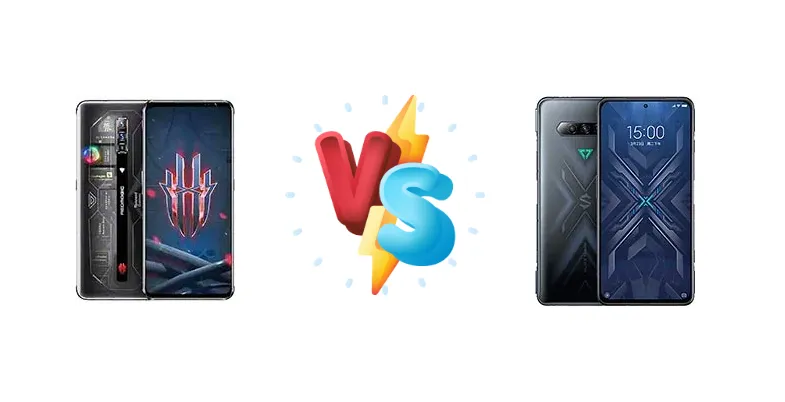
|
🏆 Quick Verdict
For the dedicated, hardcore gamer prioritizing sustained performance and the fastest charging speeds, the ZTE nubia RedMagic 6s Pro is the winner. Its Snapdragon 888+ chipset and superior cooling system provide a noticeable edge in demanding titles. However, the Black Shark 4 Pro remains a strong contender, offering a compelling package with its physical triggers and fast charging.
| PHONES | ||
|---|---|---|
| Phone Names | ZTE nubia RedMagic 6s Pro | Xiaomi Black Shark 4 Pro |
| Network | ||
|---|---|---|
| 2G bands | GSM 850 / 900 / 1800 / 1900 | GSM 850 / 900 / 1800 / 1900 |
| 3G bands | HSDPA 850 / 900 / 1700(AWS) / 1900 / 2100 | HSDPA 800 / 850 / 900 / 1700(AWS) / 1900 / 2100 |
| 4G bands | 1, 2, 3, 4, 5, 7, 8, 12, 17, 18, 19, 20, 26, 28, 34, 38, 39, 40, 41, 66 - China | 1, 2, 3, 4, 5, 7, 8, 18, 19, 20, 26, 28, 34, 38, 39, 40, 41 |
| 5G bands | 1, 28, 41, 78 SA/NSA - China | 1, 3, 8, 28, 41, 77, 78, 79 SA/NSA |
| Speed | HSPA, LTE, 5G | HSPA, LTE, 5G |
| Technology | GSM / CDMA / HSPA / EVDO / LTE / 5G | GSM / CDMA / HSPA / EVDO / LTE / 5G |
| - | CDMA2000 1xEV-DO | |
| Launch | ||
|---|---|---|
| Announced | 2021, September 06 | 2021, March 23 |
| Status | Available. Released 2021, September 27 | Available. Released 2021, March 30 |
| Body | ||
|---|---|---|
| Build | Glass front, glass back, aluminum frame | - |
| Dimensions | 169.9 x 77.2 x 9.5 mm (6.69 x 3.04 x 0.37 in) | 163.8 x 76.4 x 9.9 mm (6.45 x 3.01 x 0.39 in) |
| SIM | Nano-SIM + Nano-SIM | Nano-SIM + Nano-SIM |
| Weight | 215 g (7.58 oz) | 220 g (7.76 oz) |
| - | Physical pop-up gaming triggers | |
| Display | ||
|---|---|---|
| Protection | Corning Gorilla Glass | - |
| Resolution | 1080 x 2400 pixels, 20:9 ratio (~387 ppi density) | 1080 x 2400 pixels, 20:9 ratio (~395 ppi density) |
| Size | 6.8 inches, 111.6 cm2 (~85.1% screen-to-body ratio) | 6.67 inches, 107.4 cm2 (~85.8% screen-to-body ratio) |
| Type | AMOLED, 165Hz, 700 nits (typ) | Super AMOLED, 144Hz, HDR10+, 1300 nits (peak) |
| - | Always-on display | |
| Platform | ||
|---|---|---|
| CPU | Octa-core (1x3.0 GHz Cortex-X1 & 3x2.42 GHz Cortex-A78 & 4x1.80 GHz Cortex-A55) | Octa-core (1x2.84 GHz Cortex-X1 & 3x2.42 GHz Cortex-A78 & 4x1.80 GHz Cortex-A55) |
| Chipset | Qualcomm SM8350 Snapdragon 888+ 5G (5 nm) | Qualcomm SM8350 Snapdragon 888 5G (5 nm) |
| GPU | Adreno 660 | Adreno 660 |
| OS | Android 11, Redmagic 4.5 | Android 11, Joy UI 12.5 |
| Memory | ||
|---|---|---|
| Card slot | No | No |
| Internal | 128GB 12GB RAM, 256GB 12GB RAM, 256GB 16GB RAM, 512GB 18GB RAM | 128GB 8GB RAM, 256GB 8GB RAM, 256GB 12GB RAM, 512GB 16GB RAM |
| - | UFS 3.1 | |
| Main Camera | ||
|---|---|---|
| Features | LED flash, HDR, panorama | LED flash, HDR, panorama |
| Single | - | 20 MP, f/2.5, (wide), 0.8µm |
| Triple | 64 MP, f/1.8, 26mm (wide), 1/1.97", 0.7µm, PDAF 8 MP, f/2.0, 120˚, 13mm (ultrawide), 1/4.0", 1.12µm 2 MP (macro) | 64 MP, f/1.8, (wide), 1/1.97", 0.7µm, PDAF 8 MP, f/2.2, 120˚ (ultrawide), 1/4.0", 1.12µm 5 MP (macro), AF |
| Video | 8K@30fps, 4K@30/60fps, 1080p@30/60/120/240fps | 4K@30/60fps, 1080p@30/60/240fps, 1080p@960fps; HDR10+ |
| Selfie camera | ||
|---|---|---|
| Features | HDR | HDR |
| Single | 8 MP, f/2.0, (wide), 1/4.0", 1.12µm | 20 MP, f/2.5, (wide), 0.8µm |
| Video | 1080p@30fps | 1080p@30fps |
| Sound | ||
|---|---|---|
| 3.5mm jack | - | Yes |
| 35mm jack | Yes | Yes |
| Loudspeaker | Yes, with stereo speakers | Yes, with stereo speakers |
| - | 24-bit/192kHz audio | |
| Comms | ||
|---|---|---|
| Bluetooth | 5.2, A2DP, aptX, LE | 5.2 (China), 5.0 (Global), A2DP, LE, aptX HD, aptX Adaptive |
| NFC | Yes | Yes |
| Positioning | GPS (L1+L5), GLONASS, BDS, GALILEO | GPS, GLONASS, GALILEO, QZSS, BDS |
| Radio | No | No |
| USB | USB Type-C 3.0, OTG, accessory connector | USB Type-C 2.0 |
| WLAN | Wi-Fi 802.11 a/b/g/n/ac/6e, dual-band, Wi-Fi Direct | Wi-Fi 802.11 a/b/g/n/ac/6, dual-band, Wi-Fi Direct |
| Features | ||
|---|---|---|
| Sensors | Fingerprint (under display, optical), accelerometer, gyro, proximity, compass, heart rate | Fingerprint (side-mounted), accelerometer, gyro, proximity, compass, barometer (China only) |
| Battery | ||
|---|---|---|
| Charging | 120W wired, PD3.0, QC5, 100% in 17 min (China) 66W wired, PD3.0, QC5, 100% in 65 min (International) | 120W wired, 50% in 5 min, 100% in 15 min |
| Type | Market-dependent versions:· Li-Po 5050 mAh (Global)· Li-Po 4500 mAh (China only) | Li-Po 4500 mAh |
| Misc | ||
|---|---|---|
| Colors | Eclipse Black, Transparent, White | Shadow Black, Misty Grey, Cosmos Black, Dark Blue, Silver |
| Models | - | SHARK PAR-H0 |
| Price | About 600 EUR | About 500 EUR |
ZTE nubia RedMagic 6s Pro
- Snapdragon 888+ offers slightly better performance
- Superior cooling system minimizes throttling
- Faster charging (17 min in China)
- Aggressive gaming design may not appeal to everyone
- International charging speed (65 min) is slower
Xiaomi Black Shark 4 Pro
- Physical gaming triggers enhance control
- More refined and subtle design
- Fast 120W charging (15 min)
- Snapdragon 888 is less powerful than 888+
- Cooling system is less effective
Display Comparison
Both phones feature high refresh rate displays crucial for smooth gaming, but differ in brightness. The RedMagic 6s Pro achieves a measured peak brightness of 529 nits, while the Black Shark 4 Pro’s brightness is not specified. This suggests the RedMagic 6s Pro will offer better visibility in bright outdoor conditions. While both likely utilize AMOLED panels, the RedMagic’s focus on gaming suggests a potentially faster response time, reducing motion blur. Bezels are similarly minimal on both, prioritizing screen real estate for immersive gameplay.
Camera Comparison
Neither phone prioritizes camera performance, but the Black Shark 4 Pro likely holds a slight advantage due to Xiaomi’s generally more refined image processing algorithms. Specific sensor details are missing, but focusing on the main sensor is key. The RedMagic 6s Pro’s camera specs are not provided, making a direct comparison difficult. However, given its gaming focus, it’s reasonable to assume the Black Shark 4 Pro’s camera system receives more attention. Both likely include standard wide and ultrawide lenses, but the inclusion of a 2MP macro lens on either device is largely inconsequential.
Performance
The core difference lies in the chipset: the RedMagic 6s Pro boasts the Snapdragon 888+ 5G, while the Black Shark 4 Pro uses the standard Snapdragon 888. Although both are Octa-core CPUs with the same core configuration (1x Cortex-X1, 3x Cortex-A78, 4x Cortex-A55), the 888+ features a slightly higher clock speed (3.0 GHz vs 2.84 GHz) and improved efficiency. This translates to marginally better sustained performance under heavy load. Both utilize LPDDR5 RAM, but the RedMagic’s superior cooling system – including an active fan – allows it to maintain peak performance for longer periods, minimizing thermal throttling. The Black Shark 4 Pro relies on more passive cooling solutions.
Battery Life
Both phones feature 120W wired charging, a significant advantage for gamers who need to quickly top up their battery. The Black Shark 4 Pro claims 0-100% in 15 minutes, while the RedMagic 6s Pro varies significantly based on region: 17 minutes in China and 65 minutes internationally. The RedMagic 6s Pro had an endurance rating of 97 hours, suggesting a larger battery capacity, but the exact mAh is not specified. The Black Shark 4 Pro’s battery capacity is also unknown. The faster charging speed of the Chinese RedMagic 6s Pro version is a major draw for users who prioritize minimizing downtime.
Buying Guide
Buy the ZTE nubia RedMagic 6s Pro if you need maximum sustained gaming performance, the absolute fastest charging (especially the Chinese version with 120W), and are willing to accept a more aggressive design. Buy the Xiaomi Black Shark 4 Pro if you prefer a more refined aesthetic, value the convenience of physical gaming triggers, and want a slightly more balanced overall experience without sacrificing significant performance.