
ZTE nubia RedMagic 6R vs Xiaomi Black Shark 4 Pro: A Gamer's Deep Dive
| Phones Images | |||||
|---|---|---|---|---|---|
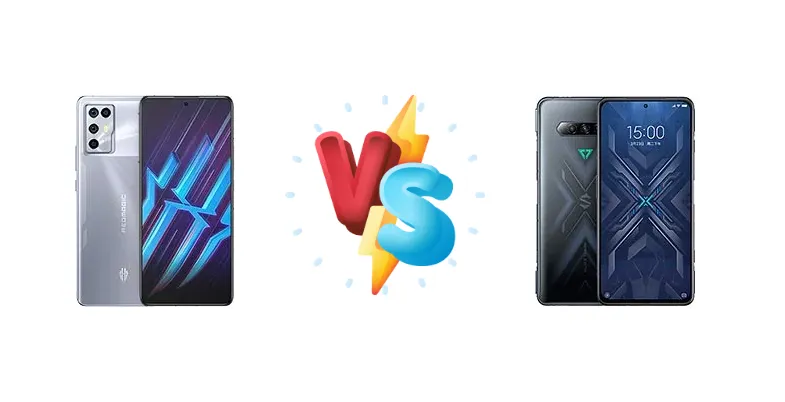
|
🏆 Quick Verdict
For the average gamer prioritizing convenience, the Xiaomi Black Shark 4 Pro is the better choice thanks to its revolutionary 120W charging, capable of a full charge in just 15 minutes. However, users who value longer gaming sessions and overall endurance will find the ZTE nubia RedMagic 6R’s 76-hour endurance rating more appealing.
| PHONES | ||
|---|---|---|
| Phone Names | ZTE nubia RedMagic 6R | Xiaomi Black Shark 4 Pro |
| Network | ||
|---|---|---|
| 2G bands | GSM 850 / 900 / 1800 / 1900 | GSM 850 / 900 / 1800 / 1900 |
| 3G bands | HSDPA 850 / 900 / 1700(AWS) / 1900 / 2100 | HSDPA 800 / 850 / 900 / 1700(AWS) / 1900 / 2100 |
| 4G bands | 1, 3, 5, 7, 8, 4, 12, 17, 20, 34, 38, 39, 40, 41 - China | 1, 2, 3, 4, 5, 7, 8, 18, 19, 20, 26, 28, 34, 38, 39, 40, 41 |
| 5G bands | 1, 28, 41, 78 SA/NSA - China | 1, 3, 8, 28, 41, 77, 78, 79 SA/NSA |
| Speed | HSPA, LTE, 5G | HSPA, LTE, 5G |
| Technology | GSM / CDMA / HSPA / CDMA2000 / LTE / 5G | GSM / CDMA / HSPA / EVDO / LTE / 5G |
| - | CDMA2000 1xEV-DO | |
| Launch | ||
|---|---|---|
| Announced | 2021, May 27 | 2021, March 23 |
| Status | Available. Released 2021, June 02 | Available. Released 2021, March 30 |
| Body | ||
|---|---|---|
| Build | Glass front (Gorilla Glass 3), aluminum frame, glass back | - |
| Dimensions | 163 x 75.3 x 7.8 mm (6.42 x 2.96 x 0.31 in) | 163.8 x 76.4 x 9.9 mm (6.45 x 3.01 x 0.39 in) |
| SIM | Nano-SIM + Nano-SIM | Nano-SIM + Nano-SIM |
| Weight | 186 g (6.56 oz) | 220 g (7.76 oz) |
| - | Physical pop-up gaming triggers | |
| Display | ||
|---|---|---|
| Protection | Corning Gorilla Glass 3 | - |
| Resolution | 1080 x 2400 pixels, 20:9 ratio (~395 ppi density) | 1080 x 2400 pixels, 20:9 ratio (~395 ppi density) |
| Size | 6.67 inches, 107.4 cm2 (~87.5% screen-to-body ratio) | 6.67 inches, 107.4 cm2 (~85.8% screen-to-body ratio) |
| Type | AMOLED, 1B colors, 144Hz, 770 nits (peak) | Super AMOLED, 144Hz, HDR10+, 1300 nits (peak) |
| - | Always-on display | |
| Platform | ||
|---|---|---|
| CPU | Octa-core (1x2.84 GHz Cortex-X1 & 3x2.42 GHz Cortex-A78 & 4x1.80 GHz Cortex-A55) | Octa-core (1x2.84 GHz Cortex-X1 & 3x2.42 GHz Cortex-A78 & 4x1.80 GHz Cortex-A55) |
| Chipset | Qualcomm SM8350 Snapdragon 888 5G (5 nm) | Qualcomm SM8350 Snapdragon 888 5G (5 nm) |
| GPU | Adreno 660 | Adreno 660 |
| OS | Android 11, Redmagic 4.0 | Android 11, Joy UI 12.5 |
| Memory | ||
|---|---|---|
| Card slot | No | No |
| Internal | 128GB 6GB RAM, 128GB 8GB RAM, 128GB 12GB RAM, 256GB 12GB RAM | 128GB 8GB RAM, 256GB 8GB RAM, 256GB 12GB RAM, 512GB 16GB RAM |
| - | UFS 3.1 | |
| Main Camera | ||
|---|---|---|
| Features | Dual-LED flash, HDR, panorama | LED flash, HDR, panorama |
| Quad | 64 MP, f/1.8, 26mm (wide), 1/1.73", 0.8µm, PDAF 8 MP, f/2.0, 120˚, 13mm (ultrawide), 1/4.0", 1.12µm 5 MP (macro) Auxiliary lens | - |
| Single | - | 20 MP, f/2.5, (wide), 0.8µm |
| Triple | - | 64 MP, f/1.8, (wide), 1/1.97", 0.7µm, PDAF 8 MP, f/2.2, 120˚ (ultrawide), 1/4.0", 1.12µm 5 MP (macro), AF |
| Video | 8K@30fps, 4K@30/60fps, 1080p@30/60/120/240fps | 4K@30/60fps, 1080p@30/60/240fps, 1080p@960fps; HDR10+ |
| Selfie camera | ||
|---|---|---|
| Features | HDR | HDR |
| Single | 16 MP, (wide) | 20 MP, f/2.5, (wide), 0.8µm |
| Video | 1080p@30fps | 1080p@30fps |
| Sound | ||
|---|---|---|
| 3.5mm jack | - | Yes |
| 35mm jack | No | Yes |
| Loudspeaker | Yes | Yes, with stereo speakers |
| - | 24-bit/192kHz audio | |
| Comms | ||
|---|---|---|
| Bluetooth | 5.2, A2DP, aptX, LE | 5.2 (China), 5.0 (Global), A2DP, LE, aptX HD, aptX Adaptive |
| NFC | Yes (market/region dependent) | Yes |
| Positioning | GPS (L1+L5), GLONASS, BDS | GPS, GLONASS, GALILEO, QZSS, BDS |
| Radio | No | No |
| USB | USB Type-C 3.0, OTG, accessory connector | USB Type-C 2.0 |
| WLAN | Wi-Fi 802.11 a/b/g/n/ac/6, dual-band, Wi-Fi Direct | Wi-Fi 802.11 a/b/g/n/ac/6, dual-band, Wi-Fi Direct |
| Features | ||
|---|---|---|
| Sensors | Fingerprint (under display, optical), accelerometer, gyro, proximity, compass | Fingerprint (side-mounted), accelerometer, gyro, proximity, compass, barometer (China only) |
| Battery | ||
|---|---|---|
| Charging | 55W wired, PD3.0, QC4 (China) 30W wired, PD3.0, QC4 (International) | 120W wired, 50% in 5 min, 100% in 15 min |
| Type | Li-Po 4200 mAh | Li-Po 4500 mAh |
| Misc | ||
|---|---|---|
| Colors | Black, Mercury Silver, Light Blue | Shadow Black, Misty Grey, Cosmos Black, Dark Blue, Silver |
| Models | NX666J | SHARK PAR-H0 |
| Price | About 500 EUR | About 500 EUR |
ZTE nubia RedMagic 6R
- Exceptional 76-hour battery endurance
- Potentially better sustained performance due to RedMagic’s cooling focus
- 55W/30W fast charging (depending on region)
- Display specs lack detail (LTPO, color accuracy)
- Camera details are minimal, suggesting a lower priority
Xiaomi Black Shark 4 Pro
- Revolutionary 120W charging (0-100% in 15 minutes)
- Likely high refresh rate display (based on Black Shark history)
- Snapdragon 888 provides flagship-level performance
- Battery endurance likely lower than RedMagic 6R
- Cooling system details are unknown, potential for throttling
Display Comparison
Both devices utilize the Qualcomm Snapdragon 888 5G chipset, meaning display differences become crucial. The RedMagic 6R boasts a measured peak brightness of 588 nits, a respectable figure, but lacks information regarding panel technology like LTPO. The Black Shark 4 Pro’s display specifications are not provided, making a direct brightness comparison difficult. However, Black Shark historically focuses on high refresh rates, potentially sacrificing peak brightness for smoother visuals. The absence of detailed display specs on the RedMagic 6R leaves questions about color accuracy and HDR support unanswered.
Camera Comparison
Camera details are sparse for both devices, with both listed as having 'Photo / Video' capabilities. This lack of specifics makes a meaningful comparison impossible. Without knowing sensor sizes, lens apertures, or image processing algorithms, it’s difficult to assess image quality. The absence of information suggests neither phone prioritizes camera performance as a key selling point, focusing instead on gaming features. We can assume both will offer adequate cameras for casual use, but enthusiasts should look elsewhere.
Performance
Both the ZTE nubia RedMagic 6R and Xiaomi Black Shark 4 Pro are powered by the Qualcomm SM8350 Snapdragon 888 5G (5 nm) chipset, featuring an Octa-core CPU configuration (1x2.84 GHz Cortex-X1, 3x2.42 GHz Cortex-A78, and 4x1.80 GHz Cortex-A55). This means raw processing power is virtually identical. The key differentiator will be thermal management. The RedMagic series is known for its advanced cooling solutions, potentially allowing for more sustained peak performance. The Black Shark 4 Pro’s cooling system is not detailed, but its focus on rapid charging suggests less emphasis on prolonged thermal dissipation. RAM specifications are missing for both, but LPDDR5 is expected, impacting multitasking and game loading times.
Battery Life
The ZTE nubia RedMagic 6R shines with an impressive 76-hour endurance rating, indicating excellent battery life for a gaming phone. This is contrasted sharply by the Xiaomi Black Shark 4 Pro’s focus on charging speed: 120W wired, achieving 50% charge in 5 minutes and 100% in 15 minutes. While the Black Shark 4 Pro’s battery capacity is unknown, the rapid charging significantly mitigates concerns about battery life. The RedMagic 6R offers 55W (China) or 30W (International) wired charging, a substantial difference compared to the Black Shark, but still respectable. The choice here depends on user preference: long-lasting power versus ultra-fast replenishment.
Buying Guide
Buy the ZTE nubia RedMagic 6R if you need a phone that can last through extended gaming marathons and daily use without constantly needing a charger. It’s ideal for users who prioritize battery life and sustained performance over the absolute fastest charging speeds. Buy the Xiaomi Black Shark 4 Pro if you prefer the convenience of incredibly fast charging, allowing you to quickly top up your battery between gaming sessions and minimize downtime. It’s perfect for users who value speed and don’t mind potentially shorter overall battery life.