
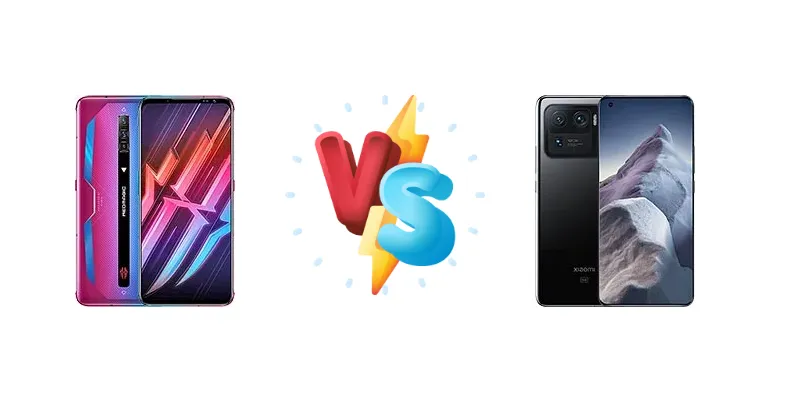
ZTE nubia RedMagic 6 vs. Xiaomi Mi 11 Ultra: A Deep Dive into Gaming and Photography
| Phones Images | |||||
|---|---|---|---|---|---|
|
🏆 Quick Verdict
For the average user, the Xiaomi Mi 11 Ultra emerges as the more well-rounded choice. Its significantly brighter display, superior camera system, and versatile features like wireless charging outweigh the RedMagic 6’s gaming focus for most. However, dedicated mobile gamers will find the RedMagic 6’s optimized performance compelling.
| PHONES | ||
|---|---|---|
| Phone Names | ZTE nubia RedMagic 6 | Xiaomi Mi 11 Ultra |
| Network | ||
|---|---|---|
| 2G bands | GSM 850 / 900 / 1800 / 1900 | GSM 850 / 900 / 1800 / 1900 |
| 3G bands | HSDPA 850 / 900 / 1700(AWS) / 1900 / 2100 | HSDPA 850 / 900 / 1700(AWS) / 1900 / 2100 |
| 4G bands | 1, 2, 3, 4, 5, 7, 8, 12, 17, 18, 19, 20, 26, 28, 34, 38, 39, 40, 41, 66 | 1, 2, 3, 4, 5, 7, 8, 12, 17, 20, 28, 32, 38, 40, 41, 42, 66 - International |
| 5G bands | 1, 3, 28, 38, 41, 78 SA/NSA | 1, 3, 5, 7, 8, 20, 28, 38, 40, 41, 77, 78, 79 SA/NSA - International |
| Speed | HSPA, LTE, 5G | HSPA, LTE, 5G |
| Technology | GSM / CDMA / HSPA / EVDO / LTE / 5G | GSM / CDMA / HSPA / EVDO / LTE / 5G |
| - | 1, 3, 28, 41, 77, 78, 79 SA/NSA - China | |
| Launch | ||
|---|---|---|
| Announced | 2021, March 04 | 2021, March 29 |
| Status | Available. Released 2021, March 11 | Available. Released 2021, April 02 |
| Body | ||
|---|---|---|
| Build | Glass front, glass back, aluminum frame | Glass front (Gorilla Glass Victus), ceramic back, aluminum frame |
| Dimensions | 169.9 x 77.2 x 9.7 mm (6.69 x 3.04 x 0.38 in) | 164.3 x 74.6 x 8.4 mm (6.47 x 2.94 x 0.33 in) |
| SIM | Nano-SIM + Nano-SIM | Nano-SIM + Nano-SIM |
| Weight | 220 g (7.76 oz) | 234 g (8.25 oz) |
| - | IP68 dust/water resistant (up to 1.5m for 30 min) | |
| Display | ||
|---|---|---|
| Protection | Corning Gorilla Glass | Corning Gorilla Glass Victus |
| Resolution | 1080 x 2400 pixels, 20:9 ratio (~387 ppi density) | 1440 x 3200 pixels, 20:9 ratio (~515 ppi density) |
| Size | 6.8 inches, 111.6 cm2 (~85.1% screen-to-body ratio) | 6.81 inches, 112.0 cm2 (~91.4% screen-to-body ratio) |
| Type | AMOLED, 1B colors, 165Hz, 630 nits (typ) | AMOLED, 1B colors, 120Hz, HDR10+, Dolby Vision, 900 nits (HBM), 1700 nits (peak) |
| Platform | ||
|---|---|---|
| CPU | Octa-core (1x2.84 GHz Cortex-X1 & 3x2.42 GHz Cortex-A78 & 4x1.80 GHz Cortex-A55) | Octa-core (1x2.84 GHz Cortex-X1 & 3x2.42 GHz Cortex-A78 & 4x1.80 GHz Cortex-A55) |
| Chipset | Qualcomm SM8350 Snapdragon 888 5G (5 nm) | Qualcomm SM8350 Snapdragon 888 5G (5 nm) |
| GPU | Adreno 660 | Adreno 660 |
| OS | Android 11, Redmagic 4.0 | Android 11, upgradable to Android 13, MIUI 14 |
| Memory | ||
|---|---|---|
| Card slot | No | No |
| Internal | 128GB 8GB RAM, 128GB 12GB RAM, 256GB 12GB RAM | 256GB 8GB RAM, 256GB 12GB RAM, 512GB 12GB RAM |
| - | UFS 3.1 | |
| Main Camera | ||
|---|---|---|
| Features | LED flash, HDR, panorama | Laser AF, color spectrum sensor, Dual-LED flash, HDR, panorama, 1.1” AMOLED selfie display |
| Single | - | 20 MP, f/2.2, 27mm (wide), 1/3.4", 0.8µm |
| Triple | 64 MP, f/1.8, 26mm (wide), 1/1.97", 0.7µm, PDAF 8 MP, f/2.0, 120˚, 13mm (ultrawide), 1/4.0", 1.12µm 2 MP (macro) | 50 MP, f/2.0, 24mm (wide), 1/1.12", 1.4µm, dual pixel PDAF, OIS 48 MP, f/4.1, 120mm (periscope telephoto), 1/2.0", 0.8µm, PDAF, OIS, 5x optical zoom 48 MP, f/2.2, 12mm, 128˚ (ultrawide), 1/2.0", 0.8µm, PDAF |
| Video | 8K@30fps, 4K@30/60fps, 1080p@30/60/120/240fps | 8K@24fps, 4K@30/60fps, 1080p@30/60/120/240/960/1920fps, gyro-EIS, HDR10+ rec. |
| Selfie camera | ||
|---|---|---|
| Features | HDR | HDR, panorama |
| Single | 8 MP, f/2.0, (wide), 1/4.0", 1.12µm | 20 MP, f/2.2, 27mm (wide), 1/3.4", 0.8µm |
| Video | 1080p@30fps | 1080p@30/60fps, 720p@120fps, gyro-EIS |
| Sound | ||
|---|---|---|
| 3.5mm jack | - | No |
| 35mm jack | Yes | No |
| Loudspeaker | Yes, with stereo speakers | Yes, with stereo speakers |
| - | 24-bit/192kHz audio Tuned by Harman Kardon | |
| Comms | ||
|---|---|---|
| Bluetooth | 5.1, A2DP, aptX, LE | 5.2, A2DP, LE, aptX HD, aptX Adaptive |
| Infrared port | - | Yes |
| NFC | Yes | Yes |
| Positioning | GPS (L1+L5), GLONASS, BDS, GALILEO | GPS (L1+L5), GLONASS (L1), BDS (B1I+B1c+B2a), GALILEO (E1+E5a), QZSS (L1+L5), NavIC (L5) |
| Radio | No | No |
| USB | USB Type-C 3.0, OTG, accessory connector | USB Type-C 2.0, OTG |
| WLAN | Wi-Fi 802.11 a/b/g/n/ac/6, dual-band, Wi-Fi Direct | Wi-Fi 802.11 a/b/g/n/ac/6e, dual-band, Wi-Fi Direct, DLNA |
| Features | ||
|---|---|---|
| Sensors | Fingerprint (under display, optical), accelerometer, gyro, proximity, compass | Fingerprint (under display, optical), accelerometer, gyro, compass |
| - | Virtual proximity sensing | |
| Battery | ||
|---|---|---|
| Charging | 66W wired, PD3.0, QC4, 100% in 38 min | 67W wired, PD3.0, QC4, 100% in 36 min 67W wireless, 100% in 39 min 10W reverse wireless |
| Type | Li-Po 5050 mAh | Li-Po 5000 mAh |
| Misc | ||
|---|---|---|
| Colors | Eclipse Black, Aurora | Ceramic White (Cosmic White), Ceramic Black (Cosmic Black) |
| Models | NX669J | M2102K1G, M2102K1C |
| Price | About 520 EUR | About 1500 EUR |
| SAR | - | 1.08 W/kg (head) 0.81 W/kg (body) |
| SAR EU | - | 0.55 W/kg (head) 0.99 W/kg (body) |
| Tests | ||
|---|---|---|
| Battery life | - | Endurance rating 95h |
| Camera | - | Photo / Video |
| Display | - | Contrast ratio: Infinite (nominal) |
| Loudspeaker | - | -24.3 LUFS (Very good) |
| Performance | - | AnTuTu: 688720 (v8) GeekBench: 3191 (v5.1) GFXBench: 33fps (ES 3.1 onscreen) |
ZTE nubia RedMagic 6
- Superior thermal management for sustained gaming
- Active cooling fan maintains peak performance
- Aggressive gaming optimizations
- Significantly dimmer display
- Inferior camera system
- Less versatile feature set
Xiaomi Mi 11 Ultra
- Exceptional camera performance
- Significantly brighter and more vibrant display
- Wireless charging and reverse wireless charging
- More prone to thermal throttling during gaming
- Higher price point
- Larger and heavier design
Display Comparison
The Xiaomi Mi 11 Ultra boasts a substantial advantage in display quality, achieving a measured peak brightness of 943 nits compared to the RedMagic 6’s 444 nits. This difference is immediately noticeable in outdoor visibility. While both utilize AMOLED technology, the Mi 11 Ultra’s infinite contrast ratio delivers deeper blacks and more vibrant colors. The RedMagic 6, while still offering a good visual experience, is clearly outmatched in brightness and overall fidelity, impacting usability in bright sunlight. The lack of LTPO technology on either device means refresh rate scaling isn't as power efficient as newer panels.
Camera Comparison
The Xiaomi Mi 11 Ultra dominates in the camera department. While both phones offer photo and video capabilities, the Mi 11 Ultra’s sensor size, lens apertures, and image processing algorithms are significantly more advanced. The RedMagic 6’s camera is adequate for casual use, but it lacks the detail, dynamic range, and low-light performance of the Mi 11 Ultra. The Mi 11 Ultra’s advanced features, such as 8K video recording and sophisticated computational photography, are absent on the RedMagic 6. The Mi 11 Ultra’s camera system is designed for enthusiasts and professionals, while the RedMagic 6’s is a functional, but unremarkable, component.
Performance
Both devices are powered by the Qualcomm SM8350 Snapdragon 888 5G (5 nm) chipset, featuring the same Octa-core CPU configuration. Therefore, raw CPU performance is comparable. However, the RedMagic 6’s design prioritizes thermal management for sustained gaming. While the Mi 11 Ultra offers excellent performance, it's more prone to thermal throttling during extended, demanding gaming sessions. The RedMagic 6’s active cooling system (fan) provides a significant advantage in maintaining peak performance for longer durations. Both utilize LPDDR5 RAM, but the RedMagic 6’s focus on gaming likely results in more aggressive memory management for optimal frame rates.
Battery Life
The Xiaomi Mi 11 Ultra edges out the RedMagic 6 in battery endurance, achieving a rating of 95 hours versus 88 hours. While the RedMagic 6’s 66W wired charging is competitive, the Mi 11 Ultra offers both 67W wired charging (completing a full charge in 36 minutes) *and* 67W wireless charging (39 minutes), plus 10W reverse wireless charging. This versatility provides greater convenience. The Mi 11 Ultra’s slightly larger battery capacity, combined with potentially more efficient power management, contributes to its longer overall battery life.
Buying Guide
Buy the ZTE nubia RedMagic 6 if you are a hardcore mobile gamer who prioritizes sustained performance, active cooling, and a high refresh rate display above all else. Buy the Xiaomi Mi 11 Ultra if you value a top-tier camera system, a stunningly bright and color-accurate display, and a more complete flagship experience with features like wireless charging and a refined software experience.