
ZTE nubia RedMagic 6 vs Xiaomi Black Shark 4 Pro: The Ultimate Gaming Phone Battle
| Phones Images | |||||
|---|---|---|---|---|---|
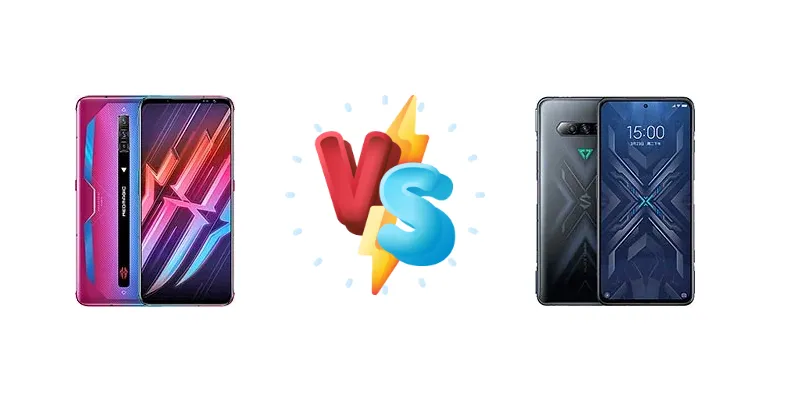
|
🏆 Quick Verdict
For the gamer prioritizing absolute charging speed and a more balanced feature set, the Xiaomi Black Shark 4 Pro is the clear winner. Its 120W charging dramatically reduces downtime, while the RedMagic 6 excels in endurance but falls behind in rapid replenishment.
| PHONES | ||
|---|---|---|
| Phone Names | ZTE nubia RedMagic 6 | Xiaomi Black Shark 4 Pro |
| Network | ||
|---|---|---|
| 2G bands | GSM 850 / 900 / 1800 / 1900 | GSM 850 / 900 / 1800 / 1900 |
| 3G bands | HSDPA 850 / 900 / 1700(AWS) / 1900 / 2100 | HSDPA 800 / 850 / 900 / 1700(AWS) / 1900 / 2100 |
| 4G bands | 1, 2, 3, 4, 5, 7, 8, 12, 17, 18, 19, 20, 26, 28, 34, 38, 39, 40, 41, 66 | 1, 2, 3, 4, 5, 7, 8, 18, 19, 20, 26, 28, 34, 38, 39, 40, 41 |
| 5G bands | 1, 3, 28, 38, 41, 78 SA/NSA | 1, 3, 8, 28, 41, 77, 78, 79 SA/NSA |
| Speed | HSPA, LTE, 5G | HSPA, LTE, 5G |
| Technology | GSM / CDMA / HSPA / EVDO / LTE / 5G | GSM / CDMA / HSPA / EVDO / LTE / 5G |
| - | CDMA2000 1xEV-DO | |
| Launch | ||
|---|---|---|
| Announced | 2021, March 04 | 2021, March 23 |
| Status | Available. Released 2021, March 11 | Available. Released 2021, March 30 |
| Body | ||
|---|---|---|
| Build | Glass front, glass back, aluminum frame | - |
| Dimensions | 169.9 x 77.2 x 9.7 mm (6.69 x 3.04 x 0.38 in) | 163.8 x 76.4 x 9.9 mm (6.45 x 3.01 x 0.39 in) |
| SIM | Nano-SIM + Nano-SIM | Nano-SIM + Nano-SIM |
| Weight | 220 g (7.76 oz) | 220 g (7.76 oz) |
| - | Physical pop-up gaming triggers | |
| Display | ||
|---|---|---|
| Protection | Corning Gorilla Glass | - |
| Resolution | 1080 x 2400 pixels, 20:9 ratio (~387 ppi density) | 1080 x 2400 pixels, 20:9 ratio (~395 ppi density) |
| Size | 6.8 inches, 111.6 cm2 (~85.1% screen-to-body ratio) | 6.67 inches, 107.4 cm2 (~85.8% screen-to-body ratio) |
| Type | AMOLED, 1B colors, 165Hz, 630 nits (typ) | Super AMOLED, 144Hz, HDR10+, 1300 nits (peak) |
| - | Always-on display | |
| Platform | ||
|---|---|---|
| CPU | Octa-core (1x2.84 GHz Cortex-X1 & 3x2.42 GHz Cortex-A78 & 4x1.80 GHz Cortex-A55) | Octa-core (1x2.84 GHz Cortex-X1 & 3x2.42 GHz Cortex-A78 & 4x1.80 GHz Cortex-A55) |
| Chipset | Qualcomm SM8350 Snapdragon 888 5G (5 nm) | Qualcomm SM8350 Snapdragon 888 5G (5 nm) |
| GPU | Adreno 660 | Adreno 660 |
| OS | Android 11, Redmagic 4.0 | Android 11, Joy UI 12.5 |
| Memory | ||
|---|---|---|
| Card slot | No | No |
| Internal | 128GB 8GB RAM, 128GB 12GB RAM, 256GB 12GB RAM | 128GB 8GB RAM, 256GB 8GB RAM, 256GB 12GB RAM, 512GB 16GB RAM |
| - | UFS 3.1 | |
| Main Camera | ||
|---|---|---|
| Features | LED flash, HDR, panorama | LED flash, HDR, panorama |
| Single | - | 20 MP, f/2.5, (wide), 0.8µm |
| Triple | 64 MP, f/1.8, 26mm (wide), 1/1.97", 0.7µm, PDAF 8 MP, f/2.0, 120˚, 13mm (ultrawide), 1/4.0", 1.12µm 2 MP (macro) | 64 MP, f/1.8, (wide), 1/1.97", 0.7µm, PDAF 8 MP, f/2.2, 120˚ (ultrawide), 1/4.0", 1.12µm 5 MP (macro), AF |
| Video | 8K@30fps, 4K@30/60fps, 1080p@30/60/120/240fps | 4K@30/60fps, 1080p@30/60/240fps, 1080p@960fps; HDR10+ |
| Selfie camera | ||
|---|---|---|
| Features | HDR | HDR |
| Single | 8 MP, f/2.0, (wide), 1/4.0", 1.12µm | 20 MP, f/2.5, (wide), 0.8µm |
| Video | 1080p@30fps | 1080p@30fps |
| Sound | ||
|---|---|---|
| 3.5mm jack | - | Yes |
| 35mm jack | Yes | Yes |
| Loudspeaker | Yes, with stereo speakers | Yes, with stereo speakers |
| - | 24-bit/192kHz audio | |
| Comms | ||
|---|---|---|
| Bluetooth | 5.1, A2DP, aptX, LE | 5.2 (China), 5.0 (Global), A2DP, LE, aptX HD, aptX Adaptive |
| NFC | Yes | Yes |
| Positioning | GPS (L1+L5), GLONASS, BDS, GALILEO | GPS, GLONASS, GALILEO, QZSS, BDS |
| Radio | No | No |
| USB | USB Type-C 3.0, OTG, accessory connector | USB Type-C 2.0 |
| WLAN | Wi-Fi 802.11 a/b/g/n/ac/6, dual-band, Wi-Fi Direct | Wi-Fi 802.11 a/b/g/n/ac/6, dual-band, Wi-Fi Direct |
| Features | ||
|---|---|---|
| Sensors | Fingerprint (under display, optical), accelerometer, gyro, proximity, compass | Fingerprint (side-mounted), accelerometer, gyro, proximity, compass, barometer (China only) |
| Battery | ||
|---|---|---|
| Charging | 66W wired, PD3.0, QC4, 100% in 38 min | 120W wired, 50% in 5 min, 100% in 15 min |
| Type | Li-Po 5050 mAh | Li-Po 4500 mAh |
| Misc | ||
|---|---|---|
| Colors | Eclipse Black, Aurora | Shadow Black, Misty Grey, Cosmos Black, Dark Blue, Silver |
| Models | NX669J | SHARK PAR-H0 |
| Price | About 520 EUR | About 500 EUR |
ZTE nubia RedMagic 6
- Exceptional battery endurance (88h rating)
- Aggressive cooling system (implied)
- 66W fast charging with multiple protocols
- Slower charging speed compared to Black Shark 4 Pro
- Limited camera details suggest a secondary focus
Xiaomi Black Shark 4 Pro
- Revolutionary 120W HyperCharge (15 min to full)
- Likely more versatile feature set (Xiaomi's approach)
- Potentially brighter and more vibrant display
- Battery endurance likely lower than RedMagic 6
- Cooling system effectiveness unknown
Display Comparison
Both phones utilize the Snapdragon 888, meaning display performance is less about the chipset and more about panel quality. The RedMagic 6 boasts a measured peak brightness of 444 nits. While adequate, this is a potential drawback in brightly lit environments. Details regarding the Black Shark 4 Pro's display brightness are absent, but Xiaomi typically prioritizes vibrant, high-contrast panels. The absence of LTPO technology in either device suggests both will rely on variable refresh rates to balance smoothness and power consumption. Bezels and color accuracy are not specified, but both brands generally aim for immersive viewing experiences.
Camera Comparison
Camera capabilities are broadly described as 'Photo / Video' for the RedMagic 6, indicating a standard feature set without specific emphasis on photographic excellence. The Black Shark 4 Pro's camera specs are also missing, but Xiaomi generally equips its phones with capable sensors. Without details on sensor size, aperture, or optical image stabilization (OIS), it's difficult to draw meaningful comparisons. The inclusion of a 2MP macro camera on either device is likely a marketing tactic, offering limited real-world benefit due to the small sensor size and low resolution.
Performance
Both the RedMagic 6 and Black Shark 4 Pro are powered by the Qualcomm SM8350 Snapdragon 888 5G (5 nm) chipset, featuring an Octa-core CPU configuration (1x2.84 GHz Cortex-X1, 3x2.42 GHz Cortex-A78, and 4x1.80 GHz Cortex-A55). This means raw processing power is virtually identical. However, thermal management is where differences emerge. The RedMagic series is known for its aggressive cooling solutions, which are not detailed here, but likely include vapor chamber cooling and active fans. The Black Shark 4 Pro also incorporates cooling technology, but its effectiveness relative to the RedMagic 6 is unknown. Sustained performance will depend on how effectively each phone dissipates heat under load.
Battery Life
The RedMagic 6 boasts an endurance rating of 88 hours, suggesting excellent battery life. However, its 66W wired charging, while supporting PD3.0 and QC4, takes 38 minutes to reach 100%. The Black Shark 4 Pro, in contrast, features a groundbreaking 120W wired charging system, achieving 50% charge in just 5 minutes and a full charge in 15 minutes. This difference in charging speed is substantial. While the RedMagic 6 offers longer runtimes, the Black Shark 4 Pro minimizes downtime, allowing for quicker returns to gaming. The actual battery capacity (mAh) of both devices is not specified, but the charging speed advantage of the Black Shark 4 Pro is significant.
Buying Guide
Buy the ZTE nubia RedMagic 6 if you need maximum battery endurance and a more focused, raw gaming experience. Its 88-hour endurance rating suggests it will last through extended gaming sessions without needing a top-up. Buy the Xiaomi Black Shark 4 Pro if you prefer lightning-fast charging and a more versatile phone that balances gaming prowess with everyday usability. The 120W charging is a game-changer for those who can't afford to be tethered to a charger for long.