
ZTE nubia RedMagic 6 vs. Apple iPhone 12 Pro Max: A Deep Dive into Gaming and Ecosystem
| Phones Images | |||||
|---|---|---|---|---|---|
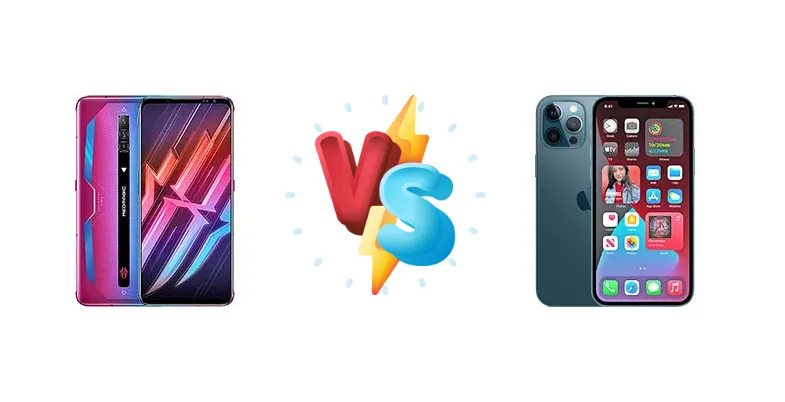
|
🏆 Quick Verdict
For the average user prioritizing a polished experience, excellent camera, and long-term software updates, the Apple iPhone 12 Pro Max is the superior choice. However, the ZTE nubia RedMagic 6 delivers unmatched gaming performance for a lower price, making it ideal for dedicated mobile gamers.
| PHONES | ||
|---|---|---|
| Phone Names | ZTE nubia RedMagic 6 | Apple iPhone 12 Pro Max |
| Network | ||
|---|---|---|
| 2G bands | GSM 850 / 900 / 1800 / 1900 | GSM 850 / 900 / 1800 / 1900 |
| 3G bands | HSDPA 850 / 900 / 1700(AWS) / 1900 / 2100 | HSDPA 850 / 900 / 1700(AWS) / 1900 / 2100 |
| 4G bands | 1, 2, 3, 4, 5, 7, 8, 12, 17, 18, 19, 20, 26, 28, 34, 38, 39, 40, 41, 66 | 1, 2, 3, 4, 5, 7, 8, 12, 13, 14, 17, 18, 19, 20, 25, 26, 28, 29, 30, 32, 34, 38, 39, 40, 41, 42, 46, 48, 66, 71 - A2342 |
| 5G bands | 1, 3, 28, 38, 41, 78 SA/NSA | 1, 2, 3, 5, 7, 8, 12, 20, 25, 28, 38, 40, 41, 66, 71, 77, 78, 79, 260, 261 Sub6/mmWave - A2342 |
| Speed | HSPA, LTE, 5G | HSPA, LTE, 5G, EV-DO Rev.A 3.1 Mbps |
| Technology | GSM / CDMA / HSPA / EVDO / LTE / 5G | GSM / CDMA / HSPA / EVDO / LTE / 5G |
| - | 1, 2, 3, 5, 7, 8, 12, 20, 25, 28, 38, 40, 41, 66, 77, 78, 79 Sub6 - A2410, A2411, A2412 | |
| Launch | ||
|---|---|---|
| Announced | 2021, March 04 | 2020, October 13 |
| Status | Available. Released 2021, March 11 | Available. Released 2020, November 13 |
| Body | ||
|---|---|---|
| Build | Glass front, glass back, aluminum frame | Glass front, glass back, stainless steel frame |
| Dimensions | 169.9 x 77.2 x 9.7 mm (6.69 x 3.04 x 0.38 in) | 160.8 x 78.1 x 7.4 mm (6.33 x 3.07 x 0.29 in) |
| SIM | Nano-SIM + Nano-SIM | · Nano-SIM + eSIM· Nano-SIM + Nano-SIM (China) |
| Weight | 220 g (7.76 oz) | 228 g (8.04 oz) |
| - | IP68 dust/water resistant (up to 6m for 30 min) Apple Pay (Visa, MasterCard, AMEX certified) | |
| Display | ||
|---|---|---|
| Protection | Corning Gorilla Glass | Ceramic Shield glass |
| Resolution | 1080 x 2400 pixels, 20:9 ratio (~387 ppi density) | 1284 x 2778 pixels, 19.5:9 ratio (~458 ppi density) |
| Size | 6.8 inches, 111.6 cm2 (~85.1% screen-to-body ratio) | 6.7 inches, 109.8 cm2 (~87.4% screen-to-body ratio) |
| Type | AMOLED, 1B colors, 165Hz, 630 nits (typ) | Super Retina XDR OLED, HDR10, Dolby Vision, 800 nits (HBM), 1200 nits (peak) |
| Platform | ||
|---|---|---|
| CPU | Octa-core (1x2.84 GHz Cortex-X1 & 3x2.42 GHz Cortex-A78 & 4x1.80 GHz Cortex-A55) | Hexa-core (2x3.1 GHz Firestorm + 4x1.8 GHz Icestorm) |
| Chipset | Qualcomm SM8350 Snapdragon 888 5G (5 nm) | Apple A14 Bionic (5 nm) |
| GPU | Adreno 660 | Apple GPU (4-core graphics) |
| OS | Android 11, Redmagic 4.0 | iOS 14.1, upgradable to iOS 26.1 |
| Memory | ||
|---|---|---|
| Card slot | No | No |
| Internal | 128GB 8GB RAM, 128GB 12GB RAM, 256GB 12GB RAM | 128GB 6GB RAM, 256GB 6GB RAM, 512GB 6GB RAM |
| - | NVMe | |
| Main Camera | ||
|---|---|---|
| Features | LED flash, HDR, panorama | Dual-LED dual-tone flash, HDR (photo/panorama) |
| Triple | 64 MP, f/1.8, 26mm (wide), 1/1.97", 0.7µm, PDAF 8 MP, f/2.0, 120˚, 13mm (ultrawide), 1/4.0", 1.12µm 2 MP (macro) | 12 MP, f/1.6, 26mm (wide), 1/1.9", 1.7µm, dual pixel PDAF, sensor-shift OIS 12 MP, f/2.2, 65mm (telephoto), 1/3.4", 1.0µm, PDAF, OIS, 2.5x optical zoom 12 MP, f/2.4, 13mm, 120˚ (ultrawide), 1/3.4", 1.0µm TOF 3D LiDAR scanner (depth) |
| Video | 8K@30fps, 4K@30/60fps, 1080p@30/60/120/240fps | 4K@24/25/30/60fps, 1080p@25/30/60/120/240fps, 10‑bit HDR, Dolby Vision HDR (up to 60fps), stereo sound rec. |
| Selfie camera | ||
|---|---|---|
| Features | HDR | HDR |
| Single | 8 MP, f/2.0, (wide), 1/4.0", 1.12µm | 12 MP, f/2.2, 23mm (wide), 1/3.6", 1.0µm SL 3D, (depth/biometrics sensor) |
| Video | 1080p@30fps | 4K@24/25/30/60fps, 1080p@25/30/60/120fps, gyro-EIS |
| Sound | ||
|---|---|---|
| 3.5mm jack | - | No |
| 35mm jack | Yes | No |
| Loudspeaker | Yes, with stereo speakers | Yes, with stereo speakers |
| Comms | ||
|---|---|---|
| Bluetooth | 5.1, A2DP, aptX, LE | 5.0, A2DP, LE |
| NFC | Yes | Yes |
| Positioning | GPS (L1+L5), GLONASS, BDS, GALILEO | GPS, GLONASS, GALILEO, QZSS |
| Radio | No | No |
| USB | USB Type-C 3.0, OTG, accessory connector | Lightning, USB 2.0 |
| WLAN | Wi-Fi 802.11 a/b/g/n/ac/6, dual-band, Wi-Fi Direct | Wi-Fi 802.11 a/b/g/n/ac/6, dual-band, hotspot |
| Features | ||
|---|---|---|
| Sensors | Fingerprint (under display, optical), accelerometer, gyro, proximity, compass | Face ID, accelerometer, gyro, proximity, compass, barometer |
| - | Ultra Wideband (UWB) support | |
| Battery | ||
|---|---|---|
| Charging | 66W wired, PD3.0, QC4, 100% in 38 min | Wired, PD2.0, 50% in 30 min 15W wireless (MagSafe) 15W wireless (Qi2) - requires iOS 17.4 update |
| Type | Li-Po 5050 mAh | Li-Ion 3687 mAh (14.13 Wh) |
| Misc | ||
|---|---|---|
| Colors | Eclipse Black, Aurora | Silver, Graphite, Gold, Pacific Blue |
| Models | NX669J | A2411, A2342, A2410, A2412, iPhone13,4 |
| Price | About 520 EUR | $ 328.00 / C$ 549.75 / £ 270.67 / € 339.00 |
| SAR EU | - | 0.99 W/kg (head) 0.99 W/kg (body) |
| Pricing | ||
|---|---|---|
| 128GB 6GB RAM | - | $ 599.99 |
| 256GB 6GB RAM | - | $ 728.45 |
| 512GB 6GB RAM | - | $ 886.67 |
| RENEWED | - | $ 627.00 |
| Tests | ||
|---|---|---|
| Battery life | - | Endurance rating 95h |
| Camera | - | Photo / Video |
| Display | - | Contrast ratio: Infinite (nominal) |
| Loudspeaker | - | -23.8 LUFS (Very good) |
| Performance | - | AnTuTu: 638584 (v8) GeekBench: 4240 (v5.1) GFXBench: 55fps (ES 3.1 onscreen) |
ZTE nubia RedMagic 6
- Significantly faster wired charging (66W)
- Optimized for gaming with Snapdragon 888 and cooling system
- Lower price point for comparable performance
- Lower display brightness
- Likely inferior camera performance
- Less refined software experience
Apple iPhone 12 Pro Max
- Superior camera system and image processing
- Brighter, higher-contrast display
- Seamless integration with Apple ecosystem
- Slower wired charging
- Higher price
- Less focused on gaming performance
Display Comparison
The iPhone 12 Pro Max boasts a significantly brighter display at 822 nits compared to the RedMagic 6’s 444 nits, making it far more usable outdoors. While both utilize 5nm chipsets, the iPhone’s display benefits from an infinite (nominal) contrast ratio, delivering deeper blacks and more vibrant colors. The RedMagic 6, however, prioritizes refresh rate for gaming, a specification not provided for the iPhone 12 Pro Max, suggesting a potential advantage in visual fluidity for compatible games. The lack of LTPO technology on either device means variable refresh rates are absent, impacting power efficiency.
Camera Comparison
Both phones offer photo and video capabilities, but their approaches differ significantly. The iPhone 12 Pro Max is renowned for its computational photography and consistent image quality across all lenses. While specific sensor details are missing for both, Apple’s image processing pipeline is a key differentiator. The RedMagic 6, geared towards gaming, likely prioritizes speed and efficiency over advanced camera features. Without detailed sensor information, it’s reasonable to assume the iPhone 12 Pro Max holds a significant advantage in image quality, especially in low-light conditions.
Performance
Both devices are powered by 5nm chipsets, but the architectural differences are substantial. The Apple A14 Bionic’s hexa-core configuration (2x3.1 GHz Firestorm + 4x1.8 GHz Icestorm) emphasizes peak performance per core, while the Snapdragon 888’s octa-core setup (1x2.84 GHz Cortex-X1 & 3x2.42 GHz Cortex-A78 & 4x1.80 GHz Cortex-A55) balances performance and efficiency. While raw clock speeds favor the iPhone, the Snapdragon 888’s Adreno 660 GPU is specifically optimized for gaming, potentially offering a more consistent frame rate in demanding titles. The RedMagic 6’s active cooling system, not present in the iPhone, further mitigates thermal throttling during extended gaming sessions.
Battery Life
Despite a similar endurance rating of 95 hours for the iPhone 12 Pro Max and 88 hours for the RedMagic 6, their charging capabilities diverge. The RedMagic 6’s 66W wired charging can fully charge the device in just 38 minutes, a substantial improvement over the iPhone’s slower wired charging (50% in 30 minutes, full charge time unspecified). The iPhone 12 Pro Max offers 15W wireless charging via MagSafe and Qi2 (with iOS 17.4), a convenience the RedMagic 6 lacks. The iPhone’s slightly higher endurance rating suggests better overall power efficiency, despite the RedMagic 6’s faster charging.
Buying Guide
Buy the ZTE nubia RedMagic 6 if you need uncompromising gaming performance, fast charging, and a high refresh rate display, and are willing to trade off camera quality and ecosystem integration. Buy the Apple iPhone 12 Pro Max if you prefer a premium build, a best-in-class camera system, seamless integration with other Apple devices, and guaranteed software support for years to come.