
ZTE nubia RedMagic 5S vs Xiaomi Black Shark 3 Pro: A Deep Dive for Gamers
| Phones Images | |||||
|---|---|---|---|---|---|
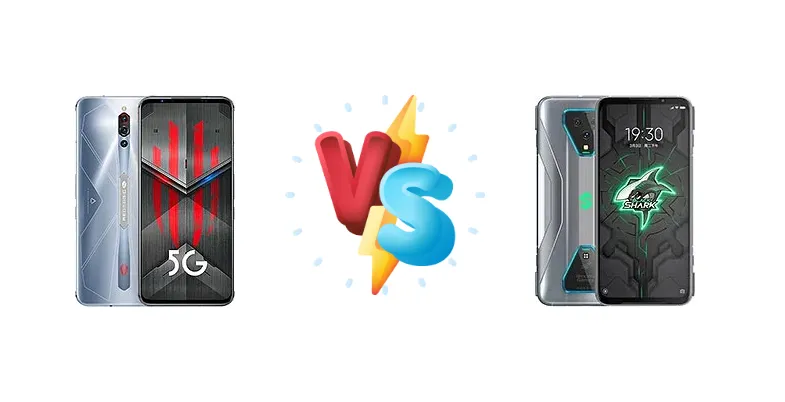
|
🏆 Quick Verdict
For most gamers, the Xiaomi Black Shark 3 Pro edges out the RedMagic 5S due to its faster 65W charging, which minimizes downtime. While the RedMagic 5S offers respectable endurance, the Black Shark’s quicker top-up is a significant advantage in a gaming context.
| PHONES | ||
|---|---|---|
| Phone Names | ZTE nubia RedMagic 5S | Xiaomi Black Shark 3 Pro |
| Network | ||
|---|---|---|
| 2G bands | GSM 850 / 900 / 1800 / 1900 | GSM 850 / 900 / 1800 / 1900 |
| 3G bands | HSDPA 850 / 900 / 1700(AWS) / 1900 / 2100 | HSDPA 800 / 850 / 900 / 1700(AWS) / 1900 / 2100 |
| 4G bands | 1, 2, 3, 4, 5, 7, 8, 12, 17, 18, 19, 20, 26, 34, 38, 39, 40, 41 | 1, 3, 4, 5, 7, 8, 12, 17, 20, 34, 38, 39, 40, 41 |
| 5G bands | 41, 78, 79 SA/NSA | 41, 78, 79 SA/NSA |
| Speed | HSPA, LTE, 5G 7.5 Gbps DL | HSPA, LTE, 5G |
| Technology | GSM / CDMA / HSPA / EVDO / LTE / 5G | GSM / CDMA / HSPA / EVDO / LTE / 5G |
| - | CDMA2000 1xEV-DO | |
| Launch | ||
|---|---|---|
| Announced | 2020, July 28. Released 2020, August 01 | 2020, March 03. Released 2020, March 17 |
| Status | Discontinued | Discontinued |
| Body | ||
|---|---|---|
| Build | Glass front (Gorilla Glass), glass back (Gorilla Glass), aluminum frame | Glass front, aluminum back, aluminum frame |
| Dimensions | 168.6 x 78 x 9.8 mm (6.64 x 3.07 x 0.39 in) | 177.8 x 83.3 x 10.1 mm (7.00 x 3.28 x 0.40 in) |
| SIM | Nano-SIM + Nano-SIM | Nano-SIM + Nano-SIM |
| Weight | 220 g (7.76 oz) | 253 g (8.92 oz) |
| - | Physical pop-up gaming triggers | |
| Display | ||
|---|---|---|
| Protection | Corning Gorilla Glass | - |
| Resolution | 1080 x 2340 pixels, 19.5:9 ratio (~388 ppi density) | 1440 x 3120 pixels, 19.5:9 ratio (~484 ppi density) |
| Size | 6.65 inches, 108.6 cm2 (~82.5% screen-to-body ratio) | 7.1 inches, 123.7 cm2 (~83.6% screen-to-body ratio) |
| Type | AMOLED, 144Hz | AMOLED, 90Hz, HDR10+, 500 nits (typ) |
| - | Always-on display | |
| Platform | ||
|---|---|---|
| CPU | Octa-core (1x2.84 GHz Cortex-A77 & 3x2.42 GHz Cortex-A77 & 4x1.80 GHz Cortex-A55) | Octa-core (1x2.84 GHz Cortex-A77 & 3x2.42 GHz Cortex-A77 & 4x1.80 GHz Cortex-A55) |
| Chipset | Qualcomm SM8250 Snapdragon 865 5G (7 nm+) | Qualcomm SM8250 Snapdragon 865 5G (7 nm+) |
| GPU | Adreno 650 | Adreno 650 |
| OS | Android 10, Redmagic 3.0 | Android 10 |
| Memory | ||
|---|---|---|
| Card slot | No | No |
| Internal | 128GB 8GB RAM, 256GB 12GB RAM, 256GB 16GB RAM | 256GB 8GB RAM, 256GB 12GB RAM, 512GB 12GB RAM |
| - | UFS 3.0 | |
| Main Camera | ||
|---|---|---|
| Features | LED flash, HDR, panorama | LED flash, HDR, panorama |
| Triple | 64 MP, f/1.8, 26mm (wide), 1/1.72", 0.8µm, PDAF 8 MP, f/2.0, 120˚, 13mm (ultrawide), 1.12µm 2 MP (macro) | 64 MP, f/1.8, 26mm (wide), 1/1.72", 0.8µm, PDAF 13 MP, f/2.3, (ultrawide) Auxiliary lens |
| Video | 8K@30fps, 4K@30/60fps, 1080p@30/60/120/240fps | 4K@30/60fps, 1080p@30/60/240fps, 720p@1920fps |
| Selfie camera | ||
|---|---|---|
| Features | HDR | HDR |
| Single | 8 MP, f/2.0, (wide), 1.12µm | 20 MP, f/2.2, (wide), 1/3", 0.9µm |
| Video | 1080p@30fps | 1080p@30fps |
| Sound | ||
|---|---|---|
| 3.5mm jack | - | Yes |
| 35mm jack | Yes | Yes |
| Loudspeaker | Yes, with stereo speakers | Yes, with stereo speakers |
| Comms | ||
|---|---|---|
| Bluetooth | 5.1, A2DP, aptX, LE | 5.0, A2DP, LE, aptX HD, aptX Adaptive |
| NFC | Yes | No |
| Positioning | GPS (L1+L5), GLONASS, BDS, GALILEO | GPS, GLONASS, GALILEO, QZSS, BDS |
| Radio | No | No |
| USB | USB Type-C 3.0, OTG, accessory connector | USB Type-C 2.0 |
| WLAN | Wi-Fi 802.11 a/b/g/n/ac/6, dual-band, Wi-Fi Direct | Wi-Fi 802.11 a/b/g/n/ac/6, dual-band, Wi-Fi Direct |
| Features | ||
|---|---|---|
| Sensors | Fingerprint (under display, optical), accelerometer, gyro, proximity, compass | Fingerprint (under display, optical), accelerometer, gyro, proximity, compass |
| Battery | ||
|---|---|---|
| Charging | 55W wired, 56% in 15 min, 100% in 40 min | 65W wired, 100% in 38 min 18W magnetic wireless |
| Type | Li-Po 4500 mAh | Li-Po 5000 mAh |
| Misc | ||
|---|---|---|
| Colors | Silver, Pulse | Phantom Black, Armor Gray |
| Models | - | SHARK MBU-A0, SHARK MBU-H0 |
| Price | About 540 EUR | About 940 EUR |
ZTE nubia RedMagic 5S
- Respectable 83-hour endurance rating
- Aggressive cooling system (implied by brand reputation)
- 55W fast charging
- Slower charging than Black Shark 3 Pro
- No wireless charging support
- Display brightness potentially lower than competitors
Xiaomi Black Shark 3 Pro
- 65W ultra-fast wired charging (38 minutes to full)
- 18W magnetic wireless charging
- Potentially better thermal management (speculation)
- Endurance rating potentially lower than RedMagic 5S
- Camera likely not a primary strength
- May throttle under sustained load (requires testing)
Display Comparison
Both phones utilize the Snapdragon 865 chipset, meaning display differences become crucial. The RedMagic 5S boasts a measured peak brightness of 459 nits. While adequate, this is a key area where Xiaomi could have an advantage, though specific brightness data isn't provided. Both likely employ high refresh rate panels (a common feature in this segment), but the RedMagic 5S’s panel characteristics (PWM dimming rate, color accuracy) would be critical for users sensitive to flicker or demanding color fidelity. Without further data, it's difficult to definitively declare a winner, but brightness is a clear advantage for any phone exceeding 459 nits.
Camera Comparison
Camera performance is a secondary concern for gaming phones, and the provided data is minimal. Both devices feature 'Photo / Video' capabilities, but lack specifics on sensor size, aperture, or image stabilization. Given the market positioning, image quality is likely adequate for casual use but won't compete with flagship camera phones. The absence of detailed camera specs suggests neither device prioritizes photography as a core feature.
Performance
Both the RedMagic 5S and Black Shark 3 Pro are powered by the Qualcomm SM8250 Snapdragon 865 5G (7 nm+), featuring the same Octa-core CPU configuration. This means raw processing power is virtually identical. The critical differentiator will be thermal management. The RedMagic series is known for its aggressive cooling solutions (not detailed in the provided data), which likely allows for sustained peak performance for longer durations. The Black Shark 3 Pro, while also equipped with cooling, may throttle slightly sooner under extended heavy load. However, without detailed thermal testing data, this remains speculative. Both phones benefit from LPDDR5 RAM, ensuring fast memory access for gaming.
Battery Life
The RedMagic 5S has an endurance rating of 83 hours, suggesting solid battery life. However, the Black Shark 3 Pro compensates for potentially lower endurance with significantly faster charging. Its 65W wired charging can fully charge the device in 38 minutes, a substantial improvement over the RedMagic 5S’s 40-minute 55W charge time. Furthermore, the Black Shark 3 Pro offers 18W magnetic wireless charging, a convenience the RedMagic 5S lacks. For gamers who frequently top up between sessions, the Black Shark 3 Pro’s charging speed is a major advantage.
Buying Guide
Buy the ZTE nubia RedMagic 5S if you prioritize a more balanced approach to gaming and everyday use, and value a potentially longer endurance rating. Buy the Xiaomi Black Shark 3 Pro if you absolutely need the fastest possible charging speeds and are willing to trade a bit of endurance for that convenience. Both are excellent choices for demanding mobile gamers.