
ZTE nubia RedMagic 5S vs. Sony Xperia 1 III: A Deep Dive into Gaming and Multimedia
| Phones Images | |||||
|---|---|---|---|---|---|
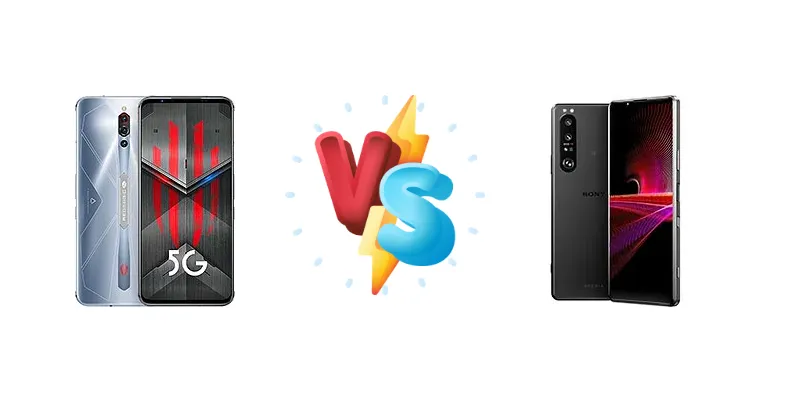
|
🏆 Quick Verdict
For the average user prioritizing a well-rounded experience, the Sony Xperia 1 III emerges as the stronger contender. Its superior display, more refined software, and versatile camera system offer a more polished and versatile package. However, gamers seeking maximum performance at a lower price point will find the RedMagic 5S a compelling option.
| PHONES | ||
|---|---|---|
| Phone Names | ZTE nubia RedMagic 5S | Sony Xperia 1 III |
| Network | ||
|---|---|---|
| 2G bands | GSM 850 / 900 / 1800 / 1900 | GSM 850 / 900 / 1800 / 1900 |
| 3G bands | HSDPA 850 / 900 / 1700(AWS) / 1900 / 2100 | HSDPA 800 / 850 / 900 / 1700(AWS) / 1900 / 2100 |
| 4G bands | 1, 2, 3, 4, 5, 7, 8, 12, 17, 18, 19, 20, 26, 34, 38, 39, 40, 41 | 1, 2, 3, 4, 5, 7, 8, 12, 13, 17, 19, 20, 25, 26, 28, 29, 32, 34, 38, 39, 40, 41, 46, 66 - Europe |
| 5G bands | 41, 78, 79 SA/NSA | 1, 3, 5, 7, 8, 20, 28, 38, 40, 41, 77, 78 SA/NSA/Sub6 - Europe |
| Speed | HSPA, LTE, 5G 7.5 Gbps DL | HSPA, LTE, 5G |
| Technology | GSM / CDMA / HSPA / EVDO / LTE / 5G | GSM / HSPA / LTE / 5G |
| - | SA/NSA/Sub6/mmWave - USA (specific) | |
| Launch | ||
|---|---|---|
| Announced | 2020, July 28. Released 2020, August 01 | 2021, April 14 |
| Status | Discontinued | Available. Released 2021, August 25 |
| Body | ||
|---|---|---|
| Build | Glass front (Gorilla Glass), glass back (Gorilla Glass), aluminum frame | Glass front (Gorilla Glass Victus), glass back (Gorilla Glass 6), aluminum frame |
| Dimensions | 168.6 x 78 x 9.8 mm (6.64 x 3.07 x 0.39 in) | 165 x 71 x 8.2 mm (6.50 x 2.80 x 0.32 in) |
| SIM | Nano-SIM + Nano-SIM | Nano-SIM + Nano-SIM |
| Weight | 220 g (7.76 oz) | 186 g / 187.1 g (mmWave) (6.56 oz) |
| - | IP65/IP68 dust/water resistant (up to 1.5m for 30 min) | |
| Display | ||
|---|---|---|
| Protection | Corning Gorilla Glass | Corning Gorilla Glass Victus |
| Resolution | 1080 x 2340 pixels, 19.5:9 ratio (~388 ppi density) | 1644 x 3840 pixels, 21:9 ratio (~643 ppi density) |
| Size | 6.65 inches, 108.6 cm2 (~82.5% screen-to-body ratio) | 6.5 inches, 98.6 cm2 (~84.2% screen-to-body ratio) |
| Type | AMOLED, 144Hz | OLED, 1B colors, 120Hz, HDR BT.2020 |
| - | Runs at 1096 x 2560 pixels except for select use cases | |
| Platform | ||
|---|---|---|
| CPU | Octa-core (1x2.84 GHz Cortex-A77 & 3x2.42 GHz Cortex-A77 & 4x1.80 GHz Cortex-A55) | Octa-core (1x2.84 GHz Cortex-X1 & 3x2.42 GHz Cortex-A78 & 4x1.80 GHz Cortex-A55) |
| Chipset | Qualcomm SM8250 Snapdragon 865 5G (7 nm+) | Qualcomm SM8350 Snapdragon 888 5G (5 nm) |
| GPU | Adreno 650 | Adreno 660 |
| OS | Android 10, Redmagic 3.0 | Android 11, upgradable to Android 13 |
| Memory | ||
|---|---|---|
| Card slot | No | microSDXC (uses shared SIM slot) |
| Internal | 128GB 8GB RAM, 256GB 12GB RAM, 256GB 16GB RAM | 256GB 12GB RAM, 512GB 12GB RAM |
| - | UFS 3.X | |
| Main Camera | ||
|---|---|---|
| Features | LED flash, HDR, panorama | Zeiss optics, Zeiss T* lens coating, color spectrum sensor, LED flash, panorama, HDR, eye tracking |
| Single | - | 8 MP, f/2.0, 24mm (wide), 1/4", 1.12µm |
| Triple | 64 MP, f/1.8, 26mm (wide), 1/1.72", 0.8µm, PDAF 8 MP, f/2.0, 120˚, 13mm (ultrawide), 1.12µm 2 MP (macro) | 12 MP, f/1.7, 24mm (wide), 1/1.7", 1.8µm, dual pixel PDAF, OIS 12 MP, f/2.3, 70mm (telephoto), f/2.8, 105mm (telephoto), 1/2.9", dual pixel PDAF, 3x/4.4x optical zoom, OIS 12 MP, f/2.2, 124˚, 16mm (ultrawide), 1/2.6", dual pixel PDAF 0.3 MP, TOF 3D, (depth) |
| Video | 8K@30fps, 4K@30/60fps, 1080p@30/60/120/240fps | 4K@24/25/30/60/120fps HDR, 1080p@30/60/120fps; 5-axis gyro-EIS, OIS |
| Selfie camera | ||
|---|---|---|
| Features | HDR | HDR |
| Single | 8 MP, f/2.0, (wide), 1.12µm | 8 MP, f/2.0, 24mm (wide), 1/4.0", 1.12µm |
| Video | 1080p@30fps | 1080p@30fps, 5-axis gyro-EIS |
| Sound | ||
|---|---|---|
| 3.5mm jack | - | Yes |
| 35mm jack | Yes | Yes |
| Loudspeaker | Yes, with stereo speakers | Yes, with stereo speakers |
| - | 24-bit/192kHz audio Dynamic vibration system | |
| Comms | ||
|---|---|---|
| Bluetooth | 5.1, A2DP, aptX, LE | 5.2, A2DP, LE, aptX HD, aptX Adaptive |
| NFC | Yes | Yes |
| Positioning | GPS (L1+L5), GLONASS, BDS, GALILEO | GPS, GLONASS, BDS, GALILEO, QZSS |
| Radio | No | No |
| USB | USB Type-C 3.0, OTG, accessory connector | USB Type-C 3.1, OTG, video output |
| WLAN | Wi-Fi 802.11 a/b/g/n/ac/6, dual-band, Wi-Fi Direct | Wi-Fi 802.11 a/b/g/n/ac/6, dual-band, Wi-Fi Direct, DLNA |
| Features | ||
|---|---|---|
| Sensors | Fingerprint (under display, optical), accelerometer, gyro, proximity, compass | Fingerprint (side-mounted), accelerometer, gyro, proximity, barometer, compass |
| - | Native Sony Alpha camera support | |
| Battery | ||
|---|---|---|
| Charging | 55W wired, 56% in 15 min, 100% in 40 min | 30W wired, PD, 50% in 30 min Wireless Reverse wireless |
| Type | Li-Po 4500 mAh | Li-Po 4500 mAh |
| Misc | ||
|---|---|---|
| Colors | Silver, Pulse | Frosted Black, Frosted Gray, Frosted Purple |
| Models | - | XQBC62/V, XQBC52V.UKCX, SO-51B, SOG03, A101SO, XQ-BC62, XQ-BC72, XQ-BC52, XQ-BC01, XQ-BC11, XQ-BC21, XQ-BC72 |
| Price | About 540 EUR | € 505.26 / $ 903.43 |
| Tests | ||
|---|---|---|
| Battery life | - | Endurance rating 82h |
| Camera | - | Photo / Video |
| Display | - | Contrast ratio: Infinite (nominal) |
| Loudspeaker | - | -26.5 LUFS (Good) |
| Performance | - | AnTuTu: 607423 (v8) GeekBench: 3515 (v5.1) GFXBench: 54fps (ES 3.1 onscreen) |
ZTE nubia RedMagic 5S
- Faster charging (55W)
- Active cooling system for sustained gaming
- Higher refresh rate display (144Hz)
- Older chipset (Snapdragon 865)
- Likely inferior camera performance
- Less refined software experience
Sony Xperia 1 III
- Brighter and higher-quality display
- More powerful chipset (Snapdragon 888)
- Versatile camera system with professional features
- Wireless and reverse wireless charging
- Slower charging (30W)
- Potential for thermal throttling
- Higher price point
Display Comparison
The Sony Xperia 1 III boasts a significantly brighter display at 620 nits compared to the RedMagic 5S’s 459 nits, making it far more usable outdoors. While both offer excellent color reproduction, the Xperia 1 III’s infinite contrast ratio (nominal) suggests a superior OLED panel. The RedMagic 5S prioritizes a 144Hz refresh rate for smoother gaming, but the Xperia 1 III’s 120Hz is still exceptionally fluid. The Xperia 1 III’s display is geared towards content consumption and professional use, while the RedMagic 5S is optimized for competitive gaming.
Camera Comparison
Both phones feature capable camera systems, but their philosophies differ. The Xperia 1 III focuses on professional-grade photography and videography, offering extensive manual controls and features like 4K 120fps video recording. While both are listed as having Photo/Video capabilities, the Xperia 1 III’s sensor size and image processing are likely more advanced, given Sony’s expertise in imaging. The RedMagic 5S’s camera is likely a secondary consideration, prioritizing gaming features over photographic excellence. Details on the RedMagic 5S’s camera sensors are scarce, suggesting a less competitive offering.
Performance
The Xperia 1 III’s Snapdragon 888 (5nm) represents a generational leap over the RedMagic 5S’s Snapdragon 865 (7nm+). The 5nm process offers improved power efficiency and thermal performance, though the Xperia 1 III is still known to throttle under sustained load. The Xperia 1 III’s CPU features the Cortex-X1 prime core, offering a performance advantage over the RedMagic 5S’s Cortex-A77. However, the RedMagic 5S’s active cooling system mitigates some of the Snapdragon 865’s thermal limitations, allowing for sustained performance during gaming. Both devices utilize Octa-core CPUs, but the architectural improvements in the 888 give the Xperia 1 III an edge in overall responsiveness.
Battery Life
Both devices achieve similar endurance ratings of around 82-83 hours, despite differing battery capacities (not specified in the provided data). The RedMagic 5S’s 55W wired charging is significantly faster than the Xperia 1 III’s 30W charging, achieving 56% charge in 15 minutes and 100% in 40 minutes. The Xperia 1 III offers wireless and reverse wireless charging, features absent on the RedMagic 5S. The RedMagic 5S prioritizes quick top-ups, while the Xperia 1 III offers more versatile charging options.
Buying Guide
Buy the ZTE nubia RedMagic 5S if you need uncompromising gaming performance, active cooling, and a high refresh rate display, and are willing to accept compromises in camera quality and software refinement. Buy the Sony Xperia 1 III if you prefer a cinematic display, a versatile camera system with professional video capabilities, and a more polished, premium software experience, even if it means paying a premium and potentially managing thermal throttling during extended gaming sessions.