
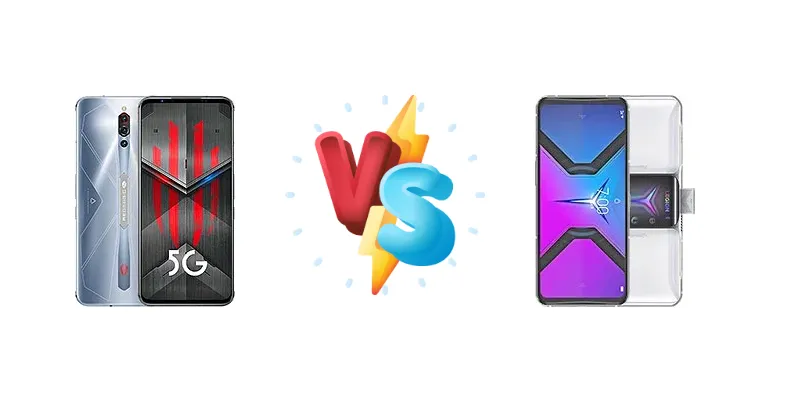
ZTE nubia RedMagic 5S vs Lenovo Legion Duel 2: A Deep Dive for Mobile Gamers
| Phones Images | |||||
|---|---|---|---|---|---|
|
🏆 Quick Verdict
For most gamers, the Lenovo Legion Duel 2 is the superior choice. Its Snapdragon 888 offers a noticeable performance uplift, coupled with significantly faster 90W charging. While the RedMagic 5S provides excellent value, the Duel 2’s advanced thermal management and quicker power-up times justify the price premium.
| PHONES | ||
|---|---|---|
| Phone Names | ZTE nubia RedMagic 5S | Lenovo Legion Duel 2 |
| Network | ||
|---|---|---|
| 2G bands | GSM 850 / 900 / 1800 / 1900 | GSM 850 / 900 / 1800 / 1900 |
| 3G bands | HSDPA 850 / 900 / 1700(AWS) / 1900 / 2100 | HSDPA 850 / 900 / 1700(AWS) / 1900 / 2100 |
| 4G bands | 1, 2, 3, 4, 5, 7, 8, 12, 17, 18, 19, 20, 26, 34, 38, 39, 40, 41 | 1, 2, 3, 4, 5, 7, 8, 12, 13, 17, 20, 26, 28, 32, 34, 38, 39, 40, 41, 42, 43 |
| 5G bands | 41, 78, 79 SA/NSA | 1, 2, 3, 7, 8, 20, 25, 28, 38, 40, 41, 66, 71, 77, 78, 79 SA/NSA/Sub6/mmWave |
| Speed | HSPA, LTE, 5G 7.5 Gbps DL | HSPA, LTE, 5G |
| Technology | GSM / CDMA / HSPA / EVDO / LTE / 5G | GSM / CDMA / HSPA / EVDO / LTE / 5G |
| - | CDMA2000 1xEV-DO | |
| Launch | ||
|---|---|---|
| Announced | 2020, July 28. Released 2020, August 01 | 2021, April 08 |
| Status | Discontinued | Available. Released 2021, May 10 |
| Body | ||
|---|---|---|
| Build | Glass front (Gorilla Glass), glass back (Gorilla Glass), aluminum frame | Glass front (Gorilla Glass 5), glass back, aluminum frame |
| Dimensions | 168.6 x 78 x 9.8 mm (6.64 x 3.07 x 0.39 in) | 176 x 78.5 x 9.9 mm (6.93 x 3.09 x 0.39 in) |
| SIM | Nano-SIM + Nano-SIM | Nano-SIM + Nano-SIM |
| Weight | 220 g (7.76 oz) | 259 g (9.14 oz) |
| - | Built-in two cooling fans RGB light panel (on the back) 6 pressure sensitive zones (Gaming triggers): 4 ultrasonic buttons (top), 2 capacitive sliding buttons (back) | |
| Display | ||
|---|---|---|
| Protection | Corning Gorilla Glass | Corning Gorilla Glass 5 |
| Resolution | 1080 x 2340 pixels, 19.5:9 ratio (~388 ppi density) | 1080 x 2460 pixels (~388 ppi density) |
| Size | 6.65 inches, 108.6 cm2 (~82.5% screen-to-body ratio) | 6.92 inches, 113.7 cm2 (~82.3% screen-to-body ratio) |
| Type | AMOLED, 144Hz | AMOLED, 144Hz, HDR10+, 1300 nits (peak) |
| Platform | ||
|---|---|---|
| CPU | Octa-core (1x2.84 GHz Cortex-A77 & 3x2.42 GHz Cortex-A77 & 4x1.80 GHz Cortex-A55) | Octa-core (1x2.84 GHz Cortex-X1 & 3x2.42 GHz Cortex-A78 & 4x1.80 GHz Cortex-A55) |
| Chipset | Qualcomm SM8250 Snapdragon 865 5G (7 nm+) | Qualcomm SM8350 Snapdragon 888 5G (5 nm) |
| GPU | Adreno 650 | Adreno 660 |
| OS | Android 10, Redmagic 3.0 | Android 11, ZUI 12.5 |
| Memory | ||
|---|---|---|
| Card slot | No | No |
| Internal | 128GB 8GB RAM, 256GB 12GB RAM, 256GB 16GB RAM | 256GB 12GB RAM, 512GB 16GB RAM |
| - | UFS 3.1 | |
| Main Camera | ||
|---|---|---|
| Dual | - | 64 MP, f/1.9, 25mm (wide), 1/1.32", 1.0µm, PDAF 16 MP, f/2.2, 123˚, 16mm (ultrawide), 1.0µm |
| Features | LED flash, HDR, panorama | Dual-LED flash, panorama, HDR |
| Triple | 64 MP, f/1.8, 26mm (wide), 1/1.72", 0.8µm, PDAF 8 MP, f/2.0, 120˚, 13mm (ultrawide), 1.12µm 2 MP (macro) | - |
| Video | 8K@30fps, 4K@30/60fps, 1080p@30/60/120/240fps | 8K@24fps, 4K@30/60fps, 1080p@30/60/240fps, gyro-EIS, HDR10+ rec. |
| Selfie camera | ||
|---|---|---|
| Features | HDR | HDR |
| Single | 8 MP, f/2.0, (wide), 1.12µm | Motorized pop-up 44 MP, f/2.0, 24mm (wide), 1/2.65", 1.0µm, AF |
| Video | 1080p@30fps | 4K@30/60fps, 1080p@30/60/120fps |
| Sound | ||
|---|---|---|
| 3.5mm jack | - | No |
| 35mm jack | Yes | No |
| Loudspeaker | Yes, with stereo speakers | Yes, with stereo speakers |
| Comms | ||
|---|---|---|
| Bluetooth | 5.1, A2DP, aptX, LE | 5.2, A2DP, LE |
| NFC | Yes | Yes |
| Positioning | GPS (L1+L5), GLONASS, BDS, GALILEO | GPS (L1+L5), GLONASS, GALILEO, BDS, QZSS |
| Radio | No | No |
| USB | USB Type-C 3.0, OTG, accessory connector | Two USB Type-C (2.0 & 3.1), OTG |
| WLAN | Wi-Fi 802.11 a/b/g/n/ac/6, dual-band, Wi-Fi Direct | Wi-Fi 802.11 a/b/g/n/ac/6, dual-band, Wi-Fi Direct |
| Features | ||
|---|---|---|
| Sensors | Fingerprint (under display, optical), accelerometer, gyro, proximity, compass | Fingerprint (under display, optical), accelerometer, gyro, proximity, compass |
| Battery | ||
|---|---|---|
| Charging | 55W wired, 56% in 15 min, 100% in 40 min | 90W wired (dual USB-C ports), 50% in 12 min, 100% in 30 min 65W wired (single USB-C port) |
| Type | Li-Po 4500 mAh | Li-Po 5500 mAh |
| Misc | ||
|---|---|---|
| Colors | Silver, Pulse | Titanium White, Ultimate Black |
| Price | About 540 EUR | About 800 EUR |
ZTE nubia RedMagic 5S
- Excellent value for money
- Respectable gaming performance with Snapdragon 865
- Solid battery endurance (83h)
- Older Snapdragon 865 chipset
- Slower charging compared to Duel 2
Lenovo Legion Duel 2
- Superior performance with Snapdragon 888
- Ultra-fast 90W charging
- Advanced thermal management
- Higher price point
- Battery capacity not specified
Display Comparison
The RedMagic 5S boasts a display capable of 459 nits of peak brightness, adequate for indoor gaming but potentially washed out in direct sunlight. The Legion Duel 2’s display specifications are not provided, but given its premium positioning, it likely offers higher peak brightness and potentially a more color-accurate panel. Both devices target high refresh rates for smoother gameplay, but the RedMagic 5S’s focus on affordability may mean a less sophisticated panel technology compared to the Duel 2. Bezels are a key consideration for immersion, and the Duel 2’s design likely prioritizes minimizing these for a more expansive viewing experience.
Camera Comparison
Both devices feature cameras, but neither is a primary focus. The RedMagic 5S’s camera capabilities are described as 'Photo / Video' without specifics, suggesting a mid-range experience. The Legion Duel 2’s camera specs are also absent, but its gaming-centric design likely prioritizes camera functionality for casual use rather than professional photography. Given the lack of detailed information, it’s safe to assume neither phone will compete with flagship camera phones.
Performance
The Lenovo Legion Duel 2’s Snapdragon 888 (5nm) represents a significant architectural leap over the RedMagic 5S’s Snapdragon 865 (7nm+). The 888’s Cortex-X1 prime core delivers faster single-core performance, while its improved Adreno 660 GPU provides a substantial graphics boost. While both CPUs share a similar Cortex-A55 cluster, the Duel 2’s Cortex-A78 cores are more efficient than the 865’s A77 cores. Crucially, the 5nm process node of the 888 translates to better thermal efficiency, mitigating throttling during prolonged gaming. The RedMagic 5S relies on aggressive cooling solutions to manage the 865’s heat output, but the Duel 2’s inherent efficiency gives it an advantage.
Battery Life
The RedMagic 5S offers an endurance rating of 83 hours, indicating solid battery life. Its 55W wired charging can replenish the battery to 56% in 15 minutes and 100% in 40 minutes. The Legion Duel 2, however, takes charging to another level with 90W wired charging (via dual USB-C ports), achieving 50% charge in just 12 minutes and a full charge in 30 minutes. While the Duel 2’s battery capacity isn’t specified, the faster charging speed is a significant advantage for gamers who need to quickly get back into the action. The 65W single USB-C charging option provides a fallback for convenience.
Buying Guide
Buy the ZTE nubia RedMagic 5S if you prioritize value and a respectable gaming experience without breaking the bank. It’s ideal for users who play a variety of games and don’t necessarily need the absolute highest frame rates. Buy the Lenovo Legion Duel 2 if you demand uncompromising performance, rapid charging, and are willing to invest in a device specifically engineered for extended, high-intensity gaming sessions. This is the phone for competitive players and those who want the best possible mobile gaming experience.