
ZTE nubia RedMagic 5S vs Asus ROG Phone 3: Which Gaming Phone Delivers the Most?
| Phones Images | |||||
|---|---|---|---|---|---|
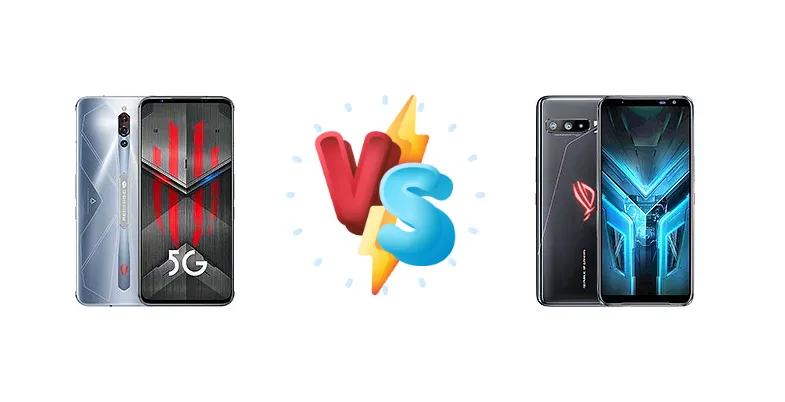
|
🏆 Quick Verdict
For the average gamer prioritizing sustained performance and battery life, the Asus ROG Phone 3 is the superior choice. Its larger 120-hour endurance battery and Snapdragon 865+ chipset provide a noticeable advantage in demanding titles, despite the slower 30W charging. However, the RedMagic 5S remains a compelling option for budget-conscious gamers.
| PHONES | ||
|---|---|---|
| Phone Names | ZTE nubia RedMagic 5S | Asus ROG Phone 3 |
| Network | ||
|---|---|---|
| 2G bands | GSM 850 / 900 / 1800 / 1900 | GSM 850 / 900 / 1800 / 1900 |
| 3G bands | HSDPA 850 / 900 / 1700(AWS) / 1900 / 2100 | HSDPA 800 / 850 / 900 / 1700(AWS) / 1800 / 1900 / 2100 - A version |
| 4G bands | 1, 2, 3, 4, 5, 7, 8, 12, 17, 18, 19, 20, 26, 34, 38, 39, 40, 41 | 1, 2, 3, 4, 5, 7, 8, 12, 13, 17, 18, 19, 20, 25, 26, 28, 29, 30, 32, 34, 38, 39, 40, 41, 42, 48, 66, 71 - A version |
| 5G bands | 41, 78, 79 SA/NSA | 1, 2, 3, 5, 28, 41, 66, 71, 77, 78, 79 SA/NSA - A version |
| Speed | HSPA, LTE, 5G 7.5 Gbps DL | HSPA 42.2/5.76 Mbps, LTE (6CA) Cat20 2000/150 Mbps, 5G 4.4 Gbps DL |
| Technology | GSM / CDMA / HSPA / EVDO / LTE / 5G | GSM / CDMA / HSPA / LTE / 5G |
| Launch | ||
|---|---|---|
| Announced | 2020, July 28. Released 2020, August 01 | 2020, July 22. Released 2020, July 23 |
| Status | Discontinued | Discontinued |
| Body | ||
|---|---|---|
| Build | Glass front (Gorilla Glass), glass back (Gorilla Glass), aluminum frame | Glass front (Gorilla Glass 6), glass back (Gorilla Glass 3), aluminum frame |
| Dimensions | 168.6 x 78 x 9.8 mm (6.64 x 3.07 x 0.39 in) | 171 x 78 x 9.9 mm (6.73 x 3.07 x 0.39 in) |
| SIM | Nano-SIM + Nano-SIM | Nano-SIM + Nano-SIM |
| Weight | 220 g (7.76 oz) | 240 g (8.47 oz) |
| Display | ||
|---|---|---|
| Protection | Corning Gorilla Glass | Corning Gorilla Glass 6 |
| Resolution | 1080 x 2340 pixels, 19.5:9 ratio (~388 ppi density) | 1080 x 2340 pixels, 19.5:9 ratio (~391 ppi density) |
| Size | 6.65 inches, 108.6 cm2 (~82.5% screen-to-body ratio) | 6.59 inches, 106.6 cm2 (~79.9% screen-to-body ratio) |
| Type | AMOLED, 144Hz | AMOLED, 1B colors, 144Hz, HDR10+, 650 nits (typ) |
| Platform | ||
|---|---|---|
| CPU | Octa-core (1x2.84 GHz Cortex-A77 & 3x2.42 GHz Cortex-A77 & 4x1.80 GHz Cortex-A55) | Octa-core (1x3.10 GHz Cortex-A77 & 3x2.42 GHz Cortex-A77 & 4x1.80 GHz Cortex-A55) |
| Chipset | Qualcomm SM8250 Snapdragon 865 5G (7 nm+) | Qualcomm SM8250 Snapdragon 865 5G+ (7 nm+) |
| GPU | Adreno 650 | Adreno 650 |
| OS | Android 10, Redmagic 3.0 | Android 10, upgradable to Android 12, ROG UI |
| Memory | ||
|---|---|---|
| Card slot | No | No |
| Internal | 128GB 8GB RAM, 256GB 12GB RAM, 256GB 16GB RAM | 128GB 8GB RAM, 128GB 12GB RAM, 256GB 12GB RAM, 512GB 12GB RAM, 512GB 16GB RAM |
| Main Camera | ||
|---|---|---|
| Features | LED flash, HDR, panorama | LED flash, HDR, panorama |
| Triple | 64 MP, f/1.8, 26mm (wide), 1/1.72", 0.8µm, PDAF 8 MP, f/2.0, 120˚, 13mm (ultrawide), 1.12µm 2 MP (macro) | 64 MP, f/1.8, 26mm (wide), 1/1.73", 0.8µm, PDAF 13 MP, f/2.4, 11mm, 125˚ (ultrawide) 5 MP (macro) |
| Video | 8K@30fps, 4K@30/60fps, 1080p@30/60/120/240fps | 8K@30fps, 4K@30/60/120fps, 1080p@30/60/240fps, 720p@480fps; gyro-EIS |
| Selfie camera | ||
|---|---|---|
| Features | HDR | Panorama, HDR |
| Single | 8 MP, f/2.0, (wide), 1.12µm | 24 MP, f/2.0, 27mm (wide), 0.9µm |
| Video | 1080p@30fps | 1080p@30fps |
| Sound | ||
|---|---|---|
| 3.5mm jack | - | No |
| 35mm jack | Yes | No |
| Loudspeaker | Yes, with stereo speakers | Yes, with DTS:X stereo speakers (2 dedicated amplifiers) |
| Comms | ||
|---|---|---|
| Bluetooth | 5.1, A2DP, aptX, LE | 5.1, A2DP, LE, aptX HD, aptX Adaptive |
| NFC | Yes | Yes |
| Positioning | GPS (L1+L5), GLONASS, BDS, GALILEO | GPS (L1+L5), GLONASS, BDS, GALILEO, QZSS |
| Radio | No | No |
| USB | USB Type-C 3.0, OTG, accessory connector | USB Type-C 3.1 (side), USB Type-C 2.0 (bottom), OTG, accessory connector |
| WLAN | Wi-Fi 802.11 a/b/g/n/ac/6, dual-band, Wi-Fi Direct | Wi-Fi 802.11 a/b/g/n/ac/6, dual-band, Wi-Fi Direct |
| Features | ||
|---|---|---|
| Sensors | Fingerprint (under display, optical), accelerometer, gyro, proximity, compass | Fingerprint (under display, optical), accelerometer, gyro, proximity, compass |
| Battery | ||
|---|---|---|
| Charging | 55W wired, 56% in 15 min, 100% in 40 min | 30W wired, PD3.0, QC4 10W reverse wired |
| Type | Li-Po 4500 mAh | Li-Po 6000 mAh |
| Misc | ||
|---|---|---|
| Colors | Silver, Pulse | Black Glare |
| Models | - | ASUS_I003D, ZS661KS, I003DD, I003D |
| Price | About 540 EUR | About 650 EUR |
| SAR | - | 0.74 W/kg (head) 1.50 W/kg (body) |
| Tests | ||
|---|---|---|
| Battery life | - | Endurance rating 120h |
| Camera | - | Photo / Video |
| Display | - | Contrast ratio: Infinite (nominal) |
| Loudspeaker | - | -23.1 LUFS (Very good) |
| Performance | - | AnTuTu: 621932 (v8) GeekBench: 13306 (v4.4), 3386 (v5.1) GFXBench: 48fps (ES 3.1 onscreen) |
ZTE nubia RedMagic 5S
- Faster 55W charging for quick top-ups
- Competitive price point for gaming features
- High refresh rate display for smooth gameplay
- Significantly shorter battery life compared to ROG Phone 3
- Less powerful chipset (Snapdragon 865 vs 865+)
- Lower display brightness for outdoor visibility
Asus ROG Phone 3
- Exceptional 120-hour battery life for extended gaming
- More powerful Snapdragon 865+ chipset
- Brighter display for better outdoor visibility
- Slower 30W charging compared to RedMagic 5S
- Higher price point
- Larger size and weight
Display Comparison
The Asus ROG Phone 3 boasts a significantly brighter display at 719 nits compared to the RedMagic 5S’s 459 nits. This translates to better visibility outdoors and a more vibrant image. Both phones offer high refresh rates, but the ROG Phone 3’s infinite contrast ratio (nominal) suggests a superior viewing experience with deeper blacks. While both are excellent for gaming, the ROG Phone 3’s display is demonstrably superior for multimedia consumption and outdoor use.
Camera Comparison
Both phones feature photo and video capabilities, but the provided data offers limited insight into camera quality. Without sensor size or aperture information, a direct comparison is difficult. Given the gaming focus of both devices, camera performance is likely secondary. The ROG Phone 3’s brand reputation suggests a more polished camera experience, but this is speculative without further data. The inclusion of a 2MP macro lens on either device is unlikely to significantly impact image quality.
Performance
Both devices utilize the Qualcomm Snapdragon 865 5G chipset, but the ROG Phone 3 features the Snapdragon 865+ variant. The ROG Phone 3’s CPU clocks slightly higher at 3.10 GHz versus the RedMagic 5S’s 2.84 GHz, offering a marginal performance boost in CPU-intensive tasks. However, the ROG Phone 3’s larger battery and potentially more sophisticated cooling solution (not detailed in the provided data) are more critical for sustained gaming performance, mitigating thermal throttling. Both utilize LPDDR5 RAM, but the ROG Phone 3’s larger battery capacity allows for longer periods of peak performance.
Battery Life
The Asus ROG Phone 3’s 120-hour endurance rating dwarfs the RedMagic 5S’s 83-hour rating, indicating a substantial advantage in battery life. While the RedMagic 5S supports significantly faster 55W wired charging (56% in 15 minutes, 100% in 40 minutes), the ROG Phone 3’s 30W charging, while slower, is still respectable and benefits from PD3.0 and QC4 compatibility. The ROG Phone 3 also offers 10W reverse wired charging, a feature absent on the RedMagic 5S. The ROG Phone 3’s larger battery capacity allows for longer gaming sessions without needing to be tethered to a charger.
Buying Guide
Buy the ZTE nubia RedMagic 5S if you need a high refresh rate gaming experience on a tighter budget and value rapid 55W charging. It’s ideal for gamers who prioritize quick top-ups and aren’t as concerned with absolute peak performance or extended play sessions. Buy the Asus ROG Phone 3 if you prefer a more refined gaming experience with exceptional battery life, a brighter display, and a slightly more powerful processor, even if it means sacrificing charging speed and paying a premium.