
ZTE nubia RedMagic 5G vs Xiaomi Black Shark 3 Pro: A Deep Dive for Gamers
| Phones Images | |||||
|---|---|---|---|---|---|
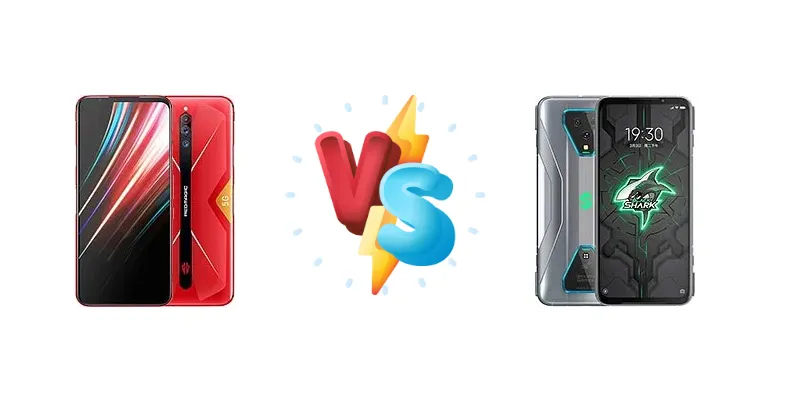
|
🏆 Quick Verdict
For the average gamer prioritizing rapid recharge times and wireless charging convenience, the Xiaomi Black Shark 3 Pro edges out the RedMagic 5G. However, the RedMagic 5G’s endurance rating suggests it can sustain gaming sessions for longer, making it a strong contender for marathon players.
| PHONES | ||
|---|---|---|
| Phone Names | ZTE nubia RedMagic 5G | Xiaomi Black Shark 3 Pro |
| Network | ||
|---|---|---|
| 2G bands | GSM 850 / 900 / 1800 / 1900 | GSM 850 / 900 / 1800 / 1900 |
| 3G bands | HSDPA 850 / 900 / 1700(AWS) / 1800 / 1900 / 2100 | HSDPA 800 / 850 / 900 / 1700(AWS) / 1900 / 2100 |
| 4G bands | 1, 2, 3, 4, 5, 7, 8, 20, 12, 17, 18, 19, 26, 34, 38, 39, 40, 41 | 1, 3, 4, 5, 7, 8, 12, 17, 20, 34, 38, 39, 40, 41 |
| 5G bands | 41, 78, 79 SA/NSA | 41, 78, 79 SA/NSA |
| Speed | HSPA, LTE, 5G 7.5 Gbps DL | HSPA, LTE, 5G |
| Technology | GSM / CDMA / HSPA / EVDO / LTE / 5G | GSM / CDMA / HSPA / EVDO / LTE / 5G |
| - | CDMA2000 1xEV-DO | |
| Launch | ||
|---|---|---|
| Announced | 2020, March 12. Released 2020, March 19 | 2020, March 03. Released 2020, March 17 |
| Status | Discontinued | Discontinued |
| Body | ||
|---|---|---|
| Build | Glass front (Gorilla Glass), glass back (Gorilla Glass), aluminum frame | Glass front, aluminum back, aluminum frame |
| Dimensions | 168.6 x 78 x 9.8 mm (6.64 x 3.07 x 0.39 in) | 177.8 x 83.3 x 10.1 mm (7.00 x 3.28 x 0.40 in) |
| SIM | Nano-SIM + Nano-SIM | Nano-SIM + Nano-SIM |
| Weight | 218 g (7.69 oz) | 253 g (8.92 oz) |
| - | Physical pop-up gaming triggers | |
| Display | ||
|---|---|---|
| Protection | Corning Gorilla Glass | - |
| Resolution | 1080 x 2340 pixels, 19.5:9 ratio (~388 ppi density) | 1440 x 3120 pixels, 19.5:9 ratio (~484 ppi density) |
| Size | 6.65 inches, 108.6 cm2 (~82.5% screen-to-body ratio) | 7.1 inches, 123.7 cm2 (~83.6% screen-to-body ratio) |
| Type | AMOLED, 144Hz | AMOLED, 90Hz, HDR10+, 500 nits (typ) |
| - | Always-on display | |
| Platform | ||
|---|---|---|
| CPU | Octa-core (1x2.84 GHz Cortex-A77 & 3x2.42 GHz Cortex-A77 & 4x1.80 GHz Cortex-A55) | Octa-core (1x2.84 GHz Cortex-A77 & 3x2.42 GHz Cortex-A77 & 4x1.80 GHz Cortex-A55) |
| Chipset | Qualcomm SM8250 Snapdragon 865 5G (7 nm+) | Qualcomm SM8250 Snapdragon 865 5G (7 nm+) |
| GPU | Adreno 650 | Adreno 650 |
| OS | Android 10, Redmagic 3.0 | Android 10 |
| Memory | ||
|---|---|---|
| Card slot | No | No |
| Internal | 128GB 8GB RAM, 128GB 12GB RAM, 256GB 12GB RAM, 256GB 16GB RAM | 256GB 8GB RAM, 256GB 12GB RAM, 512GB 12GB RAM |
| - | UFS 3.0 | |
| Main Camera | ||
|---|---|---|
| Features | LED flash, HDR, panorama | LED flash, HDR, panorama |
| Triple | 64 MP, f/1.8, 26mm (wide), 1/1.72", 0.8µm, PDAF 8 MP, f/2.0, 13mm (ultrawide), 1.12µm 2 MP (macro) | 64 MP, f/1.8, 26mm (wide), 1/1.72", 0.8µm, PDAF 13 MP, f/2.3, (ultrawide) Auxiliary lens |
| Video | 8K@15fps, 4K@30/60fps, 1080p@30/60/120/240fps | 4K@30/60fps, 1080p@30/60/240fps, 720p@1920fps |
| Selfie camera | ||
|---|---|---|
| Features | HDR | HDR |
| Single | 8 MP, f/2.0, (wide), 1.12µm | 20 MP, f/2.2, (wide), 1/3", 0.9µm |
| Video | 1080p@30fps | 1080p@30fps |
| Sound | ||
|---|---|---|
| 3.5mm jack | - | Yes |
| 35mm jack | Yes | Yes |
| Loudspeaker | Yes, with stereo speakers | Yes, with stereo speakers |
| Comms | ||
|---|---|---|
| Bluetooth | 5.1, A2DP, aptX, LE | 5.0, A2DP, LE, aptX HD, aptX Adaptive |
| NFC | Yes | No |
| Positioning | GPS (L1+L5), GLONASS, BDS, GALILEO | GPS, GLONASS, GALILEO, QZSS, BDS |
| Radio | No | No |
| USB | USB Type-C 3.0, OTG, accessory connector | USB Type-C 2.0 |
| WLAN | Wi-Fi 802.11 a/b/g/n/ac/6, dual-band, Wi-Fi Direct | Wi-Fi 802.11 a/b/g/n/ac/6, dual-band, Wi-Fi Direct |
| Features | ||
|---|---|---|
| Sensors | Fingerprint (under display, optical), accelerometer, gyro, proximity, compass | Fingerprint (under display, optical), accelerometer, gyro, proximity, compass |
| Battery | ||
|---|---|---|
| Charging | 55W wired, 56% in 15 min, 100% in 40 min | 65W wired, 100% in 38 min 18W magnetic wireless |
| Type | Li-Po 4500 mAh | Li-Po 5000 mAh |
| Misc | ||
|---|---|---|
| Colors | Eclipse Black, Hot Rod Red, Black, Mars Red, Cyber Neon, Transparent | Phantom Black, Armor Gray |
| Models | NX659J | SHARK MBU-A0, SHARK MBU-H0 |
| Price | About 880 EUR | About 940 EUR |
ZTE nubia RedMagic 5G
- Exceptional battery endurance (83h rating)
- Potentially superior thermal management with active cooling
- High display brightness (685 nits)
- Slower charging speed compared to Black Shark 3 Pro
- No wireless charging support
Xiaomi Black Shark 3 Pro
- Faster 65W wired charging (100% in 38 min)
- Convenient 18W magnetic wireless charging
- Potentially more versatile feature set
- Lower endurance rating (implied)
- Thermal throttling potentially more pronounced under sustained load
Display Comparison
Both the RedMagic 5G and Black Shark 3 Pro utilize high refresh rate displays, crucial for smooth gaming visuals. However, the RedMagic 5G boasts a measured peak brightness of 685 nits, suggesting a more visible screen in bright outdoor conditions. While both likely employ AMOLED panels, the RedMagic 5G’s brightness advantage is a tangible benefit for outdoor gaming. Details regarding PWM dimming rates are absent, but this is a critical factor for users sensitive to flicker, and further investigation would be needed to determine which device is preferable in this regard.
Camera Comparison
Camera performance appears to be a secondary consideration for both devices, focusing on 'Photo / Video' capabilities without specific details. Without sensor size or aperture information, a direct comparison is difficult. The Black Shark 3 Pro’s inclusion of 18W magnetic wireless charging suggests a broader focus on everyday usability, potentially extending to camera features. The absence of detailed camera specs implies neither phone aims to compete with flagship camera phones, prioritizing gaming features instead.
Performance
Both devices are powered by the Qualcomm SM8250 Snapdragon 865 5G (7 nm+), featuring the same Octa-core CPU configuration. This means raw processing power is virtually identical. The key differentiator will be thermal management. The RedMagic 5G’s design heavily emphasizes cooling, with a larger vapor chamber and active fan, potentially allowing it to sustain peak performance for longer periods. The Black Shark 3 Pro also features a cooling system, but its effectiveness relative to the RedMagic 5G is unknown without thermal testing. The identical chipset means RAM speed (likely LPDDR5) and storage type will have minimal impact on overall performance.
Battery Life
The RedMagic 5G boasts an endurance rating of 83 hours, indicating excellent battery life. The Black Shark 3 Pro, while not having an endurance rating provided, compensates with significantly faster charging. Its 65W wired charging can fully charge the battery in 38 minutes, compared to the RedMagic 5G’s 40 minutes for a full charge with its 55W system. Furthermore, the Black Shark 3 Pro adds 18W magnetic wireless charging, a feature absent on the RedMagic 5G, offering added convenience for users who prefer cable-free charging.
Buying Guide
Buy the ZTE nubia RedMagic 5G if you need maximum sustained gaming performance and prioritize battery endurance over the fastest possible charging. Its 83-hour endurance rating is ideal for users who frequently game on the go without easy access to power outlets. Buy the Xiaomi Black Shark 3 Pro if you prefer a faster charging experience, including the convenience of wireless charging, and value a more versatile feature set beyond pure gaming performance.