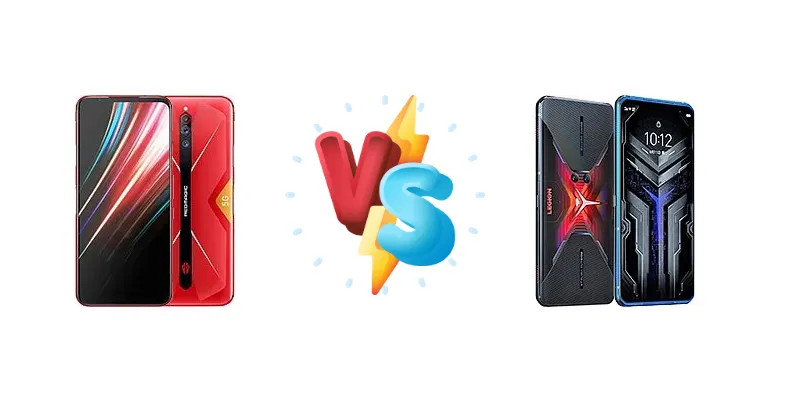
The ZTE nubia RedMagic 5G and Lenovo Legion Pro represent distinct approaches to the mobile gaming market. The RedMagic 5G, released earlier, focused on aggressive cooling and a high refresh rate display, while the Legion Pro arrived later with a more refined design and the slightly more powerful Snapdragon 865+. This comparison dissects their key differences to determine which device delivers the ultimate gaming experience.
🏆 Quick Verdict
For the average gamer prioritizing sustained performance and faster charging, the Lenovo Legion Pro emerges as the winner. Its Snapdragon 865+ chipset and variable charging speeds (up to 90W) provide a noticeable edge, especially during extended gaming sessions. However, the RedMagic 5G remains a compelling option for budget-conscious gamers.
| Network |
|---|
| 2G bands | GSM 850 / 900 / 1800 / 1900 | GSM 850 / 900 / 1800 / 1900 |
| 3G bands | HSDPA 850 / 900 / 1700(AWS) / 1800 / 1900 / 2100 | HSDPA 850 / 900 / 1900 / 2100 |
| 4G bands | 1, 2, 3, 4, 5, 7, 8, 20, 12, 17, 18, 19, 26, 34, 38, 39, 40, 41 | LTE |
| 5G bands | 41, 78, 79 SA/NSA | SA/NSA |
| Speed | HSPA, LTE, 5G 7.5 Gbps DL | HSPA 42.2/5.76 Mbps, LTE (4CA) Cat15 800/210 Mbps, 5G 2.5 Gbps DL |
| Technology | GSM / CDMA / HSPA / EVDO / LTE / 5G | GSM / CDMA / HSPA / LTE / 5G |
| | - | CDMA 800 & TD-SCDMA |
| Launch |
|---|
| Announced | 2020, March 12. Released 2020, March 19 | 2020, July 22. Released 2020, July 30 |
| Status | Discontinued | Discontinued |
| Body |
|---|
| Build | Glass front (Gorilla Glass), glass back (Gorilla Glass), aluminum frame | Glass front, glass back, aluminum frame |
| Dimensions | 168.6 x 78 x 9.8 mm (6.64 x 3.07 x 0.39 in) | 169.2 x 78.5 x 9.9 mm (6.66 x 3.09 x 0.39 in) |
| SIM | Nano-SIM + Nano-SIM | Nano-SIM + Nano-SIM |
| Weight | 218 g (7.69 oz) | 239 g (8.43 oz) |
| | - | Water-repellent coating |
| Display |
|---|
| Protection | Corning Gorilla Glass | - |
| Resolution | 1080 x 2340 pixels, 19.5:9 ratio (~388 ppi density) | 1080 x 2340 pixels, 19.5:9 ratio (~388 ppi density) |
| Size | 6.65 inches, 108.6 cm2 (~82.5% screen-to-body ratio) | 6.65 inches, 108.6 cm2 (~81.7% screen-to-body ratio) |
| Type | AMOLED, 144Hz | AMOLED, 144Hz, HDR10+ |
| Platform |
|---|
| CPU | Octa-core (1x2.84 GHz Cortex-A77 & 3x2.42 GHz Cortex-A77 & 4x1.80 GHz Cortex-A55) | Octa-core (1x3.09 GHz Cortex-A77 & 3x2.42 GHz Cortex-A77 & 4x1.80 GHz Cortex-A55) |
| Chipset | Qualcomm SM8250 Snapdragon 865 5G (7 nm+) | Qualcomm SM8250 Snapdragon 865 5G+ (7 nm+) |
| GPU | Adreno 650 | Adreno 650 |
| OS | Android 10, Redmagic 3.0 | Android 10, Legion OS/ ZUI12 |
| Memory |
|---|
| Card slot | No | No |
| Internal | 128GB 8GB RAM, 128GB 12GB RAM, 256GB 12GB RAM, 256GB 16GB RAM | 128GB 8GB RAM, 128GB 12GB RAM, 256GB 12GB RAM, 512GB 16GB RAM |
| | - | UFS 3.1 |
| Main Camera |
|---|
| Dual | - | 64 MP, f/1.9, 25mm (wide), 1/1.72", 0.8µm, PDAF
16 MP, f/2.2, 120˚, 16mm (ultrawide) |
| Features | LED flash, HDR, panorama | Dual-LED flash, panorama, HDR |
| Triple | 64 MP, f/1.8, 26mm (wide), 1/1.72", 0.8µm, PDAF
8 MP, f/2.0, 13mm (ultrawide), 1.12µm
2 MP (macro) | - |
| Video | 8K@15fps, 4K@30/60fps, 1080p@30/60/120/240fps | 4K@30fps gyro-EIS |
| Selfie camera |
|---|
| Features | HDR | LED flash, HDR |
| Single | 8 MP, f/2.0, (wide), 1.12µm | Motorized pop-up 20 MP, f/2.2, 25mm (wide), 1/3.1", 0.9µm |
| Video | 1080p@30fps | 4K@30fps |
| Sound |
|---|
| 3.5mm jack | - | No |
| 35mm jack | Yes | No |
| Loudspeaker | Yes, with stereo speakers | Yes, with stereo speakers |
| Comms |
|---|
| Bluetooth | 5.1, A2DP, aptX, LE | 5.0, A2DP, LE, aptX HD, aptX Adaptive |
| NFC | Yes | Yes |
| Positioning | GPS (L1+L5), GLONASS, BDS, GALILEO | GPS (L1+L5), GLONASS, GALILEO, BDS, QZSS |
| Radio | No | No |
| USB | USB Type-C 3.0, OTG, accessory connector | Two USB Type-C, OTG |
| WLAN | Wi-Fi 802.11 a/b/g/n/ac/6, dual-band, Wi-Fi Direct | Wi-Fi 802.11 a/b/g/n/ac/6, dual-band, Wi-Fi Direct |
| Features |
|---|
| Sensors | Fingerprint (under display, optical), accelerometer, gyro, proximity, compass | Fingerprint (under display, optical), accelerometer, gyro, proximity, compass |
| Battery |
|---|
| Charging | 55W wired, 56% in 15 min, 100% in 40 min | 45W wired, (128GB 8GB RAM model)
65W wired, (128GB 12GB RAM, 256GB 12GB RAM models)
90W wired, 50% in 10 min, 100% in 30 min (512GB 16GB RAM model) |
| Type | Li-Po 4500 mAh | Li-Po 5000 mAh |
| Misc |
|---|
| Colors | Eclipse Black, Hot Rod Red, Black, Mars Red, Cyber Neon, Transparent | Vengeance Red, Blazing Blue, White |
| Models | NX659J | L79031 |
| Price | About 880 EUR | - |
ZTE nubia RedMagic 5G
- More affordable price point
- Excellent battery endurance (83h rating)
- Aggressive cooling system for sustained performance
- Slightly less powerful chipset (Snapdragon 865)
- Slower charging speeds compared to Legion Pro
Lenovo Legion Pro
- More powerful chipset (Snapdragon 865+)
- Faster charging speeds (up to 90W)
- Potentially better thermal management
- Higher price tag
- Battery endurance likely lower than RedMagic 5G
Display Comparison
The nubia RedMagic 5G boasts a 6.65-inch display capable of reaching 685 nits of peak brightness, ensuring visibility even in bright conditions. While the Legion Pro’s display specifications aren’t provided, Lenovo typically prioritizes color accuracy and refresh rates in their gaming devices. The RedMagic 5G’s high refresh rate is a key advantage for smoother gameplay, but without knowing the Legion Pro’s panel technology (LTPO or not) and refresh rate, a direct comparison is difficult. Both likely employ high PWM dimming rates, but the RedMagic 5G’s is likely higher, potentially benefiting users sensitive to flicker.
Camera Comparison
Camera details are sparse for both devices, with both listed as having 'Photo / Video' capabilities. This suggests neither prioritizes photography as a core feature. Given the gaming focus, image quality is likely adequate but not class-leading. Without sensor size or aperture information, it’s difficult to make a meaningful comparison. We can assume both will offer standard features like HDR and portrait modes, but don't expect flagship-level camera performance.
Performance
Both phones are powered by the Qualcomm Snapdragon 865 5G (7nm+), but the Legion Pro steps up to the Snapdragon 865+ (7nm+). The ‘Plus’ variant features a slightly higher clock speed – 3.09 GHz on the Legion Pro versus 2.84 GHz on the RedMagic 5G – resulting in a modest performance increase in CPU-intensive tasks. Both share the same CPU core configuration (1x Cortex-A77 at higher clock, 3x Cortex-A77, 4x Cortex-A55). The Legion Pro’s advantage is more pronounced in sustained performance due to its potentially superior thermal management, allowing it to maintain peak clock speeds for longer. RAM speed isn’t specified, but both likely utilize LPDDR5 for fast memory access.
Battery Life
The nubia RedMagic 5G offers an endurance rating of 83 hours, indicating strong battery life. It supports 55W wired charging, achieving 56% charge in 15 minutes and 100% in 40 minutes. The Legion Pro’s charging varies significantly based on configuration: 45W for the 8GB RAM/128GB storage model, 65W for the 12GB RAM/128GB and 256GB models, and a blazing-fast 90W for the 16GB RAM/512GB model, reaching 50% in just 10 minutes and 100% in 30 minutes. While the RedMagic 5G offers good endurance, the Legion Pro’s faster charging, particularly the 90W option, is a significant advantage for gamers who need to quickly top up their battery between matches.
Buying Guide
Buy the ZTE nubia RedMagic 5G if you need a highly capable gaming phone at a more affordable price point and value long endurance over peak charging speed. Buy the Lenovo Legion Pro if you prefer a more premium build quality, faster charging capabilities, and the slight performance uplift offered by the Snapdragon 865+, even if it comes at a higher cost.
Frequently Asked Questions
❓ Does the Legion Pro's 90W charging generate excessive heat during fast charging?
While 90W charging is incredibly fast, Lenovo likely incorporates thermal management technologies to mitigate heat buildup. The Legion Pro's advanced cooling system, designed for gaming, likely extends to the charging circuitry, preventing significant temperature increases during fast charging. However, some warmth is expected.
❓ How effective is the RedMagic 5G's cooling system in preventing thermal throttling during prolonged gaming sessions?
The RedMagic 5G utilizes an integrated fan and vapor chamber cooling system, which is highly effective at dissipating heat. This allows the Snapdragon 865 to maintain higher clock speeds for longer periods, minimizing thermal throttling and ensuring consistent performance during extended gaming sessions. However, the Legion Pro's potentially more advanced thermal design may offer slightly better sustained performance.
❓ Will either phone run Genshin Impact at 60fps with high settings?
Both the RedMagic 5G and Legion Pro are capable of running Genshin Impact at 60fps with high settings, but the Legion Pro's Snapdragon 865+ provides a slight advantage in maintaining a stable framerate, especially during intense combat scenarios. The RedMagic 5G will likely require some settings adjustments to achieve consistent 60fps.