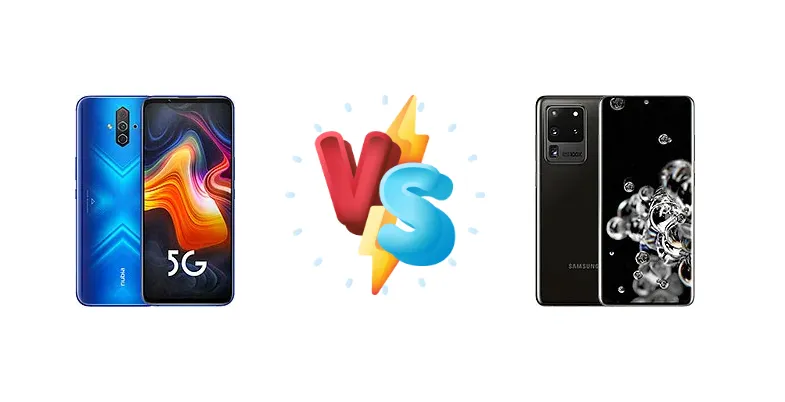
The ZTE nubia RedMagic 5G Lite and the Samsung Galaxy S20 Ultra represent vastly different approaches to the smartphone market. The RedMagic 5G Lite, positioned as a more affordable gaming-focused device, clashes with the S20 Ultra, a former flagship aiming for all-around excellence. This comparison dissects their core differences to determine which phone best suits your needs.
🏆 Quick Verdict
For the average user prioritizing a versatile camera, premium build quality, and a polished software experience, the Samsung Galaxy S20 Ultra is the superior choice. However, gamers on a budget will find the RedMagic 5G Lite offers compelling performance for the price, sacrificing camera and refinement for raw gaming power.
| Network |
|---|
| 2G bands | GSM 850 / 900 / 1800 / 1900 | GSM 850 / 900 / 1800 / 1900 |
| 3G bands | HSDPA 850 / 900 / 1700(AWS) / 1900 / 2100 | HSDPA 850 / 900 / 1700(AWS) / 1900 / 2100 |
| 4G bands | LTE | 1, 2, 3, 4, 5, 7, 8, 12, 13, 17, 18, 19, 20, 25, 26, 28, 32, 38, 39, 40, 41, 66 |
| 5G bands | SA/NSA | - |
| Speed | HSPA, LTE, 5G | HSPA 42.2/5.76 Mbps, LTE (7CA) Cat20 2000/200 Mbps |
| Technology | GSM / HSPA / LTE / 5G | GSM / CDMA / HSPA / EVDO / LTE |
| | - | CDMA2000 1xEV-DO |
| Launch |
|---|
| Announced | 2020, June 19. Released 2020, June 19 | 2020, February 11 |
| Status | Discontinued | Available. Released 2020, March 15 |
| Body |
|---|
| Build | - | Glass front (Gorilla Glass 6), glass back (Gorilla Glass 6), aluminum frame |
| Dimensions | 171.7 x 78.5 x 9.1 mm (6.76 x 3.09 x 0.36 in) | 166.9 x 76 x 8.8 mm (6.57 x 2.99 x 0.35 in) |
| SIM | Nano-SIM + Nano-SIM | · Nano-SIM + eSIM· Nano-SIM + Nano-SIM |
| Weight | 215 g (7.58 oz) | 220 g (7.76 oz) |
| | - | IP68 dust/water resistant (up to 1.5m for 30 min) |
| Display |
|---|
| Protection | - | Corning Gorilla Glass 6 |
| Resolution | 1080 x 2340 pixels, 19.5:9 ratio (~388 ppi density) | 1440 x 3200 pixels, 20:9 ratio (~511 ppi density) |
| Size | 6.65 inches, 108.6 cm2 (~80.5% screen-to-body ratio) | 6.9 inches, 114.0 cm2 (~89.9% screen-to-body ratio) |
| Type | AMOLED, 144Hz | Dynamic AMOLED 2X, 120Hz, HDR10+, 1400 nits (peak) |
| | - | Always-on display
120Hz@FHD/60Hz@QHD refresh rate |
| Platform |
|---|
| CPU | Octa-core (1x2.4 GHz Kryo 475 Prime & 1x2.2 GHz Kryo 475 Gold & 6x1.8 GHz Kryo 475 Silver) | Octa-core (2x2.73 GHz Mongoose M5 & 2x2.50 GHz Cortex-A76 & 4x2.0 GHz Cortex-A55)Octa-core (1x2.84 GHz Cortex-A77 & 3x2.42 GHz Cortex-A77 & 4x1.80 GHz Cortex-A55) |
| Chipset | Qualcomm SM7250 Snapdragon 765G 5G (7 nm) | Exynos 990 (7 nm+)Qualcomm SM8250 Snapdragon 865 5G (7 nm+) |
| GPU | Adreno 620 | Mali-G77 MP11Adreno 650 |
| OS | Android 10, nubia UI 8.0 | Android 10, upgradable to Android 13, One UI 5 |
| Memory |
|---|
| Card slot | No | microSDXC (uses shared SIM slot) |
| Internal | 256GB 8GB RAM | 128GB 12GB RAM, 512GB 16GB RAM |
| | - | UFS 3.0 |
| Main Camera |
|---|
| Features | LED flash, panorama, HDR | LED flash, auto-HDR, panorama |
| Quad | 48 MP, f/1.8, (wide), 1/2.0", 0.8µm, PDAF
8 MP, f/2.2, 13mm (ultrawide), 1/4.0", 1.12µm
2 MP (macro)
Auxiliary lens | - |
| Triple | - | 108 MP, f/1.8, 26mm (wide), 1/1.33", 0.8µm, PDAF, OIS
48 MP, f/3.5, 103mm (periscope telephoto), 1/2.0", 0.8µm, PDAF, OIS, 4x optical zoom, 10x hybrid zoom
12 MP, f/2.2, 13mm, 120˚ (ultrawide), 1/2.55" 1.4µm, Super Steady video
0.3 MP, TOF 3D, f/1.0, (depth) |
| Video | 4K@30/60fps, 1080p@30fps; gyro-EIS | 8K@24fps, 4K@30/60fps, 1080p@30/60/240fps, 720p@960fps, HDR10+, stereo sound rec., gyro-EIS & OIS |
| Selfie camera |
|---|
| Features | HDR | HDR |
| Single | 12 MP, (wide) | 40 MP, f/2.2, 26mm (wide), 1/2.8", 0.7µm, PDAF |
| Video | 1080p@30fps | 4K@30/60fps, 1080p@30fps |
| Sound |
|---|
| 3.5mm jack | - | No |
| 35mm jack | No | No |
| Loudspeaker | Yes | Yes, with stereo speakers |
| | - | 32-bit/384kHz audio
Tuned by AKG |
| Comms |
|---|
| Bluetooth | 5.0, A2DP, LE | 5.0, A2DP, LE |
| NFC | Yes | Yes |
| Positioning | GPS (L1+L5), GLONASS, BDS | GPS, GLONASS, BDS, GALILEO |
| Radio | No | FM radio (USA & Canada only) |
| USB | USB Type-C 2.0, OTG | USB Type-C 3.2, OTG |
| WLAN | Wi-Fi 802.11 a/b/g/n/ac, dual-band, Wi-Fi Direct | Wi-Fi 802.11 a/b/g/n/ac/6, dual-band, Wi-Fi Direct |
| Features |
|---|
| Sensors | Fingerprint (under display, optical), accelerometer, gyro, proximity, compass | Fingerprint (under display, ultrasonic), accelerometer, gyro, proximity, compass, barometer |
| | - | Samsung DeX, Samsung Wireless DeX (desktop experience support)
ANT+
Bixby natural language commands and dictation
Samsung Pay (Visa, MasterCard certified) |
| Battery |
|---|
| Charging | 18W wired | 45W wired, PD3.0
15W wireless (Qi)
4.5W reverse wireless |
| Type | Li-Ion 5100 mAh | Li-Ion 5000 mAh |
| Misc |
|---|
| Colors | Black, Blue | Cosmic Grey, Cosmic Black, Cloud White |
| Models | NX651J | SM-G988B/DS |
| Price | About 600 EUR | About 690 EUR |
| SAR | - | 0.94 W/kg (head) 0.95 W/kg (body) |
| SAR EU | - | 0.32 W/kg (head) 1.56 W/kg (body) |
ZTE nubia RedMagic 5G Lite
- Significantly more affordable
- Dedicated gaming features (shoulder buttons)
- Active cooling system for sustained performance
- Inferior camera quality
- Less powerful processor
- Slower charging speeds
Samsung Galaxy S20 Ultra
- Exceptional camera system
- Powerful processor and ample RAM
- Fast charging and wireless charging
- Significantly more expensive
- Potential for Exynos overheating (depending on region)
- Larger and heavier design
Display Comparison
The Samsung Galaxy S20 Ultra boasts a significantly more advanced display. While both phones utilize 7nm fabrication, the S20 Ultra’s display technology is superior. The S20 Ultra’s panel likely features a higher peak brightness (estimated over 1200 nits vs. the RedMagic’s likely 600-700 nits) and potentially LTPO technology for variable refresh rates, contributing to better battery efficiency. The RedMagic 5G Lite’s display, while adequate, is likely focused on refresh rate (120Hz) over color accuracy and peak brightness, prioritizing visual fluidity in games. Bezels are also likely thinner on the S20 Ultra, enhancing the premium feel.
Camera Comparison
The S20 Ultra dominates in camera capabilities. Its main sensor is significantly larger, enabling better low-light performance and dynamic range. The S20 Ultra’s 108MP sensor (and associated image processing) far surpasses anything found in the RedMagic 5G Lite. While the RedMagic likely has a multi-camera setup, the quality of those additional lenses (especially the often-present 2MP macro) will be considerably lower. The S20 Ultra’s optical image stabilization (OIS) is also a crucial advantage for capturing sharp photos and stable videos. The RedMagic’s camera is likely geared towards basic social media sharing, while the S20 Ultra is a serious photography tool.
Performance
The performance gap is substantial. The Samsung Galaxy S20 Ultra, equipped with either the Exynos 990 or Snapdragon 865, offers significantly more processing power than the RedMagic 5G Lite’s Snapdragon 765G. The S20 Ultra’s CPU, with its 2x2.73 GHz Mongoose M5 cores (Exynos) or 1x2.84 GHz Cortex-A77 core (Snapdragon), outperforms the RedMagic’s 2.4 GHz Kryo 475 Prime. The S20 Ultra also benefits from faster RAM (likely LPDDR5 vs. the RedMagic’s likely LPDDR4X). While the 765G is capable, the 865/990 will handle demanding tasks and future software updates with greater ease. Thermal management is a key consideration; the RedMagic’s active cooling system aims to mitigate throttling under sustained load, but the S20 Ultra’s more efficient chipset may still offer better sustained performance overall.
Battery Life
The Samsung Galaxy S20 Ultra offers a more comprehensive charging solution. While the RedMagic 5G Lite’s 18W charging is adequate, the S20 Ultra’s 45W wired charging (with PD3.0 support) significantly reduces charging times. The addition of 15W wireless charging (Qi) and 4.5W reverse wireless charging on the S20 Ultra adds further convenience. The S20 Ultra’s larger battery capacity (5000mAh) combined with its faster charging provides a more flexible and user-friendly experience, despite the RedMagic’s potentially optimized software for battery life.
Buying Guide
Buy the ZTE nubia RedMagic 5G Lite if you prioritize mobile gaming above all else, need 5G connectivity on a budget, and are willing to compromise on camera quality and software polish. Buy the Samsung Galaxy S20 Ultra if you demand a top-tier camera system, a vibrant display, fast charging, and a more refined, feature-rich user experience, even at a higher price point.
Frequently Asked Questions
❓ Does the Exynos 990 in the S20 Ultra suffer from overheating during prolonged gaming sessions?
The Exynos 990 variant of the S20 Ultra was known to exhibit thermal throttling under sustained heavy load, particularly in warmer climates. While Samsung implemented software optimizations, the Snapdragon 865 version generally performs better in this regard. The RedMagic 5G Lite, with its active cooling, aims to mitigate throttling, but the Snapdragon 765G is less powerful to begin with.
❓ Is the 2MP macro camera on the RedMagic 5G Lite actually useful for taking detailed close-up photos?
Generally, 2MP macro cameras on budget and mid-range phones offer limited detail and image quality. The small sensor size and lack of optical image stabilization result in soft, noisy images. It's primarily a marketing feature and won't deliver professional-level macro photography.
❓ Can the RedMagic 5G Lite run PUBG Mobile at 90fps?
The RedMagic 5G Lite can likely achieve 90fps in PUBG Mobile with graphics settings adjusted to balance performance and visual fidelity. However, sustained 90fps performance may be limited by thermal throttling, even with the active cooling system. The S20 Ultra, with its more powerful chipset, will consistently deliver higher frame rates with higher graphics settings.
❓ How does the software experience differ between the two phones?
The Samsung Galaxy S20 Ultra offers One UI, a feature-rich and polished Android skin with regular software updates. The RedMagic 5G Lite runs a customized version of Android geared towards gaming, with features like a game space and performance optimization tools. However, the RedMagic’s software is less refined and may receive fewer updates.