
ZTE nubia RedMagic 5G Lite vs. Google Pixel 4 XL: A Deep Dive Comparison
| Phones Images | |||||
|---|---|---|---|---|---|
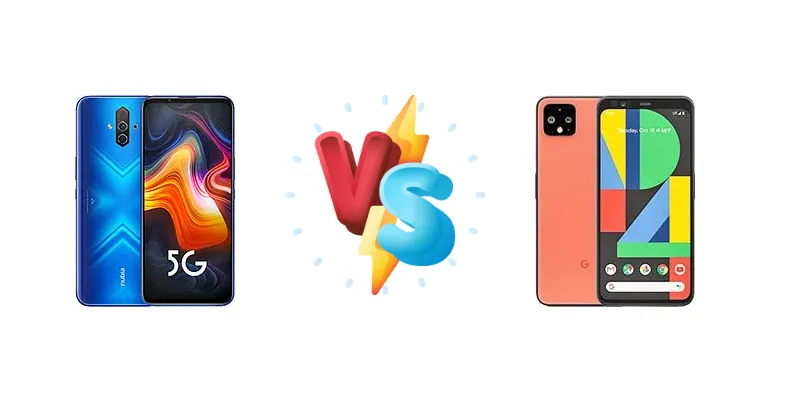
|
🏆 Quick Verdict
For the average user prioritizing camera quality and a smooth, Google-optimized Android experience, the Pixel 4 XL remains a compelling choice, especially at its current price point. However, gamers and those seeking 5G connectivity on a tighter budget will find the RedMagic 5G Lite a more suitable option, despite its compromises in camera performance.
| PHONES | ||
|---|---|---|
| Phone Names | ZTE nubia RedMagic 5G Lite | Google Pixel 4 XL |
| Network | ||
|---|---|---|
| 2G bands | GSM 850 / 900 / 1800 / 1900 | GSM 850 / 900 / 1800 / 1900 |
| 3G bands | HSDPA 850 / 900 / 1700(AWS) / 1900 / 2100 | HSDPA 850 / 900 / 1700(AWS) / 1900 / 2100 |
| 4G bands | LTE | 1, 2, 3, 4, 5, 7, 8, 12, 13, 17, 20, 25, 26, 28, 32, 38, 39, 40, 41, 66, 71 - Global |
| 5G bands | SA/NSA | - |
| Speed | HSPA, LTE, 5G | HSPA 42.2/5.76 Mbps, LTE (5CA) Cat18 1200/150 Mbps |
| Technology | GSM / HSPA / LTE / 5G | GSM / CDMA / HSPA / EVDO / LTE |
| - | 1, 2, 3, 4, 5, 7, 8, 12, 13, 14, 17, 18, 19, 20, 25, 26, 28, 29, 30, 38, 39, 40, 41, 46, 48, 66, 71 - USA | |
| Launch | ||
|---|---|---|
| Announced | 2020, June 19. Released 2020, June 19 | 2019, October 15 |
| Status | Discontinued | Available. Released 2019, October 22 |
| Body | ||
|---|---|---|
| Build | - | Glass front (Gorilla Glass 5), glass back (Gorilla Glass 5), aluminum frame |
| Dimensions | 171.7 x 78.5 x 9.1 mm (6.76 x 3.09 x 0.36 in) | 160.4 x 75.1 x 8.2 mm (6.31 x 2.96 x 0.32 in) |
| SIM | Nano-SIM + Nano-SIM | Nano-SIM + eSIM |
| Weight | 215 g (7.58 oz) | 193 g (6.81 oz) |
| - | IP68 dust/water resistant (up to 1.5m for 30 min) | |
| Display | ||
|---|---|---|
| Protection | - | Corning Gorilla Glass 5 |
| Resolution | 1080 x 2340 pixels, 19.5:9 ratio (~388 ppi density) | 1440 x 3040 pixels, 19:9 ratio (~537 ppi density) |
| Size | 6.65 inches, 108.6 cm2 (~80.5% screen-to-body ratio) | 6.3 inches, 98.0 cm2 (~81.3% screen-to-body ratio) |
| Type | AMOLED, 144Hz | P-OLED, 90Hz, HDR |
| - | Always-on display | |
| Platform | ||
|---|---|---|
| CPU | Octa-core (1x2.4 GHz Kryo 475 Prime & 1x2.2 GHz Kryo 475 Gold & 6x1.8 GHz Kryo 475 Silver) | Octa-core (1x2.84 GHz Kryo 485 & 3x2.42 GHz Kryo 485 & 4x1.78 GHz Kryo 485) |
| Chipset | Qualcomm SM7250 Snapdragon 765G 5G (7 nm) | Qualcomm SM8150 Snapdragon 855 (7 nm) |
| GPU | Adreno 620 | Adreno 640 |
| OS | Android 10, nubia UI 8.0 | Android 10, upgradable to Android 13 |
| Memory | ||
|---|---|---|
| Card slot | No | No |
| Internal | 256GB 8GB RAM | 64GB 6GB RAM, 128GB 6GB RAM |
| - | UFS 2.1 | |
| Main Camera | ||
|---|---|---|
| Dual | - | 12.2 MP, f/1.7, 27mm (wide), 1/2.55", 1.4µm, dual pixel PDAF, OIS 16 MP, f/2.4, 50mm (telephoto), 1/3.6", 1.0µm, PDAF, OIS, 2x optical zoom |
| Features | LED flash, panorama, HDR | Dual-LED flash, Pixel Shift, Auto-HDR, panorama |
| Quad | 48 MP, f/1.8, (wide), 1/2.0", 0.8µm, PDAF 8 MP, f/2.2, 13mm (ultrawide), 1/4.0", 1.12µm 2 MP (macro) Auxiliary lens | - |
| Video | 4K@30/60fps, 1080p@30fps; gyro-EIS | 4K@30fps, 1080p@30/60/120fps, 1080p@30fps (gyro-EIS) |
| Selfie camera | ||
|---|---|---|
| Features | HDR | HDR |
| Single | 12 MP, (wide) | 8 MP, f/2.0, 22mm (wide), 1.22µm, no AF TOF 3D, (depth/biometrics sensor) |
| Video | 1080p@30fps | 1080p@30fps |
| Sound | ||
|---|---|---|
| 3.5mm jack | - | No |
| 35mm jack | No | No |
| Loudspeaker | Yes | Yes, with stereo speakers |
| Comms | ||
|---|---|---|
| Bluetooth | 5.0, A2DP, LE | 5.0, A2DP, LE, aptX HD |
| NFC | Yes | Yes |
| Positioning | GPS (L1+L5), GLONASS, BDS | GPS, GLONASS, BDS, GALILEO |
| Radio | No | No |
| USB | USB Type-C 2.0, OTG | USB Type-C 3.1 |
| WLAN | Wi-Fi 802.11 a/b/g/n/ac, dual-band, Wi-Fi Direct | Wi-Fi 802.11 a/b/g/n/ac, dual-band, Wi-Fi Direct, DLNA |
| Features | ||
|---|---|---|
| Sensors | Fingerprint (under display, optical), accelerometer, gyro, proximity, compass | Face ID, accelerometer, gyro, proximity, compass, barometer |
| Battery | ||
|---|---|---|
| Charging | 18W wired | 18W wired, PD2.0 Wireless |
| Type | Li-Ion 5100 mAh | Li-Po 3700 mAh, non-removable |
| Misc | ||
|---|---|---|
| Colors | Black, Blue | Clearly White, Just Black, Oh So Orange |
| Models | NX651J | G020P, G020, GA01181-US, GA01182-US, GA01180-US |
| Price | About 600 EUR | About 180 EUR |
| Pricing | ||
|---|---|---|
| 128GB 6GB RAM | - | $ 364.52 |
| 64GB 6GB RAM | - | $ 274.99 |
| RENEWED | - | $ 149.00 |
| Tests | ||
|---|---|---|
| Audio quality | - | Noise -93.9 / Crosstalk -94.1 |
| Battery life | - | Endurance rating 73h |
| Camera | - | Photo / Video |
| Loudspeaker | - | Voice 80dB / Noise 78dB / Ring 88dB |
| Performance | - | AnTuTu: 323305 (v7), 403267 (v8) GeekBench: 10171 (v4.4), 2267 (v5.1) GFXBench: 21fps (ES 3.1 onscreen) |
ZTE nubia RedMagic 5G Lite
- Affordable price point
- Integrated 5G modem
- Gaming-focused design and potential thermal management
- Inferior camera performance
- Less powerful chipset compared to the Pixel 4 XL
- Limited software support compared to Pixel
Google Pixel 4 XL
- Excellent camera quality and image processing
- Smooth and refined Android experience
- Wireless charging and PD2.0 support
- Older chipset prone to throttling
- Higher price point
- Battery life may be impacted by power-hungry chipset
Display Comparison
Neither device boasts cutting-edge display technology by today's standards, but they differ in focus. While specific display specs for the RedMagic 5G Lite are missing, nubia phones generally prioritize high refresh rates for gaming. The Pixel 4 XL, however, offers a 6.3-inch OLED display known for its color accuracy and brightness. Both share 18W charging, but the Pixel 4 XL also supports PD2.0 and wireless charging, offering greater convenience. The Pixel 4 XL's display benefits from Google's image processing, resulting in a more visually refined experience.
Camera Comparison
The Pixel 4 XL excels in computational photography, leveraging Google’s renowned image processing algorithms. While specific sensor details are missing for both, the Pixel 4 XL’s camera is widely praised for its dynamic range, detail, and low-light performance. The RedMagic 5G Lite, geared towards gaming, likely features a more basic camera setup, prioritizing affordability over image quality. The Pixel 4 XL’s video capabilities are also superior, benefiting from advanced stabilization and processing. The inclusion of 'Photo / Video' for both is a broad statement; the Pixel 4 XL delivers a demonstrably more refined experience.
Performance
The core difference lies in the chipsets. The Pixel 4 XL’s Snapdragon 855 (7nm) features a Kryo 485 CPU clocked up to 2.84 GHz, offering higher peak performance than the RedMagic 5G Lite’s Snapdragon 765G (7nm) with its 2.4 GHz Kryo 475 Prime core. However, the 765G’s integrated 5G modem is a significant advantage. While the 855 is powerful, it's prone to throttling under sustained load, a concern for demanding games. The RedMagic 5G Lite, designed for gaming, likely incorporates more aggressive thermal management to mitigate throttling, despite the less powerful chipset. Both devices feature 6GB of RAM, but the RAM type (LPDDR4X vs potentially LPDDR5 in the RedMagic) isn't specified, impacting memory bandwidth.
Battery Life
Both phones share an endurance rating of 73 hours, suggesting similar real-world battery life despite potentially different capacities. However, the Pixel 4 XL’s support for 18W wired charging with PD2.0 and wireless charging provides greater flexibility. The RedMagic 5G Lite’s 18W wired charging is more basic. While battery life is comparable, the Pixel 4 XL’s charging options offer a more convenient user experience. The Snapdragon 855's power draw, however, could negate some of the battery life advantage.
Buying Guide
Buy the ZTE nubia RedMagic 5G Lite if you need a dedicated gaming phone with 5G connectivity at an affordable price, and are willing to compromise on camera quality. Buy the Google Pixel 4 XL if you prefer a superior camera experience, a clean Android interface with timely updates (though nearing end-of-life), and a more balanced overall smartphone experience, even if the chipset is a generation older.