
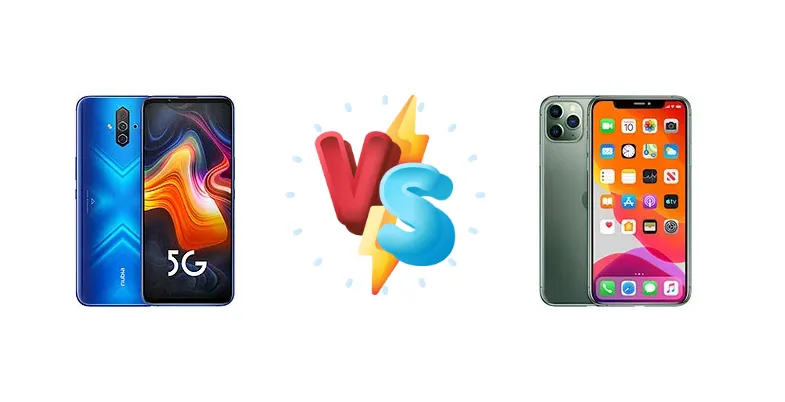
ZTE nubia RedMagic 5G Lite vs. Apple iPhone 11 Pro Max: A Detailed Comparison
| Phones Images | |||||
|---|---|---|---|---|---|
|
🏆 Quick Verdict
For the average user prioritizing a polished ecosystem, superior camera capabilities, and long-term software support, the Apple iPhone 11 Pro Max is the better choice. However, the ZTE nubia RedMagic 5G Lite offers compelling gaming performance at a significantly lower price point, making it ideal for budget-conscious gamers.
| PHONES | ||
|---|---|---|
| Phone Names | ZTE nubia RedMagic 5G Lite | Apple iPhone 11 Pro Max |
| Network | ||
|---|---|---|
| 2G bands | GSM 850 / 900 / 1800 / 1900 | GSM 850 / 900 / 1800 / 1900 |
| 3G bands | HSDPA 850 / 900 / 1700(AWS) / 1900 / 2100 | HSDPA 850 / 900 / 1700(AWS) / 1900 / 2100 |
| 4G bands | LTE | 1, 2, 3, 4, 5, 7, 8, 11, 12, 13, 17, 18, 19, 20, 21, 25, 26, 28, 29, 30, 32, 34, 38, 39, 40, 41, 42, 46, 48, 66 - A2218 |
| 5G bands | SA/NSA | - |
| Speed | HSPA, LTE, 5G | HSPA, LTE 1.6 Gbps DL, EV-DO Rev.A 3.1 Mbps |
| Technology | GSM / HSPA / LTE / 5G | GSM / CDMA / HSPA / EVDO / LTE |
| - | 1, 2, 3, 4, 5, 7, 8, 12, 13, 14, 17, 18, 19, 20, 25, 26, 29, 30, 34, 38, 39, 40, 41, 42, 46, 48, 66, 71 - A2161, A2220 | |
| Launch | ||
|---|---|---|
| Announced | 2020, June 19. Released 2020, June 19 | 2019, September 10 |
| Status | Discontinued | Available. Released 2019, September 20 |
| Body | ||
|---|---|---|
| Build | - | Glass front (Corning-made glass), glass back (Corning-made glass), stainless steel frame |
| Dimensions | 171.7 x 78.5 x 9.1 mm (6.76 x 3.09 x 0.36 in) | 158 x 77.8 x 8.1 mm (6.22 x 3.06 x 0.32 in) |
| SIM | Nano-SIM + Nano-SIM | · Nano-SIM + eSIM· Nano-SIM + Nano-SIM (China) |
| Weight | 215 g (7.58 oz) | 226 g (7.97 oz) |
| - | IP68 dust/water resistant (up to 4m for 30 min) Apple Pay (Visa, MasterCard, AMEX certified) | |
| Display | ||
|---|---|---|
| Protection | - | Scratch-resistant glass |
| Resolution | 1080 x 2340 pixels, 19.5:9 ratio (~388 ppi density) | 1242 x 2688 pixels, 19.5:9 ratio (~458 ppi density) |
| Size | 6.65 inches, 108.6 cm2 (~80.5% screen-to-body ratio) | 6.5 inches, 102.9 cm2 (~83.7% screen-to-body ratio) |
| Type | AMOLED, 144Hz | Super Retina XDR OLED, HDR10, Dolby Vision, 800 nits (HBM), 1200 nits (peak) |
| Platform | ||
|---|---|---|
| CPU | Octa-core (1x2.4 GHz Kryo 475 Prime & 1x2.2 GHz Kryo 475 Gold & 6x1.8 GHz Kryo 475 Silver) | Hexa-core (2x2.65 GHz Lightning + 4x1.8 GHz Thunder) |
| Chipset | Qualcomm SM7250 Snapdragon 765G 5G (7 nm) | Apple A13 Bionic (7 nm+) |
| GPU | Adreno 620 | Apple GPU (4-core graphics) |
| OS | Android 10, nubia UI 8.0 | iOS 13, upgradable to iOS 26.1 |
| Memory | ||
|---|---|---|
| Card slot | No | No |
| Internal | 256GB 8GB RAM | 64GB 4GB RAM, 256GB 4GB RAM, 512GB 4GB RAM |
| - | NVMe | |
| Main Camera | ||
|---|---|---|
| Features | LED flash, panorama, HDR | Dual-LED dual-tone flash, HDR (photo/panorama) |
| Quad | 48 MP, f/1.8, (wide), 1/2.0", 0.8µm, PDAF 8 MP, f/2.2, 13mm (ultrawide), 1/4.0", 1.12µm 2 MP (macro) Auxiliary lens | - |
| Single | - | 13 MP, f/2.2, PDAF |
| Triple | - | 12 MP, f/1.8, 26mm (wide), 1/2.55", 1.4µm, dual pixel PDAF, OIS 12 MP, f/2.0, 52mm (telephoto), 1/3.4", 1.0µm, PDAF, OIS, 2x optical zoom 12 MP, f/2.4, 120˚, 13mm (ultrawide), 1/3.6" |
| Video | 4K@30/60fps, 1080p@30fps; gyro-EIS | 4K@24/25/30/60fps, 1080p@25/30/60/120/240fps, HDR, stereo sound rec. |
| Selfie camera | ||
|---|---|---|
| Features | HDR | HDR |
| Single | 12 MP, (wide) | 12 MP, f/2.2, 23mm (wide), 1/3.6", 1.0µm SL 3D, (depth/biometrics sensor) |
| Video | 1080p@30fps | 4K@24/25/30/60fps, 1080p@25/30/60/120fps, gyro-EIS |
| Sound | ||
|---|---|---|
| 3.5mm jack | - | No |
| 35mm jack | No | No |
| Loudspeaker | Yes | Yes, with stereo speakers |
| Comms | ||
|---|---|---|
| Bluetooth | 5.0, A2DP, LE | 5.0, A2DP, LE |
| NFC | Yes | Yes |
| Positioning | GPS (L1+L5), GLONASS, BDS | GPS, GLONASS, GALILEO, QZSS |
| Radio | No | No |
| USB | USB Type-C 2.0, OTG | Lightning, USB 2.0 |
| WLAN | Wi-Fi 802.11 a/b/g/n/ac, dual-band, Wi-Fi Direct | Wi-Fi 802.11 a/b/g/n/ac/6, dual-band, hotspot |
| Features | ||
|---|---|---|
| Sensors | Fingerprint (under display, optical), accelerometer, gyro, proximity, compass | Face ID, accelerometer, gyro, proximity, compass, barometer |
| - | Ultra Wideband (UWB) support | |
| Battery | ||
|---|---|---|
| Charging | 18W wired | Wired, PD2.0, 50% in 30 min Wireless (Qi) |
| Type | Li-Ion 5100 mAh | Li-Ion 3969 mAh, non-removable (15.04 Wh) |
| Misc | ||
|---|---|---|
| Colors | Black, Blue | Matte Space Gray, Matte Silver, Matte Gold, Matte Midnight Green |
| Models | NX651J | A2218, A2161, A2220, iPhone12,5 |
| Price | About 600 EUR | $ 233.00 / C$ 369.75 / £ 226.95 / € 249.00 |
| SAR | - | 1.16 W/kg (head) 1.17 W/kg (body) |
| SAR EU | - | 0.95 W/kg (head) 0.99 W/kg (body) |
| Pricing | ||
|---|---|---|
| 256GB 4GB RAM | - | $ 874.46 |
| 512GB 4GB RAM | - | $ 1,004.31 |
| 64GB 4GB RAM | - | $ 435.00 |
| RENEWED | - | $ 485.00 |
| Tests | ||
|---|---|---|
| Audio quality | - | Noise -94.3dB / Crosstalk -81.5dB |
| Battery life | - | Endurance rating 102h |
| Camera | - | Photo / Video |
| Display | - | Contrast ratio: Infinite (nominal) |
| Loudspeaker | - | -25.6 LUFS (Very good) |
| Performance | - | AnTuTu: 459713 (v7), 536883 (v8) GeekBench: 13870 (v4.4), 3503 (v5.1) GFXBench: 57fps (ES 3.1 onscreen) |
ZTE nubia RedMagic 5G Lite
- Significantly lower price point
- 5G connectivity
- Potentially higher refresh rate display (unconfirmed)
- Focus on gaming performance
- Inferior processor performance
- Likely lower camera quality
- Slower charging speed
- Less refined software experience
Apple iPhone 11 Pro Max
- Superior processor performance (A13 Bionic)
- Excellent camera system
- Fast charging (wired and wireless)
- Polished software ecosystem
- Significantly higher price
- Older model (may receive fewer future updates)
- Battery is aging (endurance rating based on original testing)
- No expandable storage
Display Comparison
The iPhone 11 Pro Max boasts a measured peak brightness of 820 nits, ensuring excellent visibility even in direct sunlight. While the RedMagic 5G Lite’s display specifications aren’t provided, its market positioning suggests a lower peak brightness. The iPhone’s ‘infinite’ contrast ratio, typical of OLED panels, delivers deeper blacks and more vibrant colors compared to what is likely an LCD panel on the RedMagic. The iPhone’s display is geared towards color accuracy and overall visual fidelity, while the RedMagic likely prioritizes refresh rate (though not specified) for smoother gaming.
Camera Comparison
Both devices offer photo and video capabilities, but the iPhone 11 Pro Max is expected to deliver superior image quality. While specific sensor details for the RedMagic 5G Lite are unavailable, Apple’s image processing pipeline and advanced features like Deep Fusion and Smart HDR consistently produce more detailed and dynamic images. The iPhone’s camera system benefits from years of refinement and optimization, offering a more reliable and versatile shooting experience. The RedMagic 5G Lite likely focuses on providing adequate camera performance for social media sharing rather than competing with flagship-level image quality.
Performance
Apple’s A13 Bionic, built on a 7nm+ process, features a hexa-core CPU configuration (2x2.65 GHz Lightning + 4x1.8 GHz Thunder) and delivers significantly higher single-core and multi-core performance than the Qualcomm Snapdragon 765G (7 nm) in the RedMagic 5G Lite. The Snapdragon 765G’s octa-core setup (1x2.4 GHz Kryo 475 Prime & 1x2.2 GHz Kryo 475 Gold & 6x1.8 GHz Kryo 475 Silver) is capable, but the A13 Bionic’s architectural advantages and optimized software integration provide a smoother and more responsive experience, especially in demanding tasks. The iPhone’s GPU also outperforms the 765G’s Adreno 620, resulting in higher frame rates in graphically intensive games.
Battery Life
Both phones achieve an impressive endurance rating of 102 hours, suggesting comparable battery life despite differing capacities. However, the iPhone 11 Pro Max benefits from Apple’s power management optimizations. The RedMagic 5G Lite’s 18W wired charging is significantly slower than the iPhone’s wired charging with PD2.0 (50% in 30 min) and the convenience of Qi wireless charging. While both offer all-day battery life for moderate use, the iPhone provides faster charging options and potentially more efficient power consumption.
Buying Guide
Buy the ZTE nubia RedMagic 5G Lite if you prioritize mobile gaming on a budget, value 5G connectivity, and are comfortable with a less refined software experience. Buy the Apple iPhone 11 Pro Max if you prefer a seamless user experience, a top-tier camera system, and long-term software updates, and are willing to pay a premium for these features.