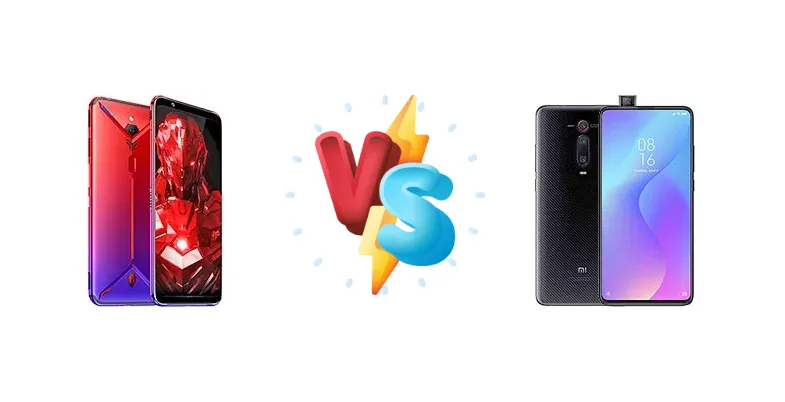
The ZTE nubia RedMagic 3S and Xiaomi Mi 9T Pro represent distinct approaches to the upper-midrange smartphone market. The RedMagic 3S aggressively targets mobile gamers with a focus on sustained performance, while the Mi 9T Pro aims for a more balanced experience, blending power with everyday usability and a more refined feature set. Both devices leverage the Qualcomm Snapdragon 855 series, but key differences in chipset, charging, and design create a compelling head-to-head.
🏆 Quick Verdict
For dedicated mobile gamers prioritizing sustained performance, the ZTE nubia RedMagic 3S is the clear winner. Its Snapdragon 855+ chipset and focus on cooling provide a noticeable edge. However, the Xiaomi Mi 9T Pro offers a more well-rounded experience with faster charging and a potentially more versatile camera system for the average user.
| Network |
|---|
| 2G bands | GSM 850 / 900 / 1800 / 1900 | GSM 850 / 900 / 1800 / 1900 |
| 3G bands | HSDPA 850 / 900 / 1700(AWS) / 1800 / 1900 / 2100 | HSDPA 850 / 900 / 1700(AWS) / 1900 / 2100 |
| 4G bands | 1, 2, 3, 4, 5, 7, 8, 12, 17, 18, 19, 20, 25, 26, 28, 30, 66 - Global | 1, 2, 3, 4, 5, 7, 8, 20, 28, 38, 40 |
| Speed | HSPA 42.2/5.76 Mbps, LTE (7CA) Cat20 2000/150 Mbps | HSPA, LTE |
| Technology | GSM / CDMA / HSPA / EVDO / LTE | GSM / HSPA / LTE |
| Launch |
|---|
| Announced | 2019, September. Released 2019, September | 2019, August 21. Released 2019, August 21 |
| Status | Discontinued | Discontinued |
| Body |
|---|
| Build | Glass front (Gorilla Glass 4), aluminum back, aluminum frame | Glass front (Gorilla Glass 5), glass back (Gorilla Glass 5), aluminum frame |
| Dimensions | 171.7 x 78.5 x 9.7 mm (6.76 x 3.09 x 0.38 in) | 156.7 x 74.3 x 8.8 mm (6.17 x 2.93 x 0.35 in) |
| SIM | Nano-SIM + Nano-SIM | Nano-SIM + Nano-SIM |
| Weight | 215 g (7.58 oz) | 191 g (6.74 oz) |
| Display |
|---|
| Protection | Corning Gorilla Glass 4 | Corning Gorilla Glass 5 |
| Resolution | 1080 x 2340 pixels, 19.5:9 ratio (~388 ppi density) | 1080 x 2340 pixels, 19.5:9 ratio (~403 ppi density) |
| Size | 6.65 inches, 108.6 cm2 (~80.5% screen-to-body ratio) | 6.39 inches, 100.2 cm2 (~86.1% screen-to-body ratio) |
| Type | AMOLED, 90Hz | Super AMOLED, HDR |
| Platform |
|---|
| CPU | Octa-core (1x2.96 GHz Kryo 485 & 3x2.42 GHz Kryo 485 & 4x1.8 GHz Kryo 485) | Octa-core (1x2.84 GHz Kryo 485 & 3x2.42 GHz Kryo 485 & 4x1.78 GHz Kryo 485) |
| Chipset | Qualcomm SM8150 Snapdragon 855+ (7 nm) | Qualcomm SM8150 Snapdragon 855 (7 nm) |
| GPU | Adreno 640 (700 MHz) | Adreno 640 |
| OS | Android 9.0 (Pie), Redmagic 2.0 | Android 9.0 (Pie), upgradable to Android 11, MIUI 12.5 |
| Memory |
|---|
| Card slot | No | No |
| Internal | 128GB 8GB RAM, 256GB 12GB RAM | 64GB 6GB RAM, 128GB 6GB RAM, 256GB 8GB RAM |
| | - | UFS 2.1 |
| Main Camera |
|---|
| Features | LED flash, HDR, panorama | Laser AF, Dual-LED flash, HDR, panorama |
| Single | 48 MP, f/1.7, 26mm (wide), 1/2.0", 0.8µm, PDAF | - |
| Triple | - | 48 MP, f/1.8, 26mm (wide), 1/2.0", 0.8µm, PDAF
8 MP, f/2.4, 53mm (telephoto), 1/4.0", 1.12µm, PDAF, 2x optical zoom
13 MP, f/2.4, 12mm (ultrawide), 1/3.1", 1.12µm |
| Video | 8K@15fps, 4K@30/60fps, 1920fps | 4K@30/60fps, 1080p@30/120/240fps, 1080p@960fps |
| Selfie camera |
|---|
| Features | HDR | HDR |
| Single | 16 MP, f/2.0, 26mm (wide), 1/3.06", 1.0µm | Motorized pop-up 20 MP, f/2.2, (wide), 1/3.4", 0.8µm |
| Video | 1080p@30fps | 1080p@30fps |
| Sound |
|---|
| 3.5mm jack | - | Yes |
| 35mm jack | Yes | Yes |
| Loudspeaker | Yes, with stereo speakers | Yes |
| | - | 24-bit/192kHz audio
|
| Comms |
|---|
| Bluetooth | 5.0, A2DP, aptX, LE | 5.0, A2DP, LE, aptX HD |
| NFC | No | Yes |
| Positioning | GPS (L1+L5), GLONASS, BDS, GALILEO | GPS (L1+L5), GLONASS (G1), BDS (B1), GALILEO (E1+E5a) |
| Radio | No | Yes |
| USB | USB Type-C 3.1, OTG, accessory connector | USB Type-C 2.0, OTG |
| WLAN | Wi-Fi 802.11 a/b/g/n/ac, dual-band, Wi-Fi Direct | Wi-Fi 802.11 a/b/g/n/ac, dual-band, Wi-Fi Direct |
| Features |
|---|
| Sensors | Fingerprint (rear-mounted), accelerometer, gyro, proximity, compass | Fingerprint (under display, optical), accelerometer, gyro, proximity, compass |
| Battery |
|---|
| Charging | 18W wired, QC4 | 27W wired, QC4 |
| Type | Li-Po 5000 mAh, non-removable | Li-Po 4000 mAh, non-removable |
| Misc |
|---|
| Colors | Mecha Silver, Cyber Shade, Eclipse Black | Carbon black, Red flame, Glacier blue |
| Models | NX629J_V1S | M1903F11G |
| Price | About 820 EUR | About 150 EUR |
| SAR | - | 1.03 W/kg (head) 0.72 W/kg (body) |
| SAR EU | - | 1.30 W/kg (head) 1.51 W/kg (body) |
| Tests |
|---|
| Audio quality | - |
Noise -93.9dB / Crosstalk -94.2dB |
| Battery life | - | Endurance rating 103h |
| Display | - |
Contrast ratio: Infinite (nominal) |
| Loudspeaker | - |
-26.9 LUFS (Good) |
| Performance | - |
AnTuTu: 368846 (v7), 437823 (v8)
GeekBench: 10684 (v4.4), 2732 (v5.1)
GFXBench: 36fps (ES 3.1 onscreen) |
ZTE nubia RedMagic 3S
- Superior gaming performance with Snapdragon 855+
- More robust thermal management for sustained gaming
- Longer battery endurance (115h)
- Slower charging speed (18W)
- Likely inferior camera quality
- Less refined design
Xiaomi Mi 9T Pro
- Faster charging (27W)
- Potentially better camera system
- More balanced overall experience
- Slightly lower gaming performance
- Shorter battery endurance (103h)
- May experience more throttling under heavy load
Display Comparison
The Xiaomi Mi 9T Pro boasts an 'Infinite' contrast ratio, suggesting a high-quality AMOLED panel, but lacks specific brightness data. The nubia RedMagic 3S, measured at 479.7 nits, provides a quantifiable brightness level. While the Mi 9T Pro’s contrast ratio implies deeper blacks and more vibrant colors, the RedMagic 3S’s measured brightness ensures better visibility in direct sunlight. Both lack high refresh rate panels, a common omission in this price bracket. The lack of detailed display specs for the Mi 9T Pro makes a direct comparison difficult beyond the contrast ratio claim.
Camera Comparison
Both phones feature a 'Photo / Video' camera setup, lacking specific details. Given the market positioning, the Mi 9T Pro likely offers a more refined and versatile camera experience. Xiaomi typically prioritizes camera performance in its mid-range and flagship devices. The RedMagic 3S, focused on gaming, likely compromises on camera quality to prioritize performance and cooling. Without sensor size or aperture information, it’s difficult to make a definitive statement, but the Mi 9T Pro’s brand reputation suggests a superior imaging experience.
Performance
The core difference lies in the chipsets: the RedMagic 3S utilizes the Snapdragon 855+ (7nm) while the Mi 9T Pro features the standard Snapdragon 855 (7nm). The ‘+’ variant in the RedMagic 3S boasts a slightly higher clock speed – 2.96 GHz Kryo 485 vs 2.84 GHz in the Mi 9T Pro – and a more aggressive clock speed configuration across all cores. This translates to a measurable performance advantage in sustained workloads, particularly gaming. While both use the same architecture, the RedMagic 3S’s thermal design is more robust, mitigating throttling during prolonged gaming sessions. The Mi 9T Pro’s CPU configuration (1x2.84 GHz & 3x2.42 GHz & 4x1.78 GHz) is slightly slower than the RedMagic 3S’s (1x2.96 GHz & 3x2.42 GHz & 4x1.8 GHz).
Battery Life
The nubia RedMagic 3S offers an endurance rating of 115 hours, while the Mi 9T Pro achieves 103 hours. However, charging speeds are drastically different. The Mi 9T Pro supports 27W wired charging with QC4, significantly faster than the RedMagic 3S’s 18W QC4 charging. This means the Mi 9T Pro can replenish its battery much quicker, offsetting its slightly lower endurance rating. While the RedMagic 3S has a larger battery capacity (implied by the higher endurance), the Mi 9T Pro’s faster charging provides a more convenient user experience.
Buying Guide
Buy the ZTE nubia RedMagic 3S if you need uncompromising gaming performance, even at the expense of camera quality and battery longevity. Its Snapdragon 855+ and cooling system are designed for extended gaming sessions. Buy the Xiaomi Mi 9T Pro if you prefer a balanced smartphone experience with faster charging, a more versatile camera, and a sleeker design, making it ideal for everyday use and casual gaming.
Frequently Asked Questions
❓ Will the RedMagic 3S's cooling system actually prevent throttling during long gaming sessions?
Yes, the RedMagic 3S incorporates a more advanced cooling system, including a fan and heat pipes, specifically designed to dissipate heat generated by the Snapdragon 855+ during prolonged gaming. This allows the chipset to maintain higher clock speeds for longer periods, minimizing performance drops due to thermal throttling compared to the Mi 9T Pro.
❓ How much faster is the 27W charging on the Mi 9T Pro compared to the 18W charging on the RedMagic 3S?
The 27W charging on the Mi 9T Pro will significantly reduce charging times. While exact 0-100% times aren't available, expect the Mi 9T Pro to charge considerably faster – potentially shaving off 30-60 minutes compared to the RedMagic 3S, depending on battery level and usage.
❓ Is the difference in CPU clock speed between the Snapdragon 855+ and 855 noticeable in everyday tasks?
In everyday tasks like browsing, social media, and video playback, the difference in CPU clock speed between the two chipsets is unlikely to be noticeable. The performance gap primarily manifests during demanding tasks like gaming and video editing where the sustained performance of the 855+ becomes apparent.